

Interview w/ Cameron Joyner
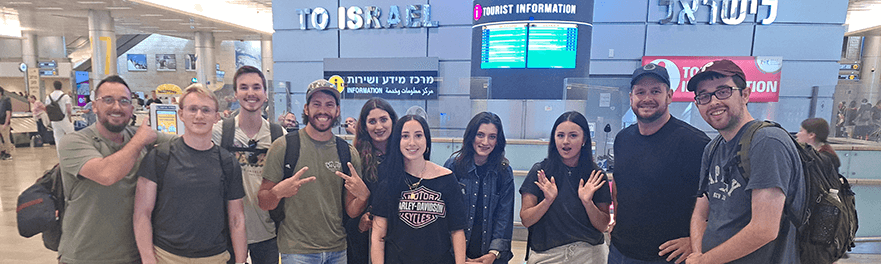
Little did The Friends of Israel’s (FOI’s) ORIGINS team members know when they touched down in Israel that, within hours, they would be planted in a warzone. In June, our team of young adults unexpectedly endured Iran’s nightly waves of rocket attacks on Israel, and they did it with confidence in the Lord, relying on His protection as they ministered to His Chosen People. Their labor was an unmistakable testament to their love for the Jewish people and the Lord’s call to bless them.
Chris speaks with Cameron Joyner, FOI’s assistant director of Ministry Mobilization and leader of the ORIGINS trip, about his group’s harrowing experience. Despite daily missile attacks near their home base, the young adults spent their days serving in an Israeli hospital and making lasting connections with the people there. Trusting in God’s provision, the team displayed great courage, and the lives of each member were changed for His glory in their two weeks in the Holy Land. Hear the incredible stories of the young believers who served Israel in the midst of its deadly war!
Find out more about our learning and volunteer opportunities at foiequip.org.
You can learn more about Cameron Joyner and support his ministry here.
Steve Conover: Thank you for joining us for The Friends of Israel Today. I'm Steve Conover, executive director of The Friends of Israel Gospel Ministry. With me is our host and teacher, Chris Katulka.
Chris Katulka: Steve, we're doing one of our great episodes where we like to highlight the ministries of the Friends of Israel because remember, we're not just a radio ministry. We are a worldwide evangelical ministry that ministers to the Jewish people all around the world. And in fact, today we're going to highlight one of those ministries. It's called ORIGINS, and we're going to have Cameron Joyner on who leads the ORIGINS program. It's a young adult ministry trip and volunteer trip to Israel, but what's unique about this year is that the day that they landed, they had a few hours in the land and then all of a sudden rockets were pouring down from Iran. And so Cameron's going to share with us about his experience with the team in Israel during The 12-Day War.
Steve Conover: We're looking forward to having Cameron join us, but first in the news, Top West Bank Sheikh, Wadee’ al-Jaabari of Hebron, a Palestinian territory, formally pledged peace and full recognition of Israel as a Jewish state. He proposed that Hebron break away from the Palestinian Authority in Ramallah, establish its own emirate, and join the Abraham Accords in cooperation and coexistence with Israel.
Chris Katulka: Well, Steve, here's my take. This is big. The downfall of Hamas marks not just the collapse of a militant group, but the sunset of Palestinian nationalism, that common phrase “From the River to the Sea." That vision is fading into irrelevance. And by contrast, the Sheikh of Hebron is embracing a forward-looking idea that begins with recognizing Israel and rejecting a divisive national identity. His vision builds a shared peaceful future for everyone in Israel and Hebron. You know what? We'll have to wait and see what happens next.
Chris Katulka: Well, I'm excited to have Cameron Joyner. Cameron is the assistant director to our Ministry Mobilization program here at The Friends of Israel Gospel Ministry, which means he gets the opportunity to oversee a lot of the mobilization ministries that we have. To mobilize believers, to equip them to love the Jewish people. And recently Cameron and another colleague, Nathan Montgomery, were over in Israel as Iran was launching rockets into Tel Aviv, Jerusalem, Haifa. You've probably seen it on the news. In fact, as Cameron and the team of young adults left New York and landed in Tel Aviv, it would be less than 24 hours later that the rockets would be raining down. And so it's a joy to have Cameron Joyner with us. Cameron, thanks for being with us.
Cameron Joyner: Chris, thank you for having me.
Chris Katulka: Cameron, first of all, for our listeners who have never heard of ORIGINS before, why don't you go ahead and give us an overview of what ORIGINS is and really how it equips young adults to love Israel and the Jewish people?
Cameron Joyner: ORIGINS is a program that Friends of Israel has been running for over a decade. I can't even remember the first year it was started, and I can't take credit for the program, but I believe in it and I certainly appreciate the people who have gone before me, like Bruce Scott, yourself, Chris, running ORIGINS. It means Our Resolve is Giving Israel Never-Ending Support, and we strive to do that every year whether there's a war or not. We were doing that after October 7th, which I think proved our resolve that we really were there to give Israel never-ending support. While we did not plan to be there during the 12-Day War with Iran between Israel and Iran, it still rings true that our resolve really is giving Israel never-ending support. And so Christians get the opportunity to volunteer in Israel, usually at a hospital like Kaplan Medical, sometimes a food bank depending on the needs and what's going on in Israel, but it's a chance for them to demonstrate that love and for Israelis to see the love of the Messiah in us. And at the same time, the origins of our faith is Jewish, so we're able to give Christians an opportunity to really explore the land in their spare time and to see the places of scripture and really learn about the origins of our faith being Jewish. I think the name itself has a dual meaning.
Chris Katulka: I always like saying, Cameron, the fun part about ORIGINS, the young adult missions trip to Israel is that you get an opportunity not only to volunteer and to minister to the Israeli people, but then when it's time to maybe open the Word and to see the Word and study, have a devotional with the group, you're not just sitting in a room. You can go to the places where these events took place and really bring the Bible to life. So it's really an interactive way of not only ministering to Israel and the Jewish people, but interacting with God's Word in a unique way as well.
Cameron Joyner: Very much so, and I can't tell you which part is my favorite between the two. It's very difficult. It's a huge blessing to open the Word in the land and to really try to put yourself there and read the Bible in color, as they say. But at the same time, I don't know a single team member who's been on ORIGINS that comes back not thinking about the people that they got to meet and get to know. And so it's both.
Chris Katulka: Yeah, ORIGINS is a great way to connect with the church plants that we have in Israel and the believers in Israel. It's a great way to connect with opportunities to minister to the Israeli people, like you said, through Kaplan and the food bank, Leket. And then at the same time, it's also a great opportunity to see the land and in a normal year you do absolutely a fantastic job of weaving all of these things together, Cam, but this year was quite different for you. This year you landed and a conflict immediately happened and it wasn't just any old conflict. We've been there before when rockets are coming down from Hezbollah or Hamas, but these were ballistic missiles that were being launched from Iran with thousand pound warheads on them. This is a different type of experience than we've ever had before. How did this change your trip altogether?
Cameron Joyner: It upset everything and it was truly a reminder for me that I am not in control. Man can plan his way, but the Lord numbers his steps and God is in control of this, and so we had to take a step back. I had to take a step back as well, as the leader, and really go to the Lord and think through, all right Lord, you have our attention, what are we doing now? And thankfully we were still able to volunteer at Kaplan. The majority of the biblical sites where we were going to do devotions, we did not get to do that. Whenever we had clearance from certain officials that we trusted, we were able to go to see overlooks. They just parked the car and looked over the city of Jerusalem and pointed things out, but very, very minimal as far as exploring the land in our spare time, talk about impacting our plans.
Our main concern had to be the safety of the team and then ministry. What does the Israeli community need? What does the kehila need? The kehila, the church in Israel where we normally attend was not able to gather, and so we were able to do a home group worship service with one of our leaders there in the land, but then we were able to serve at the hospital and I'm very grateful that the hospital opened that door because for liability reasons, they could have very easily said, no, it's not safe. And so thankfully we were able to minister there as well.
Chris Katulka: Cam, you mentioned that you were there during a very difficult time. I'd like to know this wasn't just rockets that were getting launched over. This was also psychological warfare to not only you and the team, but also to all Israelis because these rockets weren't being launched nine to five during a business day. These rockets were coming in early, early in the morning, two, three o'clock in the morning, which means it disrupts your sleep and you're in a bomb shelter. Talk about that experience that these young adults went through.
Cameron Joyner: Well, it was rattling and it was something that you had to adjust to. There were people who, and I don't blame them for this, I myself didn't do it, but we had folks who were sleeping in community bomb shelters throughout the entire night. We relocated the team for safety to a hotel and they had these conference room size shelters. Almost the entire hotel on that level would go and meet in that shelter during a red alert, and there were people that had mattresses down in there. There were people that had a projector set up in one of the shelters so that it was just an all night movie night and we had team members that did that. But psychologically, you're already sleep deprived after a few nights of this and at the same time you're hearing, it sounds like a very loud firework show going on outside of your shelter.
I mean the booms, again, you're not sure if the Iron Dome is doing this or if something's getting through, but it's coupled with a very faint vibration that you can feel and a sound of uninterrupted thunder, just a continuous..that's the experience when it's really close and you see this thousand yard stare in people's eyes. You have to come away with that kind of regather yourself and realize, okay, we made it through and now what do we need to do moving forward? A lot of our team drew close to the Lord in this. I would say all of them. We were relying on scriptures, a lot of the Psalms to give us comfort and strength and we really felt God's protection through this. Speaking for myself and some of the others that I've talked to, recognized that God protected us through this, but psychologically it was taxing.
I mean even you had to watch how you used the internet, social media. If you're accustomed to getting on YouTube and scrolling through YouTube shorts or Facebook and scrolling through Facebook reels, which I like YouTube shorts. I think that some of the fail videos are very funny to watch and I get a lot of entertainment out of that. But videos that I never watched were popping up. Videos in Arabic that were making it look like Israel was getting bombarded and attacked severely had a psychological effect on people. People were concerned that, and these videos I believe were inflated to look worse than they really were. But there were all sorts of things that were happening that psychologically it could impact you. And I commend the Israelis for living through the environment that they live through so often because they're very resilient. They're not giving up their entire day over this. They're still going to work. There was a wedding at the hotel that took place. Life is still going on and I myself as a believer look at this and think, I don't know how people do this without the Messiah.
Chris Katulka: We're speaking with Cameron Joyner. He is the assistant director to our ministry mobilization team here at the Friends of Israel Gospel Ministry. Just a few weeks ago, he and a team returned from Israel. They were able to get out through Amman, Jordan just in time and we're thankful that he and the team are safe. Now listen, we're going to take a quick break because when we return, we want to find out exactly what Cameron and the team were able to do while they were in Israel as ballistic missiles from Iran were reigning down. Stick around.
Steve Conover: Chris, we've been blessed to add some new radio stations recently and I'm sure we have some who don't know much about The Friends of Israel Gospel Ministry.
Chris Katulka: Yeah, Steve. For years The Friends of Israel has been a trusted source for those seeking to understand God's heart for the Jewish people. We're excited to invite new listeners into our growing community. We're offering a free digital download of our popular booklet, Whose Land is it Anyway? This booklet explores the historical, legal, and biblical claims to the land of Israel, providing clarity on a complex and often misunderstood topic.
Steve Conover: It's a great resource. If you've ever wondered about the ongoing struggle in the Middle East and want to be able to understand and defend why God has given the Holy Land to the Jewish people, this is the resource for you. We want to equip you to understand and support the Jewish people, not based on mere opinion, but based on God's trustworthy and unchanging Word. To get your free digital copy of Whose Land is it Anyway?, visit foiradio.org. That's foiradio.org.
Chris Katulka: Welcome back everybody. I'm with Cameron Joyner. He is the assistant director of our ministry mobilization team here at the Friends of Israel, mobilizing Christians and equipping them to love the Jewish people, and we do this through various ways. We have ministry trips to Israel, which we're talking about right now, our ORIGINS program and Hesed program. We also have Encounter, which is a program where you get to experience the Jewish community face to face right here in the northeast between New York City and Washington DC. We also have our online training programs like Equip Online and our Bridges program, and Cameron and his amazing team oversee all of these equipping ministries that we have mobilizing Christians to love the Jewish people, and again, we've been talking about the fact that this year was a different year for ORIGINS, our young adult missions trip to Israel where young adults get an opportunity to show and share the love of the Messiah as they interact with believers in Israel and as they also get a chance to go over and to be a light of the Messiah to the Israeli people through acts of kindness and love and service.
And normally it's an amazing experience as you get a chance to see the biblical land, you get an opportunity to minister, to do volunteer work, to eat some great Israeli food, but this year was quite different. This year was different because just as they landed ballistic missiles from Iran were raining down. Cameron, despite all of the events that took place, you all still went to the hospital, Kaplan Medical Center, and you had an opportunity to do service while you were there to volunteer. Tell us about that experience.
Cameron Joyner: So it was very different as you can imagine, than what it normally is with the hospital. Safety was paramount throughout the entire thing and normally our volunteers, once they get sort of an orientation at the hospital, are able to have a little bit more freedom of movement in their spare time when they're taking a break to walk around and see the campus and get to know Israelis. This time, however, the supervisors of every station that our volunteers were serving at sort of had to keep eyes on them. They did not want us roaming around outside unnecessarily. The very first day we had to have an orientation with Professor Bader, the CEO of the hospital. He had to give a personal safety brief on behalf of the hospital to every member and we had to sign off on it and then what do you know right away, we had to go immediately downstairs to a shelter right at the end of the orientation for a good 40 minutes, and this was a huge bunker downstairs below the administrative building.
There were even kids from the daycare down there during that experience, and it was a pretty loud attack at that time, and so it was sort of an initiation into serving at Kaplan during a time of war. But the volunteers get to do, normally it's grunt work, it's working in landscaping, it's working in the cafeteria, it's housekeeping, doing some very serious deep cleaning in the maintenance department. There are things that they can do even to help get ready for inspections, painting and chipping paint, things like that. But the service matters to the hospital because they see the joy that our volunteers have when they go and they do this. I mean even the assistant to the CEO who sort of is our liaison for this whole project, she told the team on their last day, she said, “You did this with light on your faces and I can't thank you enough for doing that in a time like this.” And that made it all worth it to me when I heard her say that, and I really appreciated that the team did this in a time of war with the kind of resilience and joy that only the Lord could give you.
Chris Katulka: And Cameron I know from experience too that when you're over there, Israelis, they can't help themselves. So when they see a bunch of American kids, 18 to 28-year-old young adults, I should say, cleaning the floors and like you said, repainting and things like that, Israelis don't just walk by, they have to know what's going on. And so this opens the opportunity to show that light that she was talking about beaming from their faces.
Cameron Joyner: It's Israeli hospitality. They have to know what you're doing and are you being taken care of. We had guys on the floor one year scraping tape off of the floor and I can't tell you how many Israelis stopped by that don't work at the hospital and they're thinking, who punished you? Why are you down here doing this? And then they see that we want to do, we're here to do the hard work that needs to get done to help out where we can. It is a unique culture and I love it.
Chris Katulka: Cameron, one of the participants for ORIGINS this year that was with you, I had a chance to speak with him. His name's Micah, and Micah told me that he actually clung to Psalm 61, which says, “Hear my cry, O God, listen to my prayer. From the ends of the earth, I call to you. As I call, my heart grows faint. Lead me to the rock that is higher than I. For you have been my refuge, a strong tower against the foe.” I'm sure that there were passages that you all clung to. This one was unique to Micah as the missiles were raining down. Were there any other moments where the team came together knowing the need to take refuge in the Lord?
Cameron Joyner: Micah is a good example of what I was hoping would happen. When we started sharing the Psalms, that one was brought up in our group chat and I can't remember who first brought it up, but I had it here to point out that it was very prominent for all of us on the team, especially verses three and four about being a tower of strength and a refuge, and then in verse four, again, taking refuge in the shelter of God's wings. Psalm 20 was another one that I drew personal strength from and it was mentioned in one of their group chats as well, just because you have that, and I'll go straight to it, that famous verse, “Some boast in chariots, some in horses, but we will boast in the name of the Lord our God.” It's easy when you're in a situation like that to trust in the military, to hope that the IDF has this covered, to hope that the Iron Dome or David’s Sling or that America would get involved, which as we all know, America did get involved. And I believe personally, very appropriately, towards the end of this, there were banners all over Israel going up that said, “Thank you, Mr. President,” after America stepped in to help. And I believe God is in all of that and uses that, but at the end of the day, as an individual, you recognize how powerless you really are in a situation like this. You can't go anywhere. You have to stay put to be safe and you are confronted with the reality that you've been taught, if you've been in a good church, that God is sovereign and he is in control and that we are not in control and you have to trust in him and not in armies, not in military might. That's what I like about Psalm 20, especially verse 7.
Chris Katulka: Cam, in the few moments that we have left, I want to ask, I'm sure people are saying, I'm never going to Israel. I saw what happened over there. I was just talking with somebody this past weekend and they're like, when are you going back? And I was telling them some ideas coming up in the future and he goes, I can't believe you're going back. Is it ever safe over there? Knowing what you lived through Cam, it's probably one of the most extreme forms of attack that Israel has had in decades, since its founding in 1948, with Iran. Are you going to go back? What are your sentiments on that?
Cameron Joyner: Lord willing, I do plan on going back. And if Friends of Israel will have me, I plan on being involved in ORIGINS and Hesed and our ministry mobilization programs because I believe we have a biblical mandate to bless Israel and the Jewish people. We say this a lot in our ministry, and I know you've heard this before and I know other ministries that say this, there's no safer place to be than the center of God's will. We all went there not knowing that Israel was going to do a preemptive strike on Iran. We were only faced with it as we said, 12 hours in that Israel has attacked and there's going to be a retaliation and we need to get ready. So we were there with new information once we got there. That just made it evident even more for me, confirmed for me, this is where God wanted us. This is where he has us now. What does he want us to do with this? And so we really had to rely on him and put faith over fear and serve. And so people die every day here in America. We're dealing with the tragedy in Texas right now with the flooding. It's very sad. No one would know when things are going to happen that could take someone's life. Safety is our concern and we shouldn't go out testing God by not being safe. But at the same time, we can't live in fear. We have to do what God has called us to do and leave the details to him. No one is going to show up before his throne and him be surprised that we're standing there. So Israel is not always like this, believe it or not, the media would maybe make you believe otherwise, but Israel is normally a place that feels very safe. The country does a lot to protect its people and it's a good place to go and minister, and we always go to bless them and we end up being blessed in return and I don't know why anyone would say no to that.
Chris Katulka: That's great, Cam. Hey, listen, if you're interested in joining ORIGINS, our young adult trip to Israel where you get an opportunity to volunteer or Hesed our adult volunteer program that does the exact same thing that our ORIGINS team does, I encourage you to go to our website, foiradio.org. There we’ll have a link for you to be able to access all of our mobilization ministries that you can be a part of by joining the Friends of Israel. Cameron, thank you so much for being with us and thank you that you put your faith over fear that you trusted in the Lord during this very difficult time and led, Godly, through this very difficult time, young adults into safety as they served in Israel. Really appreciate it, Cameron. Thank you.
Cameron Joyner: All glory to God. Thank you.
Steve Conover: Thank you so much for being with us today. It was great to have Cameron Joyner be our guest today and we're looking forward to next week. Where are we headed, Chris?
Chris Katulka: Yeah, we're going to look at antisemitism next week. Antisemitism is on the rise, especially since October 7th, but nothing is new under the sun, and so we're going to highlight kind of the old forms of antisemitism, the pamphlets like the Elders of Zion, and see how people are dressing up antisemitism again in podcasts. So we're titling it From Pamphlets to Podcasts: Antisemitism, Just Redressed.
Steve Conover: Do join us next week and the week after for Pamphlets to Podcasts: Antisemitism Redressed. As we mention often, our web address is foiradio.org. Again, that’s foiradio.org. Our mailing address is FOI Radio PO Box 914, Bellmawr, New Jersey 08099. Again, that's FOI Radio PO Box 914, Bellmawr, New Jersey 08099. You can call our listener line. That number is 888-343-6940. Again, that's 888-343-6940. Today's program was engineered by Bob Beebe. Edited by Jeremy Strong, who also composed and performs our theme music. Lisa Small is our executive producer. Sarah Fern is our associate producer. Our host and teacher is Chris Katulka. And I'm Steve Conover, executive director of The Friends of Israel Gospel Ministry. The Friends of Israel Today is a production of The Friends of Israel Gospel Ministry. Passion for God's Word. Compassion for God's Chosen People.
FREE GIVEAWAY!
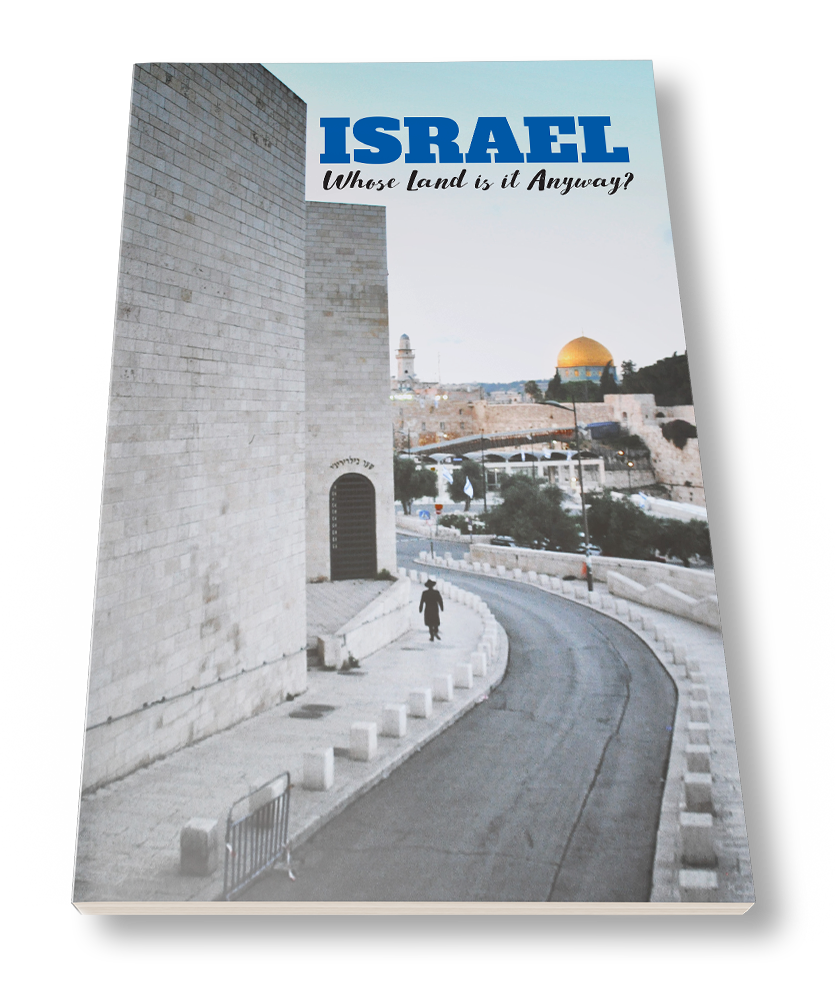
This booklet analyzes the Jewish and Arab claims to the land and makes sense of all the arguments surrounding the struggle. With historic, legal, and most importantly, biblical details about the land dispute, Israel: Whose Land Is It Anyway? will leave you with a clear, concise answer to how one should think about the land of Israel.
Music
The Friends of Israel Today theme music was composed and performed by Jeremy Strong.
We need your support!
Would you please consider making a donation to help us continue this vital work and to reach more lives with the biblical message of God's heart for Israel and the Jewish people?


