


Israel My Glory In Depth: Interview w/ Steve Herzig
 The apostle Paul is one of the Bible’s most beloved figures. He was responsible for the growth of the early church throughout the known world and penned much of the New Testament Scripture we cherish today. But before Jesus saved his soul from sin, he was an entirely different man—one who persecuted and killed Christians.
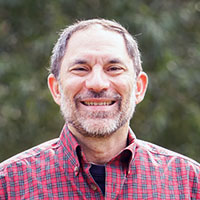
This week, Steve Herzig, The Friends of Israel’s retired vice president of North American Ministries, shares a closer look into his recent Israel My Glory magazine article about Paul’s upbringing. Paul (whose Hebrew name was Saul) was shaped by his identity as a Jewish man, a Roman, and a Pharisee. Sadly, he became a fierce enemy of the cross. But God ultimately used these defining factors to make him not only a follower of Jesus but a chosen vessel to bring many souls to saving faith in Him. Steve’s interview brings Paul to life with a memorable discussion about his heritage, training, and status that will help you better understand the man God chose from the womb to serve Jesus!
Read "The Early Years" by Steve Herzig.
Chris Katulka: Hi everyone. Thanks for joining us for The Friends of Israel Today. I'm Chris Katulka, your host and teacher. Now, let me ask you a question. Have you been to our website recently, foiradio.org? Because that's where you can connect with us. Again, it's foiradio.org. When you get there, you'll find out that we actually have over 10 years of content on our website that features biblical teaching about Israel and the Bible, also prophecy. Again, we have great interview guests that share about the Jewishness of the scriptures and the events that are actually happening in the Middle East. So if you'd like to connect with the Friends of Israel, I encourage you to go to foiradio.org. Again, that's foiradio.org. Now, today I have Steve Herzig. Steve is the former Vice President of North American Ministries for The Friends of Israel. Steve wrote a great article on the Apostle Paul, and that's what Israel My Glory is all about—this issue—the Apostle Paul. And Steve wrote about The Early Years, the background of the Apostle Paul as a Jew, as a Roman, and yes, even as a Pharisee. So Steve's going to explain how Paul's rigorous Jewish education under Gamaliel in Jerusalem shaped him into a formidable teacher and defender of the faith. So we hope that this look at Paul's upbringing will help you better appreciate the man God used in amazing ways, the Apostle Paul.
But before we get to that, let me share what's happening in the news. Mike Huckabee, the US Ambassador to Israel warned in a leaked letter to Israeli interior minister Moshe Arbel, that he would publicly declare Israel unwelcome to Christian groups after Jerusalem failed to approve tourist visas for evangelical missions. He also threatened to have his embassy impose reciprocal visa restrictions on Israeli tourists seeking entry into the United States. Well, here's my take: Ambassador Huckabee is speaking actually to a major problem with Netanyahu's current government, which was made up of largely orthodox political parties. See, unlike Netanyahu, these parties consider evangelicals religious adversaries to the Jewish state, not an ally. Huckabee and Netanyahu both know Evangelical Christians are Israel's greatest friend and partner in defending Zionism.
Chris Katulka: Hi, I am Chris Katulka. I'm the host of the Friends of Israel Today radio program and the editorial writer for Israel My Glory magazine. Now we've got a great setup for you today. We're going to be looking at our most recent issue of Israel My Glory magazine. But before we get to that, we want to highlight a way that you can get a one-year, free subscription to Israel My Glory, and we're going to share that information with you in a moment. Before we get to that, I'm excited to introduce our guest, Steve Herzig. Steve has served with The Friends of Israel for more than 40 years investing in Jewish communities all around the country and leading the North American Ministries department. Steve, it's great to be with you.
Steve Herzig: Great to be with you, Chris.
Chris Katulka: Steve, we are talking about your most recent article in Israel My Glory, which is all about the Apostle Paul. And your article is titled “The Early Years,” but I always love the way that you start an article, you get personal, and in this article you open up with a Yiddish word and maybe you can even help us pronunciate it. Is it b-bereshit?
Steve Herzig: Nope, not bereshit. That’s “in the beginning.”
Chris Katulka: Okay. Okay. What is it?
Steve Herzig: Beshert.
Chris Katulka: Beshert. Okay. I was close, but not close enough.
Steve Herzig: “In the beginning” is good for Hebrew and especially since it involves God, but this is beshert.
Chris Katulka: Okay, so explain what is beshert in Yiddish and how does this relate to Paul's calling, especially as we know it goes back to the womb, as it says.
Steve Herzig: That's right. My mother used this expression all the time. What’s beshert is beshert. And the meaning of that is “what will be will be.” In other words, from a superstitious point of view—my mother's—what's going to happen is going to happen, and there's nothing you can do. Kind of fatalistic, but at the same time predetermined. And so as we think of the Apostle Paul, he was called before the womb. He was called to the work. But he's not the only one. We could say what's beshert is beshert for Jesus. What's beshert is beshert for Jeremiah. There were others called from the womb. Because after all, there is an architect of all this. We believe that, in fact, as believers we believe that a person believes that they're called from the foundation of the Earth. So in that sense, it’s beshert. So as I was thinking about the Apostle Paul and the ministry that he would have, he was called by God, but you would never have known it had you known the Apostle Paul for the first few decades of his life.
Chris Katulka: So when you're talking about the beshert, the destiny that God would have, as God's sovereign plan for Paul, one of the things that you highlight in your article is that Paul had a unique identity because Paul was a hundred percent Jewish. You mentioned he's from the tribe of Benjamin. That's what the scriptures say. But at the same time, he also was a Roman citizen. God seemed to have been beshert in this moment by giving him these two identities in the world that he would be ministering in.
Steve Herzig: That's part of his plan. What’s beshert? If he's going to ultimately be the apostle to the Gentiles, what a way to prepare him.First of all, he is from the tribe of Benjamin, and wouldn't you know that at his Brit Milah, at his circumcision, he's given the name of Saul. What better name could a Benjamite have than Saul. King Saul, who was a Benjamite. But at the same time he's a Roman citizen and as a Roman citizen with the full rights of a Roman citizen, his name is Paul. Chris, my circumcision, my Brit Milah…
Chris Katulka: I love this story by the way. Go ahead.
Steve Herzig: I was given the name Israel Rueben.
Chris Katulka: This always, I've known you for so many years and it still hits me all the time. Your Hebrew name is Israel Reuben.
Steve Herzig: Correct.
Chris Katulka: I know you as Steve Herzig, but you're Israel Reuben.
Steve Herzig: Israel Reuben. So when I was in Hebrew school or synagogue, when they called me up to the bimah for my bar mitzvah, it was Israel Reuben. The Cantor chanted and up I came. If they would've called Steve Herzig, nobody would've acknowledged that I existed. But when I'm in school, regular public school, if somebody said, “Israel Reuben.” What? Who's that?
Chris Katulka: Even today, I think if I called you that you'd keep walking.
Steve Herzig: I'd be the only one who'd know what you were talking about. But that's happened to the Apostle Paul. His title obviously is Apostle. He's Paul. As a Roman citizen he'd be Paul. And I personally differ with some scholars who think that the name change in the book of Acts is literally he got his name changed. I don't believe that. I believe that the writer, Luke, knew about his background, et cetera, and on purpose, yes, when he starts off as a Pharisee, he is Saul, but when he's called by God in a unique way on the road to Damascus, everything changes. As a Roman citizen and as apostle to the Gentiles, he's not going to be known as Saul, he's going to be known as Paul, the Roman citizen. And I think that would make Gentiles more comfortable in dealing with him.
Chris Katulka: You talk about Paul's Hebrew name being Saul and that identity with the tribe of Benjamin, because that’s where King Saul comes from in the Old Testament, and even as you had mentioned earlier, kind of allocates him to his tribal lineage. How did this Roman name Paul that you're talking about, how do you think it helped broaden the mission that he would be on?
Steve Herzig: Well, like all Jewish people, even going back to this day, education is so important. We invented the strong desire for education. Judaism I think has survived through the years, the Jewish people have survived because they've always been able to take with them the ability to read, to write, and the emphasis of learning…
Chris Katulka: And a good mother's guilt, right? To go to the right school.
Steve Herzig: Oh, a healthy dose of guilt! Well, one of the things since he was raised in Cilicia, they wanted to give him a good Jewish education. So they sent him off to Jerusalem and he was under one of the greatest teachers of the day. And that would play a significant role because not only was the apostle Paul the apostle to the Gentiles, but Chris, he's written most of the New Testament. His teaching, his background, his whole call, his whole beshert, if you will, impacted you and me as we read the New Testament and has impacted the church from the time he wrote.
Chris Katulka: And you're saying that the name Paul would've given him the ability to spread that ministry to the Gentile world.
Steve Herzig: A hundred percent.
Chris Katulka: But at the same time he would've not abandoned—I think that's the mentality that we get is that, or you had mentioned that theologians and maybe even pastors might be saying, oh, look, he abandoned that name. That means he's abandoning the ways of the Old Testament, and look, he's moving forward beyond those things, almost like a replacement theology that's going on. But really you're saying no, he would've never abandoned that name. That would've always been his name.
Steve Herzig: Always had been his name, and if you want to see his passion and never losing it, just read Romans chapter nine. He talks about that and his heart's desires to his own people and his love for the promises that God gave in Romans 9 and the privileges that we have. As a Jewish believer, when I read Romans, a book to the church in Rome, which has connotations to the modern Jewish person, but to read that and then see, look at all these privileges that he gives, it comes from no better source than the Pharisee of Pharisees.
Chris Katulka: Okay, so to be a Pharisee of Pharisees though, you have to be raised up and trained to be a pharisee.
Steve Herzig: Big time. Big time, yeah.
Chris Katulka: You have to go through an education, as you had talked about, and that's the reason he was sent to Jerusalem. But you had mentioned that he studied under a particular teacher and his name was Gamaliel. Could you talk more about how that ministry would prepare him for, or that education would prepare him for his ministry going out into the Gentile world and even to his own people, even though if you think about it, Gamaliel probably rejected the ministry of Paul, and even the people around Paul would've rejected him, the Jewish people, most of them rejected his message. How did all that play together?
Steve Herzig: Well, just think about fellow Pharisees who are trained as well as he was. They would regard him as a traitor, but they could never take away his training. That same thing happens today with anybody in their experience, and then they testify to their experience when they get changed by the Lord Jesus. And in Paul's case, his training would be vital when he argues with other people. Look, you got an argument against Judaism and Christianity being against Judaism. Talk to me. I studied it. I studied from the main man and you bring up whatever you want and I'll be able to counter that because I lived where you live and that's really important, Chris. Ultimately, testimonies are the strongest argument we have. Look, the blind man said, look, I don't know. I don't know who did what where. All I know is I was blind and now I see. The Lord Jesus healed him. The apostle Paul could say, I hear what you're saying. I studied the same thing. That doctrine you're talking about, I believe too, but here's now why I believe. So he was where they were at, and he uses that not just with his call to the Gentiles, he uses it in his writing and in his arguments to the Jewish people as well.
Chris Katulka: Hey, did you know that August is Make-a-Will Month? It's a special time to reflect on your legacy and to take an important step for your future. Did you know that according to recent studies, only 32% of adults in the United States have a will? Creating one brings peace of mind, it protects your loved ones and allows you to support the ministries that matter most to you. Well, here at The Friends of Israel Gospel Ministry, we want to help you and that's why we've partnered with Free Will to offer a simple and secure way to write your legal will for free, that's right, for free, as our gift to you. When you include The Friends of Israel in your plans, you're leaving behind a powerful testimony of your passion for God's Word and compassion for God's Chosen People. It's fast, it's free, and it's a beautiful way to honor what God has placed on your heart. And if you remembered FOI in your legacy plans, let us know. We will be honored to include you in our FOI Heritage Society. If you'd like to participate, visit partner.foi.org to get started. Again, that's partner.foi.org. Make-a-Will Month. Your future. Your legacy. God's Glory. Again, that's partner.foi.org to get started today.
Chris Katulka: Paul is stuck in between two worlds: the Gentile world, which was very brave for him to go into, and the Jewish world that he lived in, and he felt tension from both sides, and you and…
Steve Herzig: I can relate.
Chris Katulka: That's right. And there's that tension, and we were talking about this before we got started, but did anybody like Paul? That's the question. Did anybody like Paul? Because it seemed like the Jewish people didn't like Paul. The Gentiles didn't like Paul. Who liked Paul?
Steve Herzig: One of the worst things, the worst words my wife hates to hear is, “let me be frank with you.” She doesn't like those words. Can I tell you something? The Apostle Paul was frank all the time. He never held back and some would say a characteristic in the DNA of Jewish people. Well, that doesn't play well all the time. He wasn't politically correct and he had no pretense about him, which would mean in some instances, I think we would say he didn't have a filter. When it came to doctrinal issues, the truth was the truth with the Apostle Paul. He didn't have a bedside manner and that could turn people off. I think he'd be a hard person to have to pastor because he would tell the pastor, this is the way it is.
Chris Katulka: He'd be there every weekend in his pastor's office.
Steve Herzig: Hey, I heard your message, and you know what? You should have said this.
Chris Katulka: Yeah. Well, and how that all kind of plays out with the Apostle Paul. We were talking about how nobody liked Paul. But even today, it's funny when people read through the Scriptures, I've heard people say, “Hey, I like what Jesus has to say, but the Apostle Paul, he kind of rubs me the wrong way.”
Steve Herzig: Jewish people will say, “I can talk about Jesus, but I don't want to talk about Paul.” They will blame Paul more than they blame Jesus. I've heard it many, many times. Jesus was a philosopher. They would say Jesus was a teacher. The apostle Paul, he was a liar. The Apostle Paul took the words of Jesus and the teaching, and he skewed everything. They would say that, so yeah, he'd be on the most wanted list.
Chris Katulka: Yeah, and it's a tough position to be in like we were mentioning, because he actually gave himself probably one of the, or God gave him one of the toughest jobs, which is to be that bridge that stood between the Gentile world that was coming to faith in Jesus and the Jewish world. Even the believers in Jesus in Jerusalem, the Jewish believers had issues with Paul as well, and there was that constant tension and Paul seemed to find himself right in the middle of it, but never seemed to stress in his letters. He never seemed to have a sense of anguish or stress about it. It almost seemed to force him to greater dependence on the Lord, whether he's in prison or he's out ministering. It always seemed like even in the tension that he existed in, he always was forced to dependence on the Lord.
Steve Herzig: Well, I'm glad you brought that up because I have an opinion about that. I'm Jewish, so I got an opinion. And that is, three years he spent in the most unique way with the Lord Jesus Christ. The apostles saw him alive physically before He died on the cross. They met Him before. The Apostle Paul met the resurrected Christ, and those three years are, to me, we don't know anything about them. They were transformative for him, and I think the assurance he had that you described is because of those three years.
Chris Katulka: It's very important to know too that when you read through Paul's letters, oftentimes he's arguing for his apostleship. To be able to say, ‘I am an apostle. I did see Jesus. I was with him like the other apostles just at a different time. This one's after his resurrection.’ And oftentimes Paul is arguing, ‘I am an apostle. You can trust me. You can believe the words that I'm saying.’
Steve Herzig: Well, do you believe that everybody would believe his story, that he spent three years? Who'd you spend three years with? A dead guy. That's what Jewish people would say. That's what Romans would say, philosophers would say. But he had a living encounter with Jesus Christ and yes, he wanted to defend that.
Chris Katulka: I want to know, how did Paul's transformation from persecutor to apostle demonstrate the depth of God's grace and the idea that God can use all aspects of our past for his purpose?
Steve Herzig: He was miraculously changed on the road to Damascus. He had a dramatic testimony where he encountered the living Christ. And Chris, few of us, if any of us are going to have that literal road to Damascus, but any believer, anyone who trusts Jesus Christ as Savior has an encounter, a living, lasting encounter with the risen Christ and it should have changed them. We're born again. We're born from above. We're new creatures. Old things pass away. But those old things that pass away are part of our life story, and when we go on the highways and byways of life, we are able to share how we're changed. You came from a Catholic background. I came from a Jewish background. But you were miraculously saved. You have a story and you carry your background into your story, born again. I have a Jewish background and I carry the same thing. The Apostle Paul carried his pharisaic background, his being raised where he was, being taught in Jerusalem, being part of the Jewish community, and he carries that as—encounter on the road to Damascus, three days of blindness, all that put into him by a God who calls him and it's part of his life story. Chris, that encourages me because we can tell our life story. It's unique. Your story isn't my story, but the story ends with the same person, the Lord Jesus Christ.
Chris Katulka: It's beshert.
Steve Herzig: It's beshert!
Chris Katulka: Hey, let me ask you one more thing in our remaining time here. The Apostle Paul, we had mentioned the tension that he brings, and you even had mentioned that some Jewish people go, ‘Jesus, I don't mind, but that guy, apostle Paul’—when you came to faith in the Lord Jesus, was Paul something that was a hard pill to swallow or was it something that you embraced right away?
Steve Herzig: Paul wasn't a hard pill for me because I had to get through the gospels and believe them. Jesus was the person for me. I read…I remember reading Matthew as an unsaved person, I start to read it and I don't know what's going on. The person of Jesus, the genealogy, the whole thing. The Apostle Paul, once I believed in Jesus, the New Testament was fine for me. I had a problem with Jesus
Chris Katulka: And the Apostle Paul almost becomes an example for your own life.
Steve Herzig: A hundred percent. Exactly.
Chris Katulka: In doing ministry.
Steve Herzig: I could relate to him. Yeah.
Chris Katulka: Yes, and doing ministry to the Jewish people all around the world, really. Steve, thank you so much for being a part of this. I'm really excited to hear your thoughts about Paul, his early years and how that influences the way that we read the New Testament as well. And not only seeing Paul's testimony and how he came to know the Lord Jesus, but hearing your testimony as well is very encouraging.
Steve Herzig: What's beshert is beshert.
Chris Katulka: Hey, if you want to get a free copy of Israel My Glory magazine, I promise that I would share with you how you can do that. It's really easy. All you have to do is go to israelmyglory.org/subscribe. Again, that's israelmyglory.org/subscribe, and when you go there, you actually have options. You could get a print edition of Israel My Glory, which is fantastic. You get six free issues right to your mailbox, but you could also get the Digital edition of Israel My Glory, that will give you more than 40 years of this magazine right at your fingertips, on your tablet, on your cell phone, on your computer. I hope you go to israelmyglory.org/subscribe. Thanks for listening.
Thanks for joining us today on The Friends of Israel Today. Be sure to come back next week as we take a deep dive into the modern history of Iran. Also, don't forget to visit partner.foi.org to make your free will with The Friends of Israel Gospel Ministry. Again, it's a legal will for free as our gift to you. Again, partner.foi.org. And finally, don't forget to get your free one year subscription to our award-winning Christian magazine, Israel My Glory by going to foiradio.org.
Our web address is foiradio.org. Again, that’s foiradio.org. Our mailing address is FOI Radio PO Box 914, Bellmawr, New Jersey 08099. Again that’s FOI Radio PO Box 914, Bellmawr, New Jersey 08099. You can also call our listener line. That’s 888-343-6940. Again that’s 888-343-6940. Today's program was engineered by Bob Beebe. Edited by Jeremy Strong, who also composed and performs our theme music. Lisa Small is our executive producer. Sarah Fern is our associate producer. Steve Conover is our executive director here at The Friends of Israel, and I'm Chris Katulka, your host and teacher. The Friends of Israel Today is a production of The Friends of Israel Gospel Ministry. Passion for God's Word. Compassion for God's Chosen People.
Watch the Interview
Israel My Glory Magazine
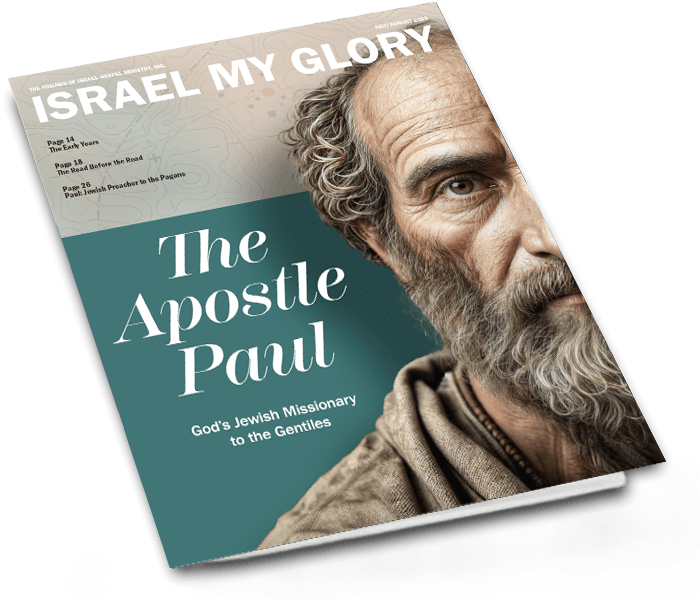
Since 1942, Israel My Glory has been a highly trusted, sought-after tool in the study of God’s Word. This award-winning magazine, published by The Friends of Israel Gospel Ministry, stands firmly on the literal-grammatical interpretation of the Bible. It is simply the best there is if you want to understand Scripture, Israel, and prophecy.
Sign up for your free one-year print or digital trial today!
*First-Time Subscribers Only
DIGITAL TRIAL

Music
The Friends of Israel Today and Apples of Gold theme music was composed and performed by Jeremy Strong.

We need your help!
Would you please consider making a donation to help us continue this vital work and to reach more lives with the biblical message of God's heart for Israel and the Jewish people?


Comments 1
Those who think Saul experienced a name change are simply in error. Saul was his Hebrew name; Paul was the Greek or Roman equivalent. The change he did experience was in his character and destination.