


Who Are "The Least of These?"
Jesus’ words in Matthew 25 concerning “the least of these” have driven many ministries seeking to help the poor and needy. Their work is a wonderful display of love for the Lord. But is it possible that this worthy drive for humanitarianism has caused some to miss the target of Jesus’ message? We’re exploring this question thoroughly over the next two weeks.
The context for Jesus’ statement is paramount. He was revealing end-times prophecies concerning Israel and the Tribulation. He spoke of judging the nations based on their treatment of “the least of these” when He returns at His Second Coming. But who are the “least of these”? Could this phrase be referring to a group of people separate from the poor and destitute? Tune in for a highly informative, biblical study of Matthew 25 designed to help you better understand this key teaching!
Chris Katulka: Welcome to the Friends of Israel Today. I'm your host and teacher, Chris Katulka. Now listen, I want to encourage you to visit our website, foiradio.org when you get there. That's how you keep up with all of the things related to The Friends of Israel Today's radio program, and really The Friends of Israel Gospel Ministry as a whole. There you can listen to all of our broadcasts—10 years worth of content with links to our featured products highlighted in our show as well, or you can even support our ministry, The Friends of Israel, by clicking on the donate button. To help continue teaching biblical truth about Israel and the Jewish people. Please visit us at foiradio.org. Now, today we're going to begin a two-part series on this phrase that Jesus uses in Matthew chapter 25, a phrase called, “The least of these.” In fact, in Matthew 25:40, Jesus says, “Truly I tell you, whatever you did for one of the least of these, my brothers and sisters, you did for me.”
Well, who is the least of these? We want to highlight this feature because I think it's only going to add more weight to how we minister to those who are in need. But first, let's get to the news. Last week, two Palestinian gunmen from the West Bank opened fire at Jerusalem's Ramot Junction killing six people and wounding 12 others, six of them seriously, as they targeted vehicles, pedestrians, and a bus stop. Police reported that a soldier and several civilians returned fire killing the attacker at the scene. Well, here's my take. All the attention is on the war in Gaza and returning the hostages which are still being held by Hamas. But once again, we are reminded that Israel's enemies surround them and that the threat is real. The Palestinian Territories of the West Bank, which is biblical Judea and Samaria remain a threat to Israel's national security.
Have you ever heard of this passage before? It's Matthew 25:34-36. It goes like this. “Then the king will say to those on his right, come you who are blessed by my father, take your inheritance, the kingdom prepared for you since the creation of the world. For I was hungry and you gave me something to eat, I was thirsty and you gave me something to drink. I was a stranger and you invited me in. I needed clothes and you clothed me. I was sick and you looked after me. I was in prison and you came to visit me.” The disciples responded to Jesus, “When have we ever done this for you?” And Jesus answered this in verse 40. “Truly, I tell you, whatever you did for the least of these my brothers and sisters, you did for me.”
I'm confident you've probably heard that at some point in your church as your pastor's preaching. Actually many ministries and nonprofits gravitate toward the powerful words of Jesus in Matthew chapter 25, especially the phrase, “the least of these” as they pursue humanitarian aid, financial support, and care for those who are most vulnerable. Organizations like the Matthew 25 Ministry or the Cherry Street Mission and others draw directly from this passage as a guiding principle, quoting it on their websites and weaving it into their mission statements. Whether providing food, shelter, education or medical support, these ministries see themselves as fulfilling Christ's call to serve by meeting the immediate needs of struggling individuals and families. Their work can often stretch across borders, cultures and circumstances, and it demonstrates a broad application of compassion that's grounded and rooted in the scriptures. It's really astonishing to see how they minister and who they minister to. Now James in James chapter one reminds believers that pure and undefiled religion before God is to care for orphans and widows in their distress.
That's those who cannot help themselves. Well in this sense in Matthew 25, this passage naturally resonates with ministries that serve the poor, that serve the hungry, the imprisoned and the homeless. It validates their commitment to practical, tangible expressions of the gospel and places dignity on the very act of offering water, food, clothing, or companioning someone in need. By embedding this passage into their identity, these organizations affirm that helping others is not just a social good, but an act of worship and obedience to Christ himself. Yet as we celebrate these ministries' efforts which are absolutely amazing, it's worth pausing to ask a very important question, who are “the least of these” in the words of Jesus? The passage itself comes in the context of his teaching about the nations and their treatment of his brothers and sisters, raising questions about whether he was pointing specifically to his disciples, the Jewish people or humanity in general.
While ministries rightly apply the principle broadly to all people in need, we have to reflect on this text and ask how it invites us to consider its immediate audience and purpose. Understanding this nuance, it doesn't diminish the value of caring for the poor. In fact, it strengthens it by rooting our compassion in a fuller reading of the Scripture. It pushes us to love widely and deeply while also seeking clarity about the unique identity of the least of these in the heart of God's Word. And that's exactly what we're going to be doing this week and next, as we ask and attempt to answer this question, who are the least of these that Jesus was talking about? Now before we can answer that, we do need to do the heavy lifting of digging into the passage and digging into the context of Matthew chapter 25. So first, let's get the big picture down. In Matthew chapter 24 and 25, Jesus is teaching his disciples about the end times. He's giving what I like to call Jesus prophecies.
Here he echoes, actually, what the Old Testament prophets had already declared—that God's judgment is coming, it will be a time of great tribulation on the earth marked by the rise of an antichrist in the pouring out of God's wrath with Jerusalem standing at the epicenter of it all. The prophet Jeremiah called this period that Jesus is speaking into, “The time of Jacob's trouble.” A time when God once again turns his focus toward Israel and all the events leading up to the climactic moment, this amazing moment, the return of the Lord Jesus at his Second Coming. And that's where Matthew chapter 25 picks up. The section about “the least of these” begins in a prophetic setting. It says this in Matthew chapter 25, starting in verse 31. This actually begins the passage where Jesus is speaking about the least of these. We can't leave this out because it says this.
Jesus opens that section with this: When the Son of man comes in his glory and all the angels with him, he will sit on his glorious throne. All the nations will be gathered before him and he will separate the people one from another as a shepherd separates the sheep from the goats. He will put the sheep on his right and the goats on his left. And this is where I want to hover for this episode because this is the lead in verse for “the least of these” passage. Matthew explains why Jesus is so interested in the least of these. Now, first let me say something. The law of God in the Old Testament was always interested in the least of these. Just look at the sacrificial system. If you wanted to offer a sacrifice to God, a whole burnt offering, for instance, if you had the means, the financial means you would bring God the best that you had, which would be a bull.
If you had the means but not enough to bring a bull, you could bring a goat or a lamb to the altar. If you didn't have enough to bring a goat or a lamb, you could bring a pigeon and if you didn't have enough to even bring a pigeon, you could bring grain to the Lord. See, he never wanted to exclude the least of these from coming into his presence. The law prohibited Israelite farmers from harvesting the corners of their land in order to provide food for the least of these. Israelites with slaves and servants were to treat them with the utmost respect, ensuring that they had the ability to fulfill the law of the Lord. Why? Because at one point, the Israelites were slaves in Egypt. They were the “least of these” in Egypt and God delivered them from that bondage. But according to the law, the Israelites were commanded to treat slaves with dignity, especially distinguishing between the Hebrew slaves and the non-Israelite slaves. A Hebrew slave who fell into servitude because of poverty was to serve only for six years and then be released on the seventh or in the year of Jubilee with the master required to send him away generously supplied so that he could start his life again. Slaves, according to the law, were to be treated not as property, but as hired workers reflecting God's reminder that Israel themselves were once slaves in Egypt. Non-Israelite slaves could be held longer, even permanently, but were still afforded protections. If injured by a master, they were set free. If killed, justice. Justice would come down on that Israelite for committing that crime. The Torah, the law of God placed boundaries around servitude, turning it into more of a system of economic relief rather than oppression, always pointing Israel back to compassion, justice and the memory of their own deliverance, considering “the least of these.”
Remember, Jesus is the law lived out in real time. So it's no surprise that he's concerned about those who can't stand up for themselves or help themselves. But now I want to get back to this introduction passage when Jesus says, “When the Son of man comes in his glory and all the angels with him, he will sit on his glorious throne.” See, he's giving us in these few words, the time, the place, and the purpose to set the context for his words on the “least of these.” First, the time. It says, “When the Son of man comes in his glory and all the angels with him.” These two phrases show that the timing is Christ at his Second Coming. Remember, Jesus is the one talking here during his first coming on the Mount of Olives about the future events that would take place. And here Jesus is saying, “When you see me coming in all my glory and all the angels with me,” again, it's the picture that Jesus is trying to paint of his Second Coming.
Second, the place. Jesus is going to come in all his glory with the angels with him, and it's then that he will sit on his glorious throne. Do you remember hearing that - His glorious throne? That glorious throne can only be in one place on earth and that's in Jerusalem. The glorious throne is the picture of Jesus sitting on the throne of David, just as God promised King David in 2 Samuel 7, that a son of David would sit on David's throne forever. So the time? Second Coming. The place? Jerusalem. But what's the purpose of this passage that's connected to Jesus's words about the “least of these?” Well, that you're going to have to stick around to find out, so stay tuned.
Steve Conover: Are you a new listener to our program? If you are, welcome. We're glad you're here. The Friends of Israel Gospel Ministry exists to fuel your passion for the Word which should overflow to a compassion for God's Chosen People, the Jewish people.
Chris Katulka: Whether you're new to our program or have listened for years, we want to encourage you with our resources to help you see why God called us to support the Jewish people in Israel and worldwide. We have a free download, a digital version of our booklet, Whose Land is it Anyway? that we'd like to send you free today. Whose Land is it Anyway? takes the Jewish and Arab claims to the land and helps make sense of the common arguments surrounding the struggle. Whose Land is it Anyway? is an easy-to-read apologetic that will give you a clear answer as you think about Israel's right to the land.
Steve Conover: To get your free digital copy of Whose Land is it Anyway?, visit foiradio.org. Again, that's foiradio.org.
Chris Katulka: Welcome back everyone. Jesus in Matthew 25 spends several verses in the gospel to the Jewish people. Remember, Matthew is the gospel to the Jewish people, speaking about the “least of these.” A passage many ministries use as a foundation for their ministry to those who are in great need. The work that these gospel ministries are doing is so important because even James 1 says, “That the truest form of our faith is to minister to those who cannot help themselves.” But the question we want to answer is who is “the least of these?” In the previous segment, we highlighted that the setting of this passage is Jesus's Second Coming, to reign from Jerusalem as the King of kings, the Messiah of Israel, but what is the purpose of this passage? Well, for that we're going to have to go to the title of Jesus's name to find out. That's right, the title that Jesus uses in this passage to describe himself.
In fact, it's his favorite title to use to describe himself—the Son of man. The title “Son of man” gives us the purpose for Jesus speaking about the “least of these.” The prophet Daniel tells us in Daniel 7:13-14 exactly who the Son of man is. Listen to this, Daniel writes, “In my vision at night, I looked and there before me was one like a Son of man coming with the clouds of heaven. He approached the Ancient of days and was led into his presence. He was given authority, glory and sovereign power. All nations and peoples of every language worshiped him. His dominion is an everlasting dominion that will not pass away, and his kingdom is one that will never be destroyed.” The Son of man, according to Daniel, is the One who is given dominion to rule over the entire world and part of that rule, over every nation and people and language, is the right to judge them.
That's why Jesus says, “All the nations will be gathered before him and he will separate the people one from another as a shepherd separates the sheep from the goats. He will put the sheep on his right and the goats on his left.” This is judgment language. Jesus is going to bring all of the nations of the earth to Jerusalem for judgment. And it's there He will judge the nations as the Son of man. He will divide them, the sheep, the righteous ones, and the goats, the unrighteous ones. In fact, Jesus isn't just making this up. The prophet Joel talks about this in Joel 3, in the very beginning of Joel 3. Joel uses the same language as Jesus when he says that, “God will bring the nations down to the valley of Jehosaphat to be judged for their treatment of the least of these.” Jehosaphat in Hebrew means judgment. And that valley is believed to sit between the Temple Mount and the Mount of Olives, exactly where Jesus will return at His Second Coming. But look, we still haven't answered the ultimate question. We have Jesus, the Son of man coming at His Second Coming to Jerusalem to judge the nations for their treatment of the “least of these.” But who are they? Who are those in need who can't help themselves? Well, you got to come back next week to find out.
Steve Conover: Israel, on the verge of becoming a state, a teenaged Holocaust survivor arrives on her shores alone. His name is Zvi Kalisher. Little did he know his search for a new life in the Holy Land would lead him to the Messiah. Zvi, enthusiastic to share his faith, engaged others in spiritual conversations, many of which can be found in our magazine Israel My Glory. While Zvi is now in the presence of his Savior, his collected writings from well over 50 years of ministry continue to encourage believers worldwide. Now, Apples of Gold, a dramatic reading from the life of Zvi.
Mike Kellogg: Recently several young Hasidic boys came to my door.
They explained, “Today we are examining the mezuzahs in your neighborhood to see if they are kosher.” (A mezuzah is a small case containing the Shema [Dt. 6:4–5] attached to the doorpost of a home.)
I asked them how they would know whether or not a mezuzah was kosher.
One replied, “It is our holy duty to know such things.”
I replied, “The most important thing is to know your heart is kosher. Have you examined your heart?”
They looked at me strangely, and one said, “What do you mean by these strange statements?”
I said, “I trust in the Lord. If I am living far from the Lord but my mezuzah is kosher, of what value will that be on Judgment Day? It is written in 1 Samuel 16:7, ‘Man looks at the outward appearance, but the LORD looks at the heart.’ I urge you to open your hearts before the Lord and receive Him as your Savior.
“The Scriptures do not say you must kiss the mezuzah when you enter the door. That is a tradition. You should do only that which is commanded in the Scriptures.”
Eventually one of the boys said, “We cannot argue against what you are saying. Would you mind if I called our rabbi and asked him to come?”
“It would be a privilege for me to talk to your rabbi.” Shortly thereafter the rabbi arrived, accompanied by two other Hasidic men. I said, “I see you have come with reinforcements, while I am here alone with my wife. But you are welcome, and I hope we have a nice meeting.”
The rabbi immediately asked, “What is going on here?”
“Ask your pupils. You have taught them for many years, but when they are tested, they are like sheep gone astray. The Scripture says, ‘Strike the Shepherd, and the sheep will be scattered’ [Zech. 13:7].”
“Rabbi,” I said, “what is more important to God— to kiss the mezuzah, or to have a clean heart? As it is written in Ezekiel 18:31, ‘Cast away from you all [your] transgressions, and get a new heart and a new spirit.’ It is not written, ‘Get yourselves a new mezuzah,’ but ‘get yourselves a new heart and a new spirit.’”
“No!” cried the rabbi. “Do you also read the New Testament?”
“Yes,” I replied, “I believe in the living God, not in idols, such as you.”
The Hasidic men and young boys were disappointed in their rabbi. He quoted from the Talmud and other rabbinic books, but I spoke from the Bible, which I kept open during our entire conversation. Finally, the rabbi asked, “Are you a Jew?”
I am always asked this, and, as usual, I replied, “I worship God according to the Bible, but you, Rabbi, are worshiping other gods. Are you a Jew?” I gave them my testimony of how I had come to believe in the Lord Jesus as my Savior.
Please pray the Lord will open their eyes to the emptiness of their traditions. As the Lord Jesus said, “For what will it profit a man if he gains the whole world, and loses his own soul?” (Mk. 8:36).
Chris Katulka: The impact of Zvi's life and ministry in Israel; it didn't end when he went home to be with the Lord. In fact, Zvi's legacy lives on. Our Friends of Israel ministry representatives continue to share the gospel in Jerusalem, Israel, and really all throughout the world. We also serve Holocaust survivors and their families. We provide free food, medicine and clothing, and we even promote the safety and security of the state of Israel and the Jewish people everywhere. So when you give to the Friends of Israel, your donation actually allows us to advance the gospel of our Messiah Jesus. You can give online by visiting foiradio.org. Again, that's foiradio.org. You can click right there on our donate link. Also, be sure to let us know where you listen when you contact us.
Thank you so much for being with us on today's episode of The Friends of Israel Today. Now, don't forget to go to our website, foiradio.org to get your free digital download of Whose Land Is it Anyway? Listen, now more than ever, you need to know whose land it is because anti-Israel sentiments are on the rise all around the world and you need to be prepared with a defense to know whose land is it. Anyway, get your free digital download at foiradio.org. Now next week, we're going to enter into part two of our passage of Matthew Chapter 25 when we're defining who are the least of these. Next week, you're going to want to come back because we're going to be wrapping up our series on who are the least of these, and we're going to put a definition to that title so that you can better understand who Jesus was speaking to during this very sensitive time.
As mentioned, our website is foiradio.org. Again that’s foiradio.org. Our mailing address is FOI Radio PO Box 914, Bellmawr, New Jersey 08099. Again that’s FOI Radio PO Box 914, Bellmawr, New Jersey 08099. Now that you know, send us a message. You can also call us on our listener line. That’s 888-343-6940. Again that’s 888-343-6940. Today's program was engineered by Bob Beebe. Edited by Jeremy Strong, who also composed and performs our theme music. The late Mike Kellogg read Apples of Gold. Lisa Small is our executive producer. Sarah Fern is our associate producer. And Steve Conover is the executive director of The Friends of Israel Gospel Ministry, and I am your host and teacher, Chris Katulka. The Friends of Israel Today is a production of The Friends of Israel Gospel Ministry. Passion for God's Word. Compassion for God's Chosen People.
FREE GIVEAWAY!
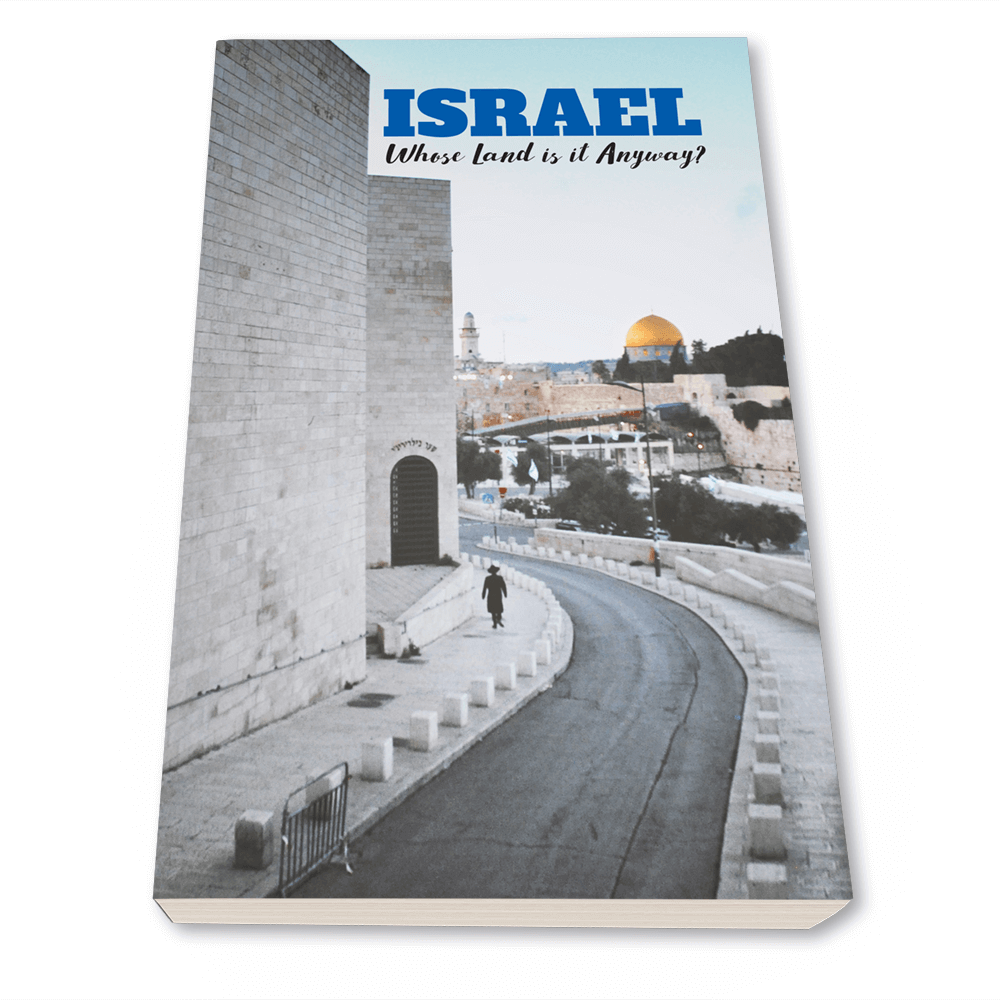
This booklet analyzes the Jewish and Arab claims to the land and makes sense of all the arguments surrounding the struggle. With historic, legal, and most importantly, biblical details about the land dispute, Israel: Whose Land Is It Anyway? will leave you with a clear, concise answer to how one should think about the land of Israel.
Apples of Gold: Are You a Jew?
Zvi was visited by several young Hasidic boys who wanted to check if his mezuzah was kosher. Zvi, always looking for chances to share biblical truth, encouraged them to examine their hearts instead. This led to a deep conversation, and he later invited their rabbi to join them. Over soft drinks and coffee, Zvi shared with them about the living God who could grant them clean hearts.
Music
The Friends of Israel Today and Apples of Gold theme music was composed and performed by Jeremy Strong.
We need your help!
Would you please consider making a donation to help us continue this vital work and to reach more lives with the biblical message of God's heart for Israel and the Jewish people?


