

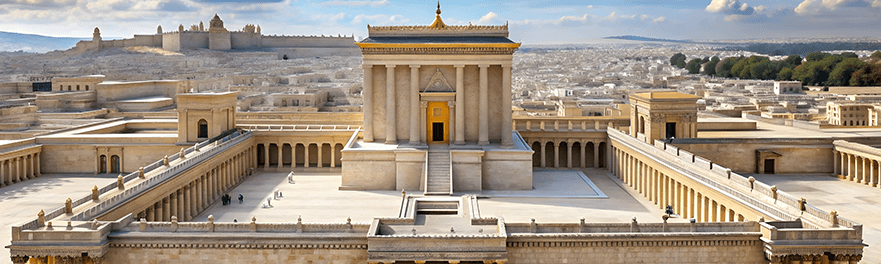
Temple Structure & the Gospel, Part 1 of 3:
Herod’s Temple was an architectural marvel of the ancient world. But it was much more than a grand building. It was the heart of the Jewish people’s worship of the Lord God. This fact was evident in the purposeful design of the Temple, as it separated sections of the structure to highlight God’s holiness. This week we begin a three-part series on how the design of this Second Jewish Temple illuminates our understanding of Ephesians 2.
The design of Herod’s Temple emphasized the distinction between holy and common—a theme we often see throughout Scripture. The apostle Paul then used the Temple’s design to teach a practical lesson about Gentiles, who were excluded from the inner parts of the Temple, being brought near to Jesus, the Son of the Most High God. Journey with us as we discover what the Second Temple teaches about God, His holiness, and the Good News of the gospel!
Chris Katulka: Welcome to the Friends of Israel Today. I'm your host and teacher, Chris Katulka. I want to encourage you to visit our website, foiradio.org to keep up on all things related to the Friends of Israel Today program. There you can listen to all of our broadcasts—that's a decade's worth of content with links to our featured products that are actually highlighted in our show. Or you can support our radio ministry by clicking on the donate button to help continue to teach biblical truth about Israel and the Jewish people. Visit our website, foiradio.org. Now listen, today we're going to begin a three-part series on looking at the structure, the architecture of the temple, and trying to see what Paul was doing in Ephesians chapter two, which talks about these interesting components of the temple and how we relate with the Lord Jesus today. So today we're going to begin a series all about the temple and tabernacle architecture and how we can approach a Holy God.
But before we get to that, let's see what's happening in the news. There's an ideological virus that is spreading fast, especially across social media, and it's infecting the minds of young Bible believing evangelicals. It convinces them that Israel no longer matters to God's redemptive plan, that the Jewish people have no unique role in his story and that Israel is just another nation on the map, and for some, America is God's kingdom today. Well, here's my take. The numbers don't lie. In just a few short years, support for Israel among young evangelicals 18 to 29 has plummeted from 69% in 2018 to barely 33% in 2021, and the trend continues to slide in the wrong direction. And the wrong direction isn't just a disdain for Israel, but a hatred, antisemitism, toward the Jewish people, which flies in the face of what God teaches in the Scriptures.
Chris Katulka: Today we are starting a three-part series on the structure, and architecture and design of Herod’s temple, the Jewish Temple that stood in the heart of Jerusalem during the days of Jesus. My goal isn’t to simply share with you the layout of the Temple, but the heart of the Gospel of Jesus and the amazing work of Christ’s blood and what it does for Jewish people and Gentiles when it comes to how we approach God, because that’s what the Tabernacle and Temple in the Bible is all about. It’s about how God’s people, the Jewish people, were to approach Him. But before we continue I want to share about archaeological finds that were discovered over the past 150 years.
In 1871 a French archaeologist, Charles Simon Clermont-Ganneau, was in Jerusalem where he found a stone that was very old that was repurposed for the structure of a Muslim school.
The stone Clermont-Gannaeu discovered was originally placed in Herod's temple precinct. The inscription was a warning telling certain individuals not to cross beyond the wall that surrounded the Temple sanctuary. The French archaeologist said, “It is remarkable that this stone that… comes from the ancient Jewish Temple hasn’t been carried away far from its original location. Indeed, the place where I found it is only 50 meters away from the Haram al Sharif, the sanctuary of the Jews.” Haram al Sharif is the Arabic name for the Temple Mount in Jerusalem.
The limestone slab now sits in Turkey, among other artifacts in the Istanbul Museum. A second inscription was found in 1935, it’s a partial inscription currently on display in the Israel Museum. It was found during an excavation as a part of a tomb outside the Lion’s Gate in Jerusalem.
Two millennia ago, these inscriptions served as a warning to anyone ritually impure—Jew or Gentile—they were warned not to enter the holier sections of the Temple complex. The inscriptions actually read in Greek, “No foreigner may enter within the balustrade around the sanctuary and the enclosure. Whoever is caught, on himself shall he put blame for the death which will ensue.” Two examples of this “Temple Warning Inscription” survived: again, one complete that’s in Istanbul’s museum and a partial one that’s in Jerusalem. These rare artifacts confirm the detailed descriptions found in historians, like Josephus, and in the Jewish texts, the Mishna, which offer archaeologists tangible evidence of the Temple’s inner boundaries.
Now you have to know Herod the Great’s Temple was a monumental blend of Jewish faith and Greco-Roman architecture. Built atop an enormous platform in Jerusalem, it became one of the ancient world’s most impressive religious complexes.
Far from being a place of exclusion, the Temple Mount welcomed Gentiles to ascend, donate sacrifices, and even worship—though not to enter the inner sanctum reserved for the ritually pure. Ancient sources record that Roman leaders, including Marcus Agrippa, offered sacrifices there, reflecting Herod’s desire to balance Jewish tradition with international prestige among his Roman benefactors.
Scholars view this warning inscription not as ethnic barriers but as expressions of ritual purity laws—restrictions that applied as much to impure Jewish people as to Gentiles.
I want to stop here for a moment because it’s important to get an understanding of the Tabernacle and Temple layout. In both of these structures, whether from the days of Moses with the Tabernacle or Solomon's Temple, or the Second Temple that was rebuilt, or even Herod’s major Temple update, the design of the temple is prohibitive. What do I mean by that? I mean there are certain places in the temple and the tabernacle that certain people can go. And there are certain places certain people can’t go.
We have these prohibitive divisions in our own society. When someone goes into surgery, you can walk your loved one up to a certain point in the hospital and then doors and signs prohibit you from entry. They might say “doctors only,” or nurses are invited unless you’ve been given special permission.
Or if you go to a special event or sports game, there is a place where you can watch the artist or game, but signs are placed on the doors and entry ways that permit only employees to enter where the artist or team might be preparing, you know backstage or in the locker room. Or even more importantly, think about a visit to the White House in Washington, DC. There are prohibitive levels of approach based on your status.
You can’t just mosey from the Washington monument to the Oval Office. There are several security levels you must go through before you can even enter the White House property. You’ll find out the hard way, you can’t just walk onto the White House lawn.
Look, the Tabernacle and Temple functioned the exact same way. There were levels of holiness.
Why? Because a holy God's presence is in the tabernacle or the temple, and the closer you get to God's presence the more holy in status you have to be.
Let’s start with the most holy place in the Temple, it’s the Holy of Holies, where the presence of God dwelled. No one was permitted to enter the Holy of Holies, only the High Priest could approach the Holy Holies and that was once a year on the Day of Atonement, Yom Kippur. It was sectioned off in the sanctuary, which was the Temple proper, and it was sectioned off by a veil. The high priest was considered Holy, set apart, and ritually clean to enter such the holy place. On the other side of the Holy of Holies was the Holy Place, where certain priests could enter, not all priests, only certain ones could enter into the Holy Place to give offerings and maintain the menorah lights, the table of showbread and the incense altar. Outside of the temple proper, the building, was the court of the priests where the altar stood, where sacrifices were offered. Again, only select priests could enter this courtyard who were permitted to offer sacrifices on behalf of the worshipers who could not pass beyond the altar. Then there was a courtyard outside of that for the men of Israel, and beyond the courtyard for the men of Israel was the courtyard for the women of Israel.
You have to think of it like this, it’s concentric circles of holiness. See, at the center is the Holy of Holies where God dwells and as you go out your status of holiness begins to lessen.
A gate called the Beautiful Gate stood on the east side of the court of women that men, women and priests entered to worship God. The Beautiful Gate is how you accessed these various courtyards and rooms in the sanctuary.
Outside the Beautiful Gate was a larger courtyard that everyone gathered into who was ritually pure to enter the precinct. This was an area for the Jewish people, but not all Jewish people, it was for those who were ritually pure to enter the Temple complex. That court was surrounded by a wall called a balestrade, and on that wall that surrounded the Temple proper were these inscriptions that I was talking about—these warning inscriptions, telling those Jewish people and Gentiles who were ritually impure to not enter beyond that point. The wall separated them.
Even today, uncertainty over the Temple’s precise layout has led most rabbis to prohibit Jewish entry to the entire Temple Mount, lest one should unknowingly step on the site of the Holy of Holies. Modern warning signs by Israel’s Chief Rabbinate echo the ancient inscriptions, reminding visitors of the Temple Mount’s sacredness. The limestone block at the Israel Museum stands as more than an archaeological curiosity—it is a surviving witness to a time when the Temple symbolized both holiness and inclusion, separation and access, purity and presence before God.
Again, when you think about the Tableracle or Temple you have to begin to think of it like a dart board. The bullseye is the Holy of Holies, the next ring is the Holy place, the next ring is the courtyard of the priests, the next ring is the courtyard for the men of Israel, the next one is the courtyard for the women of Israel, and then beyond the wall that had the inscription was another layer, outside, that was the courtyard of the Gentiles.
This is where I want to pick up with where we are over the next few weeks, and when we come back I want to read what the apostle Paul is telling believers in Ephesus when He brings this temple imagery, because this is what’s going through his mind, this temple imagery into God’s desire to form one new man, so stick around.
Steve Conover: Each Christmas, our family looks for a devotional to read in the month of December, and I think Finding Messiah in Christmas is one of the best.
Chris Katulka: I absolutely love it, Steve. Finding Messiah in Christmas is a 25-day journey through Scripture leading right up to the birth of Jesus. But here's the thing, you'll want to get your copy before December 1st so that you can follow along day by day.
Steve Conover: It's perfect for personal reflection, family devotions, or even a small group. Each day examines Old Testament prophecies and reveals how they point to Jesus.
Chris Katulka: I also appreciate the stories from Jewish believers, the Hanukkah traditions, and a fresh look at the Jewish roots of Christmas.
Steve Conover: If you're like our family and you're looking for a devotional for Christmas this season, I highly recommend Finding Messiah in Christmas.
Chris Katulka: People, don't wait! Get your copy of Finding Messiah in Christmas today and start your journey December 1st. Go to foiradio.org. Again, that's foiradio.org to get your copy of Finding Messiah in Christmas.
Chris Katulka: Welcome back, everyone. I’ve been sharing with you how the architecture, the design and layout of the tabernacle and temple is designed in a way to protect the holiness of God. The Holy of Holies was the bullseye of holiness and the High Priest was the one set apart and made holy according to Leviticus 8 and 9. He was the only one who could enter into that room, and it was once a year, as I had mentioned earlier, on Yom Kippur, the Day of Atonement.
As you move out from the Holy of Holies only certain people could enter certain levels based on their level of holiness. But one thing is true, once you go to the balustrade, there was a wall that separated the clean from the unclean. Your ritual status determined whether you could enter the holy precinct. And many scholars believe Gentiles were permitted on the temple mount, but were denied access beyond the balustrade because they were considered unclean.
This is where the apostle Paul speaks into this issue, especially since he was the Apostle to the Gentiles. He was called to minister to the Gentiles. And as a Pharisee of Pharisees, he understood the need to be ritually clean to enter beyond the wall with the inscription on it that said, “No foreigner may enter within the balustrade around the sanctuary and the enclosure. Whoever is caught, on himself shall he put blame for the death which will ensue.” Paul knew that inscription.
Again, this didn’t just include Gentiles, as a reminder, it included Jewish people who might have been unclean, or impure, to worship near the temple.
But, Herod the Great, who created the 37-acre platform above Mount Moriah in Jerusalem, wanted Gentiles to see what he built. He wanted to exhibit the grandeur of his compound, the largest temple in the ancient world, but not enrage his Jewish subjects.
The exclusion of the Gentiles, according to the inscription, is a kind of compromise between allowing them into the Temple but excluding them from the inner temple, which is the holy ground.
But see Paul says this in Ephesians 2:11-22:
“Therefore remember that formerly you, the Gentiles in the flesh—who are called “uncircumcision” by the so-called “circumcision” that is performed on the body by human hands— that you were at that time without the Messiah, alienated from the citizenship of Israel and strangers to the covenants of promise, having no hope and without God in the world. But now in Christ Jesus you who used to be far away have been brought near by the blood of Christ. For he is our peace, the one who made both groups into one and who destroyed the middle wall of partition, the hostility, when he nullified in his flesh the law of commandments in decrees. He did this to create in himself one new man out of two, thus making peace, and to reconcile them both in one body to God through the cross, by which the hostility has been killed. And he came and preached peace to you who were far off and peace to those who were near, so that through him we both have access in one Spirit to the Father. So then you are no longer foreigners and noncitizens, but you are fellow citizens with the saints and members of God’s household, because you have been built on the foundation of the apostles and prophets, with Christ Jesus himself as the cornerstone. In him the whole building, being joined together, grows into a holy temple in the Lord, in whom you also are being built together into a dwelling place of God in the Spirit.”
This is where we are going to pick up next week… now that we understand the divine design behind the architecture of the tabernacle and the temple, and what Herod was doing when he updated the temple precinct, and what Paul was alluding to when he used words and phrases like, “you have been brought near, destroying the middle was of partition, the hostility, and making peace.”
Paul is taking Gentile believers on a journey through the Temple and connecting them with an access that only the blood of Christ and the Spirit of God could provide. But here’s the deal, you have to come back next week to find out what’s happening here in Ephesians two.
Steve Conover: Israel, on the verge of becoming a state, a teenaged Holocaust survivor arrives on her shores alone. His name is Zvi Kalisher. Little did he know his search for a new life in the Holy Land would lead him to the Messiah. Zvi, enthusiastic to share his faith, engaged others in spiritual conversations, many of which can be found in our magazine Israel My Glory. While Zvi is now in the presence of his Savior, his collected writings from well over 50 years of ministry continue to encourage believers worldwide. Now, Apples of Gold, a dramatic reading from the life of Zvi.
Mike Kellogg: The situation in Israel is very tense. There is no peace. Most of the time I am on duty and must patrol the dark streets of Jerusalem on the Arab side. My task is to look for mines and booby traps. I must watch my step all the time.
Our neighboring Arab countries continually threaten to destroy us, but we are not afraid and trust in the Lord. We must hold on to this land; otherwise, they shall drive us into the sea. The Lord has promised this land to our people, and there is no power on earth that can gainsay the Lord’s will. In the meantime, I give my testimony concerning our Messiah and Savior to as many people as possible. I have visited many friends, witnessing to them, because we do not know what the next day will bring.
Last Thursday, I was on patrol in the main street of former Arab Jerusalem. Around three o’clock in the morning, I noticed a group of people coming my way. They were fully dressed in black robes. I thought they were priests, but when they came close I realized that they were students at an Orthodox Jewish school. Because it was my duty to do so, I stopped them and asked what they were doing out so early in the morning. They answered in unison, “We are going to the West Wall to recite Slichot” (penitential prayers usually recited before New Year and the Day of Atonement).
At first they were frightened, but when they saw that I was an Israeli soldier, they took courage. I asked, “When do you think the Temple will be rebuilt? One of them said, “Only when the Messiah comes will the Temple be rebuilt.” “And where is the Messiah?” I asked. He answered, “He is already here, but He is waiting to make Himself manifest. He will build the Temple, and all the dead shall rise from their graves.
Their leader, who was a rabbi, asked, “What do you think of the Messiah, the son of David, soldier?” I answered, “The Messiah, the son of David, has come and is coming again. I know Him, and many other people know Him and have received Him as their Messiah and Savior. He laid down His life for our sins and made full atonement for us, according to Isaiah 53 and Psalm 22.”
They stood there amazed, hearing things that apparently they did not know. The Lord Himself put the words into my mouth. Whatever the question, I gave them a scriptural answer. Usually Orthodox Jews do not talk to anyone who confesses Jesus as the Messiah, but they were most thrilled and impressed by the fact that I was a soldier guarding their safety while they were asleep or when they go to the Wailing Wall to pray. After I gave them my testimony, I asked, “Do you think I should have the same rights as any other Jewish person here in Israel? Or don’t I deserve such rights?” The rabbi said, “You have asked a hard question, one that is difficult to answer.” I insisted that he give me an answer because I wanted to know his opinion. “Well,” he said, “if all the Jewish Christians were like you, we would have no difficulty at all.
Instead of going on to the Wailing Wall, they lingered around me and discussed the Messiah and Messianic prophecies until nearly six o’clock in the morning. We hardly realized that the night had passed and the morning had arrived.
Chris Katulka: Thank you so much for being with us today on the Friends of Israel Today Radio Program. Now next week we're going to continue our conversation on the temple structure and what the Apostle Paul was thinking as he was writing out Ephesians chapter two talking about that middle wall of partition of hostility being torn down. We're going to talk more about that. Now listen, don't forget to get your copy of Finding Messiah in Christmas. More information is on our website at foiradio.org. Again, that's foiradio.org. Our mailing address is FOI Radio PO Box 914, Bellmawr, New Jersey 08099. Again that’s FOI Radio PO Box 914, Bellmawr, New Jersey 08099. You can call our listener line. That number is 888-343-6940. Again, 888-343-6940.
Today's program was engineered by Bob Beebe. Edited by Jeremy Strong, who also composed and performs our theme music. The late Mike Kellogg read Apples of Gold. Lisa Small is our executive producer. Sarah Fern is our associate producer. Steve Conover is the executive director of The Friends of Israel Gospel Ministry, and I am your host and teacher, Chris Katulka. The Friends of Israel Today is a production of The Friends of Israel Gospel Ministry. Passion for God's Word. Compassion for God's Chosen People.
Finding Messiah in Christmas
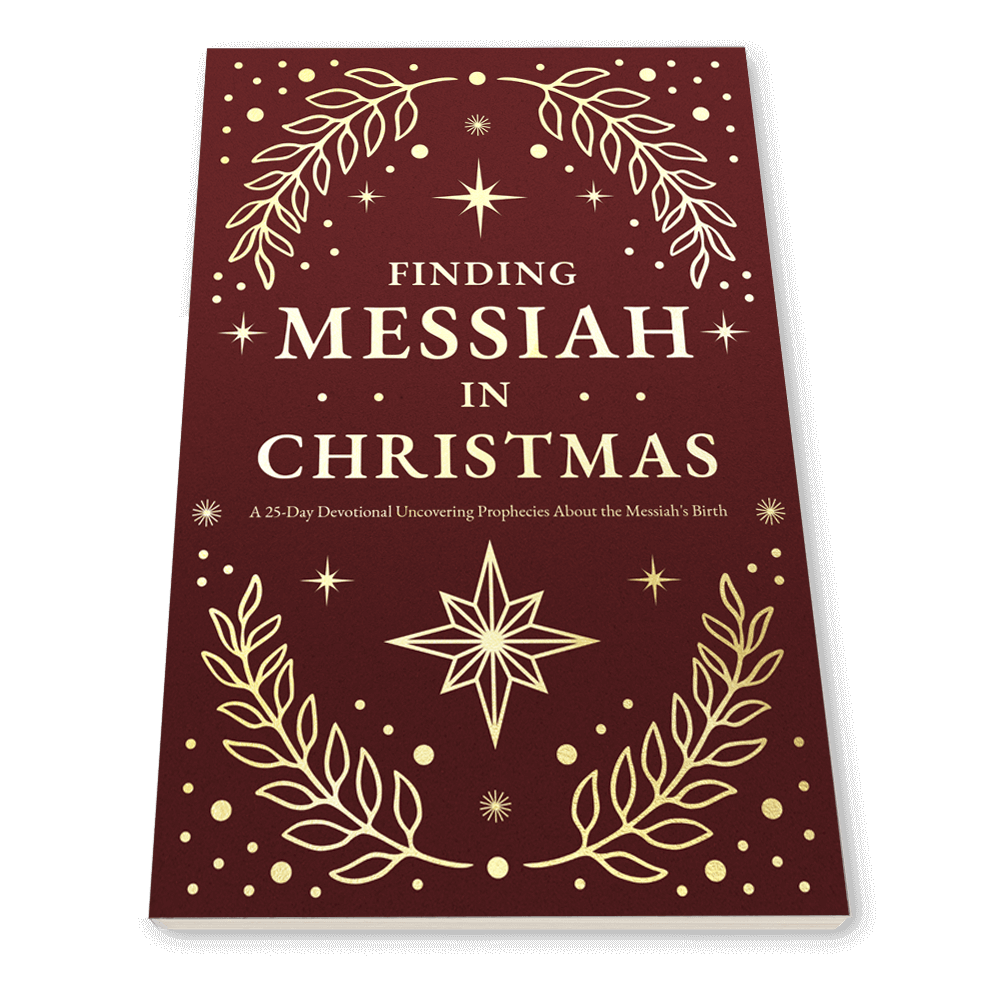
This Christmas season, take a journey through Scripture to understand the prophecies that foretold the Messiah's birth with our beautiful, 25-day devotional.
- Read unique stories of Jewish believers who celebrated Hanukkah with their families.
- Explore the Jewishness of Christmas from the homeland of the Jewish people.
- Deepen your faith as you connect the dots between the Old Testament prophecies and the New Testament fulfillment.
Apples of Gold: What Do You Think of the Messiah?
As a soldier, Zvi patrolled the dark streets of Jerusalem, where tension was high with neighboring Arab countries. Despite the threats, he trusted in the Lord and shared his testimony about the Messiah. One morning, he encountered a group of Orthodox Jewish students going to the West Wall and engaged them in a discussion about the rebuilding of the Temple and the coming of the Messiah. Zvi explained that the Messiah has already come and will come again, referencing Isaiah 53 and Psalm 22. The students, including a rabbi, were amazed by his words and lingered to discuss Messianic prophecies with him until nearly six in the morning.
Music
The Friends of Israel Today and Apples of Gold theme music was composed and performed by Jeremy Strong.
We need your help!
Would you please consider making a donation to help us continue this vital work and to reach more lives with the biblical message of God's heart for Israel and the Jewish people?


