

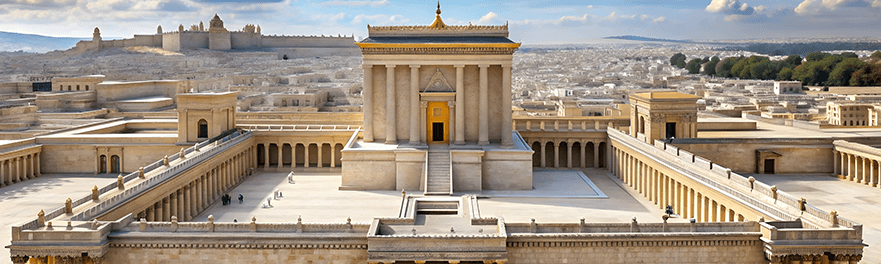
Temple Structure & the Gospel, Part 2 of 3:
In Ephesians 2, the apostle Paul laid out a brilliant truth—one best understood when we take note of the Second Jewish Temple’s structure. He explained that Gentiles, who were once far from God and didn’t know Him, now have access to Him through Jesus, the Son of God. But does this mean the special relationship the Jewish people have with God is now gone? Part 2 of our series on the Temple structure and the gospel digs into Ephesians 2 to explain how Christ gave Jewish and Gentile believers equal access to boldly approach His throne of grace.
Jewish people and Gentiles maintained their unique distinction and roles, but Christ tore down the “middle wall of partition” to allow Gentiles to become clean through His blood. The Holy Spirit was now poured out on Gentiles just as it was on Jewish people. What a beautiful, cherished truth for all Gentiles who faithfully seek to make Jesus the Lord of their lives! Tune in for more insight on the blessed lessons we learn from Ephesians 2!
If you missed Part 1 of this series, you can catch up here.
Steve Conover: Thank you for joining us for the Friends of Israel Today. I'm Steve Conover, executive director of The Friends of Israel. With me is our host and teacher, Chris Katulka.
Chris Katulka: Steve, it's great to be with you. We're going to continue our conversation today on the structure of the temple. The temple that stood during the days of Jesus and during the days of the Apostles. And we're going to look at how that temple was structured. We're going to continue this conversation to see how it limited access to the holiness of God, but ultimately through the blood of Christ, Christ opens that access for Jew and Gentile to approach him boldly. So we're going to continue our conversation on this in part two of temple structure and the gospel.
Steve Conover: We look forward to part two. But first in the news, Iran has managed to funnel about a billion dollars to Hezbollah this year despite heavy sanctions from the West that have ravaged its economy. John Hurley, the undersecretary for terrorism and financial intelligence, wants to cut off funding streams to Iran while it's in its weakened state, but says Iran remains committed to funding its proxy groups throughout the Middle East.
Chris Katulka: Well, Steve, here's my take. Despite Israel and America humiliating the largest state sponsor of terrorism, the Iranian regime remains committed to its agenda to eliminate Israel and to spread its influence throughout the Middle East. See, peace in the Middle East, it still seems very far away. So what does that mean for us as Christians? We keep praying for the peace of Jerusalem.
Chris Katulka: Last time, we began our series exploring the structure, architecture, and design of Herod’s Temple—the magnificent Jewish Temple that stood in Jerusalem during the days of Jesus. But more than studying the blueprints of an ancient building, we looked at how the Temple revealed God’s heart and His design for how people—both Jewish and Gentile—were to approach Him.
We talked about the remarkable archaeological discoveries that confirm the Temple’s historic reality—especially the “Temple Warning Inscriptions,” those limestone slabs found in Jerusalem that once surrounded the Temple sanctuary, warning anyone who was ritually impure—Jew or Gentile—not to enter the holier areas of the Temple. These inscriptions remind us that holiness and access were central themes in Temple worship.
We also traced the Temple’s layout, from the Holy of Holies at its center—where only the High Priest could enter once a year on the Day of Atonement, Yom Kippur—all the way out through the concentric courts: the Holy Place, the Court of the Priests, the Court of Israel, the Court of Women, and finally, beyond that wall that marked out the Court of the Gentiles. Each level represented a step further from God’s presence and a decrease in holiness or ritual purity.
These courts can sound restrictive, so I tried to compare these designs to everyday examples—like restricted hospital areas, limited backstage access, or the best example, the security levels of the White House—all of this to help us understand how the Temple functioned to protect the holiness of God’s presence. It was a sacred space built around the truth that the closer you approach a holy God, the more holy you yourself must be.
And yet, as we discovered, the Temple was not just about exclusion. Gentiles were invited to come near—to worship, to offer sacrifices, and to behold the God of Israel—though they couldn’t pass beyond that dividing wall that separated the Gentiles from where the Jewish people could go.
That’s where we left off, with the Apostle Paul’s powerful message in Ephesians 2, where he speaks of that “middle wall of partition” being torn down through the blood of Christ. Today, we’re going to explore exactly what Paul meant—how Jesus’ sacrifice made a way for both Jew and Gentile to be brought near, not through ritual purity or Temple boundaries, but through the cleansing power of His blood and the indwelling presence of His Spirit.
Now, if you didn’t get a chance to listen to last week’s program, be sure to visit foiradio.org to hear the first installment of this series, and again—you can listen to ten years of Friends of Israel content at foiradio.org.
Okay, so let’s go back to Ephesians 2, starting in verse 11, where the Apostle Paul is using the layout and structure of the Temple to talk about the power of Christ’s blood:
Ephesians 2:11–18
Therefore, remember that formerly you who are Gentiles by birth and called “uncircumcised” by those who call themselves “the circumcision” (which is done in the body by human hands)—
12 Remember that at that time you were separate from Christ, excluded from citizenship in Israel and foreigners to the covenants of the promise, without hope and without God in the world.
13 But now in Christ Jesus you who once were far away have been brought near by the blood of Christ. For he himself is our peace, who has made the two groups one and has destroyed the barrier, the dividing wall of hostility,
15 by setting aside in his flesh the law with its commands and regulations. His purpose was to create in himself one new humanity out of the two, thus making peace,
16 and in one body to reconcile both of them to God through the cross, by which he put to death their hostility.
17 He came and preached peace to you who were far away and peace to those who were near.
18 For through him we both have access to the Father by one Spirit.
Okay, so what’s so fascinating is that the Apostle Paul doesn’t simply collapse the distinction between Jew and Gentile here. He could have said, “Hey, guess what—these distinctions don’t matter anymore, let’s just move on.”
No, Paul highlights the state of the Gentile believers in Jesus prior to placing their faith in Him.
Before Jesus, Gentiles were excluded from Israel. They were foreigners to the covenants God made with Abraham, Isaac, and Jacob—the promises to King David, the promise of a New Covenant. They were without hope and without God in the world.
Listen, these Gentiles had gods—idols—but they had no concept of the God of Abraham, Isaac, and Jacob. No concept of the Jewish people, no concept of the Law, no concept of Israel. They were completely outside any understanding of the Temple, and the only reason they might ever go to Jerusalem was as tourists visiting the most magnificent structure, temple structure, in the Roman Empire.
But now, in Jesus—the Messiah of Israel—these Gentiles have placed their faith in the King of Israel. Now, because of their relationship with the God of Abraham, Isaac, and Jacob through Jesus, their hearts and minds are oriented, in various places around the Roman empire where Paul had been ministering, like in Ephesus, their hearts and minds are oriented toward Jerusalem and the Temple.
These Gentiles, who were once ignorant of all things Jewish—the Torah, the Law, the Hebrew Bible—are now awakening to everything God said in the Old Testament. Remember, the Old Testament is the Hebrew Bible. When Paul was writing to the church in Ephesus, there was no New Testament yet. The only book that they had was the Old Testament—the Hebrew Bible.
But here’s what’s important, and something we know from Acts 15: Gentile believers in Jesus were not required to become Jewish to follow Jesus.
So does that mean these new believers in Jesus who happen to be Gentile could make a pilgrimage to Jerusalem and walk all the way up to the Temple, but still be prevented from approaching the God of Abraham, Isaac, and Jacob? They would get all the way to the Temple and read the warning inscription on the wall that surrounded it: “Foreigners, stay out! You’re not allowed in here. Gentiles, you’re not allowed in.”
Are these Gentiles excluded from the promises and covenants God made to Israel and the Jewish people in the Old Testament?
Well, the Apostle Paul answers this in Ephesians 2:13:
“But now in Christ Jesus you who once were far away have been brought near by the blood of Christ.”
Gentiles have the same access to God now, in Jesus, that Jewish people did when the Temple stood. This is a radically new concept! Paul is talking about access to God in Christ, and the fact that these two groups—once diametrically opposed—are now one.
Again, this doesn’t mean Jewish people and Gentiles collapse into one another and both disappear. It means that in Christ, Jew and Gentile become one new man. They maintain their unique identities but form a new man who has equal access to God.
When we come back, we’re going to see exactly how Christ gave equal access to the Holy of Holies, calling Jewish and Gentile believers alike to boldly enter His throne of grace. Stick around!
Steve Conover: Each Christmas, our family looks for a devotional to read in the month of December, and I think Finding Messiah in Christmas is one of the best.
Chris Katulka: I absolutely love it, Steve. Finding Messiah in Christmas is a 25-day journey through Scripture leading right up to the birth of Jesus. But here's the thing, you'll want to get your copy before December 1st so that you can follow along day by day.
Steve Conover: It's perfect for personal reflection, family devotions, or even a small group. Each day examines Old Testament prophecies and reveals how they point to Jesus.
Chris Katulka: I also appreciate the stories from Jewish believers, the Hanukkah traditions, and a fresh look at the Jewish roots of Christmas.
Steve Conover: If you're like our family and you're looking for a devotional for Christmas this season, I highly recommend Finding Messiah in Christmas.
Chris Katulka: People, don't wait! Get your copy of Finding Messiah in Christmas today and start your journey December 1st. Go to foiradio.org. Again, that's foiradio.org to get your copy of Finding Messiah in Christmas.
Chris Katulka: Welcome back, everyone! We’re in the middle of our series exploring the structure, architecture, and design of the Temple—the magnificent Jewish Temple that stood in Jerusalem during the days of Jesus. But more than studying the blueprints of an ancient building, we’re looking inside the Temple—looking at how the Temple revealed God’s heart and His design for how people—both Jewish and Gentile—were to approach Him.
Now, we just looked at Ephesians 2:11–18 and explored it theologically. Biblically, Paul is arguing that in Christ and by His blood, Jew and Gentile have been reconciled. They are made one new man. Though they maintain their unique distinction and role, God equally values them, that’s the most important thing—that in Christ they have equal access to His presence.
If you listened to last week’s message, you’ll remember that the warning stone that stood in the Temple precinct didn’t just warn Gentiles not to enter—it also prevented unclean, impure Jewish people from entering. According to the Law, there were things in life that made Jewish people unclean, from the Old Testament, from the book of Leviticus. Some of those things are contact with a human or animal corpse, or certain skin diseases, certain bodily discharges, childbirth, or eating unclean animals. These things weren’t technically sins; they simply moved a person from being ritually pure to ritually impure—and that meant you couldn’t come to the Temple until you went through the process of becoming clean again.
Again, skin disease is not a sin, childbirth is not a sin, it's a blessing, certain aspects of life that we deal with on a day-to-day basis are not sins—it’s just a part of life. But even these things could keep you from entering beyond the barrier, that wall around the Temple that protected the holiness of God. However, according to the Law, and according to Jewish tradition especially during the days of Jesus, Jewish people had a way to become clean again. They had a process to become clean again.
Gentiles, on the other hand, were generally considered ritually impure in the eyes of first-century Jewish law and culture—they weren’t considered morally sinful. They were always in a state of being ritually impure. They were perpetually in a state of being unclean. That’s the way that they saw them. That’s why the warning inscription there at the temple said, “No foreigners allowed—you’ve come far enough. Stop.”
But see, something amazing happens when the Apostle Peter is at Simon the Tanner’s house in Joppa in Acts 10. Peter went up to the roof to pray, and while praying he became hungry and had a vision. It says, “Heaven opened, and a large sheet was let down to earth by its four corners, filled with all kinds of four-footed animals, reptiles, and birds.” Then a voice told him, “Get up, Peter. Kill and eat.”
Now remember, Peter is a good Jewish boy and this voice is asking him to eat unkosher, unclean food. And that is the reason that Peter responds, “No way, Lord! I have never eaten anything impure or unclean.” That kind of stuff that would keep you from accessing the temple.
But then the voice said something amazing and it should stick out to us always: “Do not call anything impure that God has made clean.” That's what it says in Acts chapter 10. “Do not call anything impure that God has made clean.” Now listen, God wasn't giving Peter permission to get up and go to McDonald's and grab a sausage egg McMuffin. I still believe Peter remained very Jewish throughout his life. I think he probably kept kosher in his life. God wasn't concerned about the food. His concern was for the Gentile world. Because just a few verses later, Peter is summoned right after he has this vision. He is summoned to Cornelius's house. Cornelius, the Centurion's house in Caesarea. And Caesarea is a very Gentile town where Jewish people normally wouldn't step foot. See, Cornelius was a God-fearing Gentile and he had received a vision earlier in Acts chapter 10 and an angel told Cornelius, “Go get Peter.”
And that's the reason why Peter had that vision and that's why the voice said to Peter, “Don't call anything impure that God has made clean.” That's the kind of language that kept Jews and Gentiles separated from accessing the temple. Clean and unclean, pure and impure. God was telling Peter, the good Jewish boy who would never have entered the city of Caesarea or eaten unkosher food, he said, “Go and speak to Cornelius about Jesus.” So Peter went, shared the gospel and Cornelius and his house were saved. In Acts chapter 10, starting in verse 44, it says, “While Peter was still speaking these words, the Holy Spirit came on all who heard the message. The circumcised believers, the Jewish believers, who had come with Peter were astonished that the gift of the Holy Spirit had been poured out even on Gentiles.”
The Gentiles and the Jewish people are now given equal access to become clean through the blood of Jesus, the Messiah.
Even Peter was surprised that the Holy Spirit had been poured out on the Gentile people. And that’s what helps us understand what Paul meant when he said the “middle wall of partition,” the “dividing wall of hostility,” has been torn down.
God is doing amazing things at this time to reveal exactly how he's giving access to Jew and Gentile alike to his presence and how we can boldly come to the throne of grace, not because we deserve it and not because we can even clean ourselves, but through the blood of Christ we are cleansed and Jew and Gentile alike, one new man, can walk right beyond that dividing wall. We could walk right beyond that warning inscription and come boldly before our holy God in prayer and in supplication. But we got to find out more exactly how that happens. And to do that, you're going to have to come back next week.
Steve Conover: Israel, on the verge of becoming a state, a teenaged Holocaust survivor arrives on her shores alone. His name is Zvi Kalisher. Little did he know his search for a new life in the Holy Land would lead him to the Messiah. Zvi, enthusiastic to share his faith, engaged others in spiritual conversations, many of which can be found in our magazine Israel My Glory. While Zvi is now in the presence of his Savior, his collected writings from well over 50 years of ministry continue to encourage believers worldwide. Now, Apples of Gold, a dramatic reading from the life of Zvi.
Mike Kellogg: We have lived in this neighborhood in Jerusalem for more than 35 years. I know most of my neighbors, and they know me. I try to help them in many ways, like making free repairs to their homes.
Recently an ultra-Orthodox family moved in. One day they came to me.
“Can you do us a favor?” the man asked. “This will be a great mitzvah for you.” Mitzvah means “good deed.”
“What can I do for you?” I replied.
“Our electricity is not working. Can you help us?”
So I went to help. While I was there, they spoke with me about what I believe and what their rabbis believe.
“I would be happy to give you some of our holy books so you can read what our rabbis say,” the man said.
I replied, “You are a good man. But I do not read such books. I read only the Holy Bible. I will not spend time reading fictional stories written by men who claim to be holy. Only one person is holy; and He is Almighty God.”
This family listened carefully. Then someone said, “Can you show us where the Bible talks about this man?” The Orthodox will not say the name Jesus.
I told them, “It will be my great joy to show you what the Bible says.”
So I opened my Bible to Isaiah 53, a chapter the ultra-Orthodox do not read because it is so clearly written about our Lord and Savior, Jesus Christ.
When I opened the chapter, they were surprised. “We have never read this,” one said.
“It is important to know what is written in God’s Word,” I said. “Yet many will not read this or teach it.”
This time I gave them the Bible so they could read Isaiah 53 for themselves. There it is written,
Surely He has borne our griefs and carried our sorrows; yet we esteemed Him stricken, smitten by God, and afflicted. But He was wounded for our transgressions, He was bruised for our iniquities; the chastisement for our peace was upon Him, and by His stripes we are healed (vv. 4–5).
Afterward, one asked, “About whom is this written?” And like many before him, he asked, “Why have we never read this before?”
“Please read what is written in Deuteronomy 6:13–15.” So they read:
You shall fear the LORD your God and serve Him. You shall not go after other gods, the gods of the peoples who are all around you (for the LORD your God is a jealous God among you), let the anger of the LORD your God be aroused against you and destroy you from the face of the earth.
“Do not follow the people around you,” I cautioned. “Follow only the Lord and what is written in the Bible. That way you will know the truth and not be led down the path of darkness.”
“But this one whom you believe,” one replied. “He is only for Christians.”
“He is for everyone,” I explained. “He was wounded for all of us, and the Lord laid on Him the iniquity of us all. The Bible does not say He was wounded only for Gentiles or only for Jews. He is for everyone who receives Him as personal Savior.”
We had a long conversation. Please pray it will someday bear much fruit.
Steve Conover: Thank you so much for joining us for today's episode of The Friends of Israel Today. Don't forget to get your copy of Finding Messiah in Christmas. More information can be found at our website, foiradio.org. Again, that's foiradio.org. Chris, where are we headed next week?
Chris Katulka: Yeah, Steve, we're going to wrap up our series on the temple structure and the gospel, and we're going to look primarily at what Jesus broke down. What was that middle wall of partition, that hostility that existed between Jews and Gentiles that prevented them from both equally having access to God's holiness? Well, we're going to look at exactly what the Apostle Paul was saying when the middle wall of partition, of hostility, was broken down, and I think it's going to be a fascinating study.
Steve Conover: Join us then. And as mentioned, our web address is foiradio.org. Again, that's foiradio.org. Our mailing address, that's FOI Radio PO Box 914, Bellmawr, New Jersey 08099. You can call us at (888) 343-6940. That's our listener line—(888) 343-6940. Today's program was engineered by Bob Beebe. Edited by Jeremy Strong, who also composed and performs our theme music. Lisa Small is our executive producer. Sarah Fern is our associate producer. The late Mike Kellogg read Apples of Gold. Our host and teacher is Chris Katulka. And I'm Steve Conover, executive director of The Friends of Israel. The Friends of Israel Today is a production of The Friends of Israel Gospel Ministry. Passion for God's Word. Compassion for God's Chosen People.
Finding Messiah in Christmas
This Christmas season, take a journey through Scripture to understand the prophecies that foretold the Messiah's birth with our beautiful, 25-day devotional.
- Read unique stories of Jewish believers who celebrated Hanukkah with their families.
- Explore the Jewishness of Christmas from the homeland of the Jewish people.
- Deepen your faith as you connect the dots between the Old Testament prophecies and the New Testament fulfillment.
Apples of Gold: He Was Wounded For Us All
Zvi often helped his neighbors, and one day was asked by a newly moved-in ultra-Orthodox family to fix their electricity, which led to a conversation about his faith. When the family quietly inquired about where the Bible speaks of the Person they would not name (Jesus), Zvi replied that he only reads the Holy Bible, not books written by men. He then directed the family to read Isaiah 53:4-5, a chapter often avoided by the ultra-Orthodox, which speaks of a suffering servant wounded for their transgressions. Zvi concluded by explaining that the One he believes in is for everyone, regardless of whether they are Jew or Gentile, as He was wounded for all who receive Him as their personal Savior.
Music
The Friends of Israel Today and Apples of Gold theme music was composed and performed by Jeremy Strong.
We need your help!
Would you please consider making a donation to help us continue this vital work and to reach more lives with the biblical message of God's heart for Israel and the Jewish people?


