


Mary's Song:
Do you have a favorite Christmas song? Many of us do, sometimes based on nothing more than its tune or the warm, holiday feelings it gives us. But the heart of many timeless Christmas carols is in their lyrics—unique expressions of love for the Savior born in a manger. Predating the carols we sing each December, the book of Luke records songs by three special people in the narrative of Jesus’ birth. Chris opens a three-part series on these songs by discussing Mary’s famous song in Luke 1 before she gave birth to Jesus.
Mary’s humble and grateful worship of the Lord highlight this song. But the meaning behind her praise matters greatly. Her words capture the heart of the Abrahamic Covenant and God’s faithfulness to His people, inviting all Israel and even the whole world to recognize that He was keeping His promise by sending the Messiah. Join us over the next three weeks, and experience a new love for the Bible’s own Christmas songs!
Steve Conover: Thank you for joining us for The Friends of Israel Today. I'm Steve Conover, executive director of The Friends of Israel. With me is our host and teacher, Chris Katulka.
Chris Katulka: As you reflect on God's goodness this holiday season, we want to invite you to join us in sharing His love with the Jewish people. See, when you financially give to the Friends of Israel, your gift becomes a testimony of the gospel in action—meeting needs, bringing comfort and pointing hearts to the Messiah. So here's what I want you to do. Visit foiradio.org and there you'll find a donate button. That way you can make a difference with the Friends of Israel today.
Steve Conover: Your financial gift, in a very real way, keeps us on the air teaching truth about Israel and the Jewish people all over this country. If Chris’ teaching and our regular interviews have ministered to you, consider giving to our ministry as you consider your year-end gifts. Again, that's foiradio.org. Chris, where are we headed today?
Chris Katulka: Yeah, Steve, we're going to start a three part series on the songs that Luke lays out in the very beginning of Luke in Luke chapter one and Luke chapter two. As we begin the Christmas season, that's when the songs begin to change, but really we don't even have to look to those particular songs like “Hark, the Herald Angels Sing” or "Joy to the World.” Actually, Luke gives us three important songs that were sung before Jesus was Born and one after Jesus was born: Mary, Zechariah, and Simeon. So we're going to be looking at those over the next three weeks.
Steve Conover: This is going to be great. We hope you stay with us. But first in the news X.com, formerly Twitter, released an update aimed at boosting transparency on the platform revealing the country or region an account is operating from. It's a simple change, but one that has already proven fruitful as dozens of accounts that claim to be an eyewitness in Gaza of the war turned out to be operating from Pakistan, Poland, the United Kingdom or Southeast Asia.
Chris Katulka: Well, Steve, here's my take. These so-called “citizen journalists” were telling lies to fuel global hatred toward Israel when in reality they were sitting on their sofas thousands of miles away deceiving millions about Israel's just war against Hamas. X says more transparency tools will be rolled out soon.
Chris Katulka: Well, my friends, it's already here. Christmas is upon us now in the Katulka family, the Christmas tree is up, the ornaments are properly placed, and the wishlists, well, they've all been filled out. But more important than the tree, lights, and gifts is the time that we're going to be using by turning our hearts toward the birth of Jesus. I'd like to give a shout out to my wife Karen, who designed a devotional for our family this Christmas season. We actually started it last night and it focused on Mary and the angel Gabriel's interaction in Luke chapter one starting in verse 28, and one of the monumental moments of Mary's interaction with Gabriel and the incarnation is her reaction that transitions from fear to confidence in the Lord, and that's the direction that Karen took our family last night.
Following Mary's moments of fear to confidence in the Lord, she opened her mouth and she poured out a song that we now call the Magnificat, which can be found in Luke 1:46-55, and that's what we're going to be focusing on this week. In fact, what's astonishing to see is that Mary wasn't the only one to write a song. Later in Luke chapter one, John the Baptist’s father Zechariah sings a song with the coming of his son and then later in Luke, Simeon sings a song in the temple at Jesus' dedication. This is what we're going to focus on in the next three weeks, the songs of Mary, Zechariah, and Simeon. But here's what I want you to see from all of these songs: all of them focus on the coming of the Messiah, Jesus and God's faithfulness to Israel by way of the promise that God made to Abraham back in Genesis chapter 12.
See, that's why Mary was not composing a new prayer. She was actually singing an old story, the oldest story she knew as a Jewish woman. Her words rise from the pages of Israel's Scriptures echoing the Psalms, the prophets, and especially the great promises God established with the patriarchs, Abraham, Isaac, and Jacob. Mary's song is the song of a young Jewish woman who knew that the baby in her womb had become the hinge of redemptive history. She understood that the promises made to Abraham were now being embodied,literally. In an age when Israel was weary under Roman rule and longing for deliverance, Mary's humble song would challenge the empires of the world and even stare down death itself. But to understand the power of her song, we must hear it through her ears and see it through her eyes. The eyes of a daughter of Abraham, a descendant of God's covenant people, Israel. Her Magnificat is not simply a personal expression of praise, it's a proclamation that the God who called Abraham, formed Israel, and promised a Redeemer had finally moved again in history.
Mary's song, therefore, is nothing less than the Abrahamic covenant prayed back to God. Mary begins by saying this,
“My soul glorifies the Lord and my spirit rejoices in God my Savior…”
Praise rises from her soul because she recognizes the God who is acting in her life. And this is not a vague deity or an anonymous spiritual force, it's the God of her fathers. Mary glorifies Yahweh, the covenant making and covenant keeping God of Israel. Every faithful Jewish person of Mary's day knew the covenant story. God chose Abraham out of obscurity, promised him descendants, a land, a blessing, and swore that through him all the families of the earth would be blessed. That's Genesis 12:1-3. See, Mary rejoices because that covenant once spoken under the desert stars now lives in her womb.
The God who had made himself known to Abraham as the exalted God, the shield and reward of Abraham in Genesis 15:1 was now acting as her Savior. Mary is not just praising God for his personal miracle, she's praising him because he's fulfilling the very promises that define Israel's destiny. See, Mary continues. She says,
“...for he has been mindful of the humble state of his servant.”
See, in those words, Mary connects her personal experience to Israel's corporate history. God's mindfulness is covenantal mindfulness. Just as he saw Abraham's faith, Sarah's barrenness, Hagar's tears, Israel's suffering in Egypt, and the longing of the prophets, so God also sees Mary. And in the Abrahamic Covenant, God pledges his ongoing attention and care: “I will establish my covenant to be God to you and to your offspring after you,” as God told Abraham in Genesis chapter 17:7. See, Mary sees herself inside that same condition, Israel under Roman oppression, longing for God to remember his covenant when she says, “God has been mindful of her,” she means God has been mindful not only of her but of Israel, the servant nation, as the prophet Isaiah calls Israel in chapter 41 of Isaiah. So as Mary said,
“From now on all generations will call me blessed,”
Not because Mary is exalted, but because God's covenant faithfulness has finally broken into history again and she stands at the center of its fulfillment. See, Mary exalts,
“for the Mighty One who has done great things for me—holy is his name. His mercy extends to those who fear him from generation to generation.”
That's what Mary says in this amazing prayer, this amazing song. The title “Mighty One" reaches deeply into Israel's Scriptures. It evokes the God who appeared to Abraham as El Shaddai, the Almighty, in Genesis 17:1. It reminds Israel of the God who acted with power on their behalf, delivering, rescuing and sustaining them.
Mary understands that the great things God has done for her are not disconnected acts, but the next movement in the long covenantal plan. God's holiness was proven by his faithfulness. What he promised, he performed. See, “his mercy from generation to generation” echoes the covenant refrained spoken again and again in the Torah. “I will remember my covenant. I will bless your descendants. My steadfast love will not depart from you.” All of these amazing verses from the Torah, from the Old Testament. See, Mary sees in her pregnancy the continuation of that ancient mercy. Mercy that didn't forget Abraham, Isaac and Jacob or David or the remnant of Israel that's now longing for redemption. See, Mary sings this,
“He has performed mighty deeds with his arm; he has scattered those who are proud. He has brought down rulers but has lifted up the humble.”
I love this. You know why? This is covenantal justice. Every line that Mary says echoes the Abrahamic promise that “God would bless those who bless Israel and curse those who curse her”—Genesis 12:3. See, throughout Israel's history, God scattered the proud—Pharaoh, the Canaanite kings, the Assyrians, the Babylonians, the Greek kings. He brought down empires and lifted up his humble people. Mary sees her world through that same exact pattern. Rome's power, Herod's cruelty, and Israel's humiliation will not have the final word. God is reversing the story once again, and Mary's confidence in these reversals is rooted in Israel's prophetic expectation. The Messiah would indeed bring down arrogant rulers and exalt the humble remnant. What Mary sees is that God has begun to do this through the child that she carries, the promised Son of David, the one in whom the Abrahamic covenant will ultimately find its fulfillment. She goes on,
“He has filled the hungry with good things, but has sent the rich away empty.”
See, her line recalls Israel's wilderness experience where the covenant God fed his people with manna, water from the rock, and his sustaining presence. The Abrahamic covenant wasn't only about land and descendants, it was also about God's daily provision for his people. He didn't merely make promises; he sustained his people while the promises were unfolding. The “hungry” in Mary's song are those who depend on God, those who fear him, trust him and long for him. The “rich” in contrast represent those who trust in their own strength and dismiss God's promises like the nation surrounding Israel and even Israel's own unfaithful kings. See, to be filled or emptied is not merely economic, it's spiritual. Those who receive the covenant of God receive abundance. Those who reject him experience emptiness. Through her unborn son, Mary knows God is beginning his great act of filling and emptying, restoring Israel and preparing to bless the nations. Now listen, we're going to take a quick break and when we return, we're going to look at the climax of Mary's song and what stirred her to write the Magnificat.
Steve Conover: The 2026 Israel in Focus, Pray for Israel Calendar is here and it's the perfect way to start the new year.
Chris Katulka: Steve, I saw it. It's beautiful. Each month features powerful Scripture-based prayer that's focused for Israel and the Jewish people with really stunning photos from the Holy Land.
Steve Conover: This calendar's unique in that it serves as a daily reminder to pray for the peace of Jerusalem, safety for IDF soldiers, or hope for Holocaust survivors.
Chris Katulka: It's a really great way to faithfully pray for God's Chosen People all year long.
Steve Conover: Each month has such a beautiful image that I know you'll enjoy it all year.
Chris Katulka: So whether it's for your home, office, or a gift for someone you love, get the 2026 Israel in Focus, Pray for Israel Calendar today and start your 2026 with prayer. Get your Israel in Focus 2026 calendar at foiradio.org. Again, that's foiradio.org.
Chris Katulka: Welcome back, everyone. Over the next three weeks, we're singing songs during Christmas, but not the traditional songs like “Hark the Herald", or "Joy to the World.” Now, don't get me wrong, they're great, but Luke, the gospel writer, shares with us three songs that were sung leading up to Jesus' birth and one after his birth. These are Luke's Christmas songs and they include Mary's song, Zechariah's song, and Simeon's song. Now, at the end of the last segment I wanted to share about the climax of Mary's song, the climax of her song is unmistakably covenantal. “He has helped,” she said,
“He has helped his servant Israel, remembering to be merciful to Abraham and his descendants forever just as he promised our ancestors.”
Here Mary takes us back 2000 years to a quiet night when an old man named Abram who would become Abraham looked up at a sky full of stars. God had promised him descendants. God promised him a land, the land of Israel, and a worldwide blessing that he would be the one to bring blessing to all the families of the earth. See, God swore by his own name to uphold his promise, he established a covenant that would extend forever, not only to Abraham, but to his descendants. For generations, Israel held onto that promise, through slavery, through wilderness, monarchy, exile, and even oppression. Prophets reminded them that God would not forget. Psalms celebrated his covenantal love. The faithful remnant prayed and waited for the Messiah who would finally restore Israel, and now Mary sings, “It's happening.” God is helping Israel, his servant, his Chosen People. He is remembering his mercy, his covenant loyalty, which is the Hebrew word hesed. He is honoring his oath and promise that he swore to Abraham, Isaac, and Jacob. Mary sees her child as the covenant child, “the promised seed”, as Paul says in Galatians 3:16. The One through whom the nations will be blessed. The One who will sit in the future on David's throne. The One who will bring salvation to Israel and light to the Gentiles.
Her Magnificat, this song that she's singing here in Luke chapter one, is the Abrahamic Covenant in melody form. It's in a song. Mary's not merely celebrating her personal blessings, she's narrating the story of Israel's redemption. Every line of her song is rooted in covenant promise. “God's mindfulness of her humble state” is his mindfulness of Israel. “God's mighty deeds” are the same mighty deeds he worked for Abraham and his descendants. “God's reversals” are foretastes of the Messianic age promised to Israel. The “fulfillment of the hungry” echoes God's sustaining care in the wilderness. “God's help to Israel” is the fulfillment of his oath to Abraham. Mary is standing at the turning point of redemptive history where the promises move from anticipation into incarnation. Her song announces that the God of Abraham has returned to his people. The Abrahamic covenant was never only for Abraham's household though, it was always for the world.
He's always had you in mind, in me. “In you, all the families of the earth will be blessed.” See, Mary intuitively grasps this and she knows it. The birth of the Messiah is not merely the consolation of Israel. It is the means by which God will bring his mercy to the nations. When Mary sings of God scattering the proud, feeding the hungry, and upholding mercy forever, she's describing not only Israel's story, but also the world's future. The Messiah she carries will open the way for Gentiles to join the family of Abraham, not by birth, but by faith. Mary's prayer is the hinge between the Old covenant promises and the New covenant blessings. What God began with Abraham, he will now complete in the son Mary bears. Mary's Magnificat, the song that she sings of praise, is the most profound expression of covenant hope that can be found in the New Testament.
It captures the heart of the Abrahamic promise, the longing of Israel, the dawning of the Messianic age. Her prayer tells the truth about God. He remembers. He keeps his promises. He lifts up the humble. He fills the hungry. He rescues his people and through the covenant he made with Abraham, he blesses the world. As Mary sings, she invites all Israel and ultimately all nations to see that God has not forgotten. The covenant is alive. The Messiah has come. Her prayer is the anthem of God's covenant faithfulness breaking into human history. Her voice is the voice of the Abrahamic promise becoming flesh. Her womb is the cradle of redemption, and in her song, the God of Abraham is glorified forever.
Steve Conover: Now, Apples of Gold, a dramatic reading from the life and ministry of Holocaust survivor, Zvi Kalisher.
Mike Kellogg: After living in Israel for 36 years, many know me. Some greet me with “Shalom!” Others say something like, “Are you still alive? People like you should be dead!”
When I received one such greeting recently, I replied, “No, my dear, that is not so. It is written, ‘I shall not die, but live, and declare the works of the Lord’” (Ps. 118:17).
“What can you, a Christian, possibly tell me about the Lord?” he asked.
I said, “The Lord has given me salvation, love, and peace in my heart through His Holy Spirit. This is why the Lord has kept me alive—through the Holocaust and four wars here in Israel—so that I can tell others of His mighty deeds.”
He then said “You want me to accept this new faith that you believe in—your Jesus?”
I responded, “The Lord Jesus did not come to make a new faith. He came to give us everlasting life through His suffering.”
“I know all about His suffering,” he said sarcastically.
I then asked, “Would you like me to read about His suffering?” He agreed, so I read Isaiah 53, “the forbidden chapter” for Jewish people. Suddenly this man who was so sure of himself was now interested in hearing about the Lord.
Such people have spent their entire lives listening only to their revered rabbis and reading many books of tradition. So when I present facts from the Bible, they become curious and want to hear more. It is important to articulate that Christians do not believe in a new faith, but in the one true God.
People walked by as we conversed, and one man said, “Israel is not the right place for a Christian. If you want to speak about Jesus, go somewhere else, but do not do it here!”
I had never met people with such deep hatred for those of us who believe in the Lord Jesus.
They kept repeating, “Jesus came to make a new faith, and because you believe in Him you have left the faith of our fathers.” I told them, “If you would read the Bible instead of your books of tradition, you would see this is untrue.”
One said, “You are talking about the New Testament, but that does not belong to our Holy Bible.”
I told him, “Jeremiah 31:31 says, ‘Behold, the days are coming when I will make a new covenant with the house of Israel and with the house of Judah.’ The term “New Testament" is actually the Hebrew phrase brith Hadasha. Jesus said ‘Do not think that I came to destroy the Law or the
prophets. I did not come to destroy but to fulfill. Till heaven and earth pass, one jot or one tittle will by no means pass from the law till all is fulfilled’” (Mt. 5:17–18).
Surprisingly, all were listening closely, so I asked, “Do you still think Jesus came to make a new faith? Or do you realize He came to fulfill the Hebrew Scriptures? We must have faith in Him, or we will be lost forever.”
One replied, “Reluctantly, we must admit you are right.” I told them, “Now, through the love of the Lord, we can speak together as friends. Strive to learn more about the Lord and His great love for all people, and you will be able to stand against the false teachers who abound in our midst.”
They all responded, “Amen.”
Steve Conover: Thank you so much for joining us for today's episode of The Friends of Israel today, Chris, where we headed next time?
Chris Katulka: Yeah. We looked at Mary and we saw how before Jesus' birth, Mary was seeing the culmination, the fulfillment of what God had promised to Abraham in Jesus. Well, guess what? Zechariah is going to do the same thing. Going back to that promise that God made to Abraham in Genesis chapter 12, and seeing the fulfillment of it, not only in the birth of his own son, John the Baptist, but ultimately in the coming of Jesus the Messiah.
Steve Conover: We hope you join us next week. Until then, have a great week. As mentioned, our web address is foiradio.org. Again, that's foiradio.org. Our mailing address is FOI Radio PO Box 914, Bellmawr, New Jersey 08099. Once again, that’s FOI Radio PO Box 914, Bellmawr, New Jersey 08099. You can call our listener line. That number is (888) 343-6940. Once again, that’s (888) 343-6940. Today's program was engineered by Bob Beebe, edited by Jeremy Strong, who also composed and performs our theme music. The late Mike Kellogg read Apples of Gold. Lisa Small is our executive producer. Sarah Fern is our associate producer. Chris Katulka is our host and teacher. And I'm Steve Conover, executive director of The Friends of Israel. The Friends of Israel Today is a production of The Friends of Israel Gospel Ministry. Passion for God's Word. Compassion for God's Chosen People.
2026 Israel in Focus Calendar
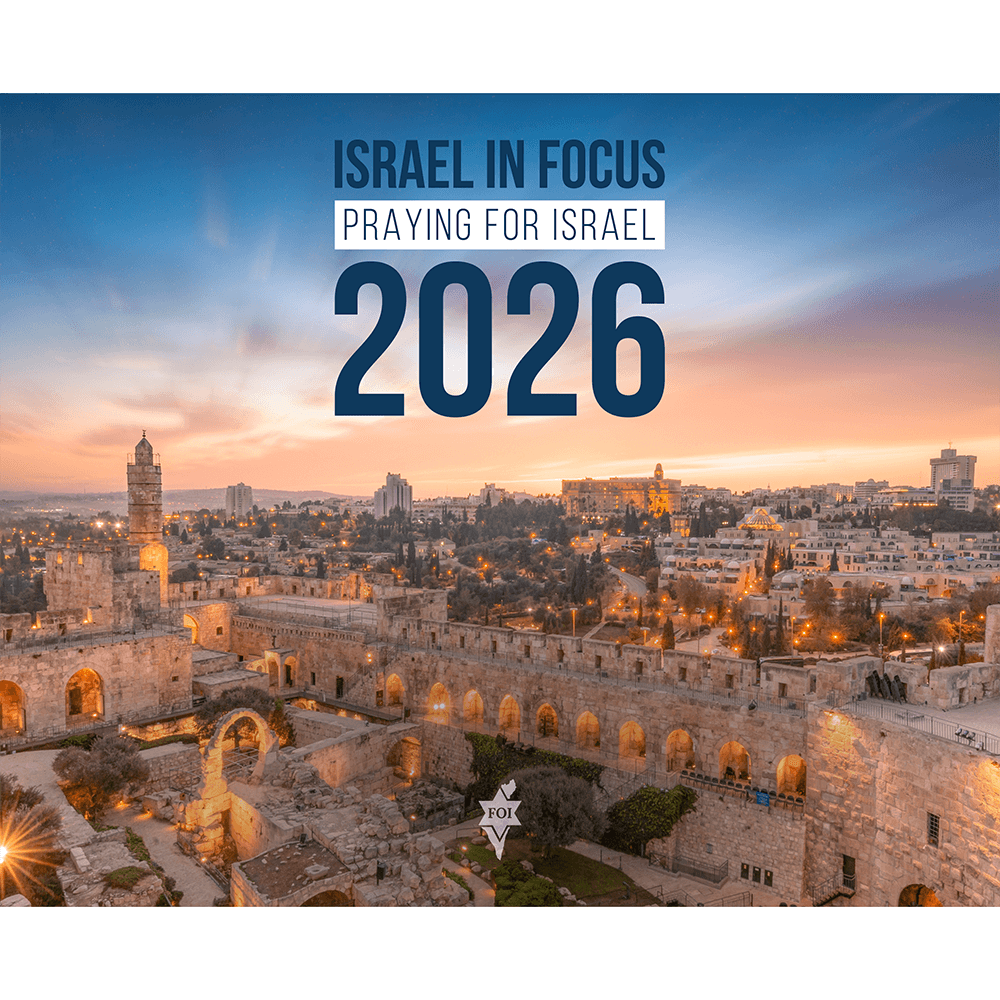
Pray purposefully through 2026 with our Praying for Israel calendar!
Each month highlights a powerful prayer focus for Israel and the Jewish people—rooted in Scripture and paired with stunning images from the Land of the Bible. Whether you're praying for peace in Jerusalem, safety for IDF soldiers, or hope for Holocaust survivors, this 12-month calendar will guide your heart and prayers with purpose. Be reminded daily of God’s promises and stand faithfully in prayer for His Chosen People throughout the year!
Apples of Gold: How Can We Believe in Jesus and Still Say That We Are Jews?
After 36 years in Israel, Zvi was instantly recognized, some greeted him warmly, but others scorned and ridiculed him. One passerby stopped him in shock, exclaiming, "Are you still alive? People like you should be dead!" When Zvi responded by sharing his faith in Jesus, the man immediately accused him of following a "new religion." With an audience gathering, Zvi firmly explained that belief in Jesus was not a new innovation, but a truth that God had already spoken of in the Hebrew Scriptures. Listen to find out how the crowd responded.
Music
The Friends of Israel Today and Apples of Gold theme music was composed and performed by Jeremy Strong.
Partner with us!
As you reflect on God’s goodness this holiday season, we invite you to partner with us in sharing His love with the Jewish people. Your financial gift is essential—it ensures we stay on the air, teaching biblical truth about Israel and the Jewish people. If this program has ministered to you, please consider making a gift today.


