


Simeon's Song:
The third and final Christmas song of Luke’s gospel belongs to Simeon, a righteous man who met baby Jesus at the Temple. Simeon’s life was marked by waiting—not in passive resignation, but in faithful expectation rooted in the promises God made to Abraham that He would bless the world. Simeon’s song reflects this theme, as he found joy in recognizing Jesus as “the consolation of Israel”—the long-awaited fulfillment of God’s promise to the Jewish people.
Once Simeon saw Jesus, His life’s purpose was complete. He saw the fulfillment of the Abrahamic Covenant’s promised blessing—the prophesied Son of David who would accomplish God’s redemptive purposes. Simeon’s words remind us that God always keeps His Word in amazing ways. Salvation had come in human form as the Son of God. Let Simeon’s song repeat this truth in your mind this Christmas season as we celebrate our Savior’s coming!
If you missed the first two parts of this series, you can find them in our archives.
Steve Conover: Thank you for joining us for the Friends of Israel Today. I'm Steve Conover, executive director here at the Friends of Israel Gospel Ministry. With me as our host and teacher, Chris Katulka.
Chris Katulka: Steve, I'm so glad to be here. I'm so glad to be speaking with our listeners. I'm so thankful that you've been able to connect with us at The Friends of Israel Today, and as you reflect on God's goodness this Christmas season, Steve and I want to invite you to join us in sharing his love, God's love, with the Jewish people. When you give financially to The Friends of Israel, your gift becomes a testimony of the gospel in action. Meeting needs, bringing comfort and pointing hearts to the Messiah Jesus. Visit foiradio.org because there you'll find a donate button to make a difference today.
Steve Conover: And your financial gift keeps us on the air, teaching truth about Israel and the Jewish people all over this country's airwaves. If Chris’ teaching and our regular interviews have ministered to you, consider giving to our ministry as you consider your year-end gifts.
Chris Katulka: Steve, today on the program we are wrapping up our series on the 3 Songs of Christmas and we're not talking about Christmas carols. We're actually talking about the three songs that can be found in Luke chapter one and Luke chapter two. Now we've already looked at the two songs that were sung by Mary and Zechariah prior to Jesus' birth. Well, today we're going to wrap up our series by listening to Simeon's song that comes from Luke chapter two, where Simeon encounters salvation right before his very eyes.
Steve Conover: But first in the news we're really devastated to bring this to you. Authorities have identified the gunman behind the terror attack who killed at least 15 people during a Hanukkah celebration in Australia on Sydney's Bondi Beach. Naveed Akram, 24, and his father, Sajid Akram, 50. The two had been investigated in 2019 for reported ties to ISIS but cleared after six months.
Chris Katulka: Steve, here's my take. This is really hard to say, but this is actually one of Australia's deadliest shootings in their history and it's linked to the deadliest antisemitic massacre outside of Israel since October 7th, 2023. I really think it's time for Western nations to wake up.
Chris Katulka: Well, my friends, Christmas is upon us. We just lit the third advent candle in our church and it's a candle that often symbolizes joy, marking a joyful pause as Christmas nears, representing the happiness of the shepherds who first heard the news of Jesus' birth and the overall delight in the Messiah's arrival. Lighting that third candle also means we're getting close to the birth of Jesus. Now, we're not following advent candles in our messages, but we are focusing this Christmas series on three individuals from the gospel of Luke who sing songs in response to the birth of our Savior, the songs of Mary, Zechariah, and Simeon.
But here's what I want you to see from all of these songs, all of them focus on the coming of the Messiah, Jesus, but all of the songs are grounded in God's faithfulness to Israel by way of the promise that God made to Abraham all the way back in Genesis chapter 12. Now, last week we went through Zechariah's song, which is famously called the Benedictus, and I stressed that Zechariah's song is all about Jesus's birth as a sign that God is acting on behalf of Israel, that God didn't forget his eternal covenant with Abraham, Isaac, and Jacob. Through Jesus, God would rescue Israel from their enemies and even more importantly from their sin and bring deliverance to the entire world. Now, the week before that we talked about Mary's song, the Magnificat, and once again, we saw how God chose the humble to bring his glory into the world and how Mary considered herself blessed by God to be the conduit of his blessing by remembering the promise, the oath that God swore to Abraham, Isaac, and Jacob. Again, Mary grounding her song in Genesis chapter 12.
Now, if he didn't get a chance to listen to last week's program, you can always go back and listen at foiradio.org. Today we're turning our attention to Simeon's song in Luke chapter two, starting in verse 22. Simeon, he stands at the threshold of fulfillment. Mary and Zechariah praised God before the birth of Jesus. Now, Simeon praises God after the birth of Jesus. Luke describes Simeon as a righteous and devout man. One who lived with his eyes fixed forward waiting for what the scriptures called the “consolation of Israel.” That phrase alone places Simeon squarely within the long covenant story, that covenant that God made to Abraham. The constellation of Israel is not vague comfort or private peace, it's the promised restoration of God's people—the moment when the covenant God would act decisively to redeem, restore, and to vindicate Israel. Simeon's entire life is shaped by waiting, waiting, not in passive resignation but in faithful expectation, rooted in the promises that God made to Abraham and reaffirmed through men like Moses, David, and the prophets.
See, Luke tells us the Holy Spirit was upon him, guiding his hope and anchoring his patience in divine promise rather than simply human speculation. Simeon's waiting is covenantal waiting. He lives with the awareness that God had sworn an oath to Abraham, that his descendants would be blessed and that through them blessing would flow to all the nations. Yet Israel's history has been marked. It's been marked by suffering, exile, and even foreign domination.
See, under Roman rule, the longing for consolation, the one that Simeon had talked about that consolation had grown even sharper. To wait for Israel's consolation was to believe that God had not abandoned his covenant. That he would yet send his Messiah and that redemption would come not merely as political relief, but even more important as covenant renewal. Simeon waits because he trusts that God remembered his promises, and Luke emphasizes that Simeon's hope is not self-generated.
The Holy Spirit reveals to him that he will not see death before he sees the Lord's Messiah. This promise transforms Simeon's waiting into certainty. His life now moves toward a fixed horizon. The encounter with God's salvation in human form. When the Spirit moves him into the Temple courts on the very day Mary and Joseph bring Jesus for the rights required by the law, Simeon recognizes what others might overlook in a poor Galilean couple. Carrying an infant, Simeon sees the culmination of centuries of promise, his faith. It's not dependent on appearances but on the faithfulness of God. See, when Simeon takes the child Jesus into his arms, the weight of Israel's story rests there as well. He holds not only a baby, but the embodiment of God's covenant faithfulness. His response is worship. “Sovereign Lord,” he says, “as you have promised, you may now dismiss your servant in peace.”
Simeon's first words are directed to God who keeps his promises. The fulfillment of the promise releases Simeon from waiting. His life's purpose, complete. The peace he speaks of is not merely personal serenity. It's actually shalom—the deep wholeness that comes from seeing God's Word fulfilled. Simeon can now depart this life because the covenant has moved from anticipation to realization. God has done exactly what he said he would do. And that's why Simeon continues, “For my eyes have seen your salvation.” Salvation for Simeon is not an abstract concept or just a future hope, it's something he can see, touch and hold. See, the Hebrew Scriptures repeatedly described salvation as God's concrete action on behalf of his people, rescuing them, redeeming them, and restoring them. Simeon understands that salvation has not arrived in the form of any army or political decree, but as a child consecrated in the Temple. This salvation is personal and national at the same time.
Simeon sees that God's saving work is unfolding in a way that honors the covenant, yet surpasses Israel's expectations. He declares that, “This salvation has been prepared in the sight of all nations.” This is a crucial statement, my friends. See, Simeon doesn't want God's work to be seen as hidden or limited. The covenant with Abraham always carried a global horizon. It was always global in the way that God laid out the promise that he made to Abraham. From the very beginning, God promised that through Abraham's seed, all the families of the earth would be blessed. Israel was chosen not as an end in itself, but as the means through which God would bring redemption to the world. Simeon understands that the arrival of the Messiah marks the moment when that promise begins to be fully realized. What God is doing for Israel is something he intends the nations to witness and ultimately to share in as well.
Simeon's next words, they actually make explicit what has been implicit throughout Israel's Scriptures. The child he is holding is “a light for revelation to the Gentiles and the glory of your people, Israel.” This is not a contradiction but covenantal harmony. Why harmony? Because Israel's glory and the Gentiles' illumination are inseparably linked. Israel's calling was to be a light to the nations, to embody God's truth in righteousness so that the world might know him. Yet Israel often struggled to fulfill that calling. Simeon now sees that Israel's glory is concentrated in this child. Jesus's mission fully aligned with God's purposes. Through Him, the light that was entrusted to Israel now shines outward to the Gentiles. For Simeon, this revelation does not diminish Israel's place in God's plan, it confirms it. The Messiah is the glory of Israel precisely because he will fulfill God's covenant to Abraham. He is the promised seed of Abraham, the son of David, the faithful servant through whom God's redemptive purposes reach their climax.
The inclusion of the Gentiles is not a deviation from the covenant, but its expansion according to God's original design. Simeon holds together what later generations try to separate. That's called replacement theology. But instead what we see through Simeon is God's enduring commitment to Israel and his gracious invitation to the nations. Luke tells us that Mary and Joseph marvel at what Simeon says. They already know that this child is special, but Simeon's words situate their son within the vast sweep of redemptive history. The marvel is appropriate because Simeon has articulated something breathtaking. The salvation of God has arrived and it will reorder the world as God sees it. Now when we come back, we're going to see how Simeon's song moves from praise to prophecy, so stick around.
Steve Conover: The 2026 Israel in Focus, Pray for Israel Calendar is here and it's the perfect way to start the new year.
Chris Katulka: Steve, I saw it. It's beautiful. Each month features powerful Scripture-based prayer that's focused for Israel and the Jewish people with really stunning photos from the Holy Land.
Steve Conover: This calendar's unique in that it serves as a daily reminder to pray for the peace of Jerusalem, safety for IDF soldiers, or hope for Holocaust survivors.
Chris Katulka: It's a really great way to faithfully pray for God's Chosen People all year long.
Steve Conover: Each month has such a beautiful image that I know you'll enjoy it all year.
Chris Katulka: So whether it's for your home, office, or a gift for someone you love, get the 2026 Israel in Focus, Pray for Israel Calendar today and start your 2026 with prayer. Get your Israel in Focus 2026 calendar at foiradio.org. Again, that's foiradio.org.
Chris Katulka: Welcome back everyone. We're wrapping up our Christmas series where we're singing the songs all about Christmas and it's not the traditional songs like “Hark, the Herald Angel Sings” or "Joy to the World.” They're great songs, but see, Luke, the gospel writer, shares with us three songs that were sung leading up to Jesus's birth and one after his birth. They are Luke's Christmas songs and they include Mary’s song, Zechariah's song and Simeon's song. We just left off where Simeon's focus turns from praise to prophecy. Simeon's blessing to Mary and Joseph also speaks words that carry a sober edge. This child is destined to cause the falling and rising of many in Israel and to be a sign that will be spoken against.
Simeon understands that the fulfillment of the covenant will not be universally welcomed. Israel's history shows that God's redemptive acts often provoke resistance. The Messiah will reveal hearts, expose false securities, and challenge entrenched expectations. Some in Israel will stumble over him because he doesn't conform to their visions of power or triumph in the moment. Others will rise because they recognize him as the true fulfillment of God's promises. The covenant always has this effect. God's Word brings blessing and judgment, salvation and exposure. The Messiah will force a reckoning within Israel revealing who truly trusts in God's promises and who relies on status, tradition, or even self-righteousness. Simeon sees that the consolation of Israel will not come without cost, struggle and division. Yet even this painful process is part of God's redemptive work, refining his people and bringing them into deeper faithfulness. Simeon's final words to Mary are actually very deeply personal. “And a sword,” he said, "will pierce your own soul too.”
Mary, who had already sung of God's covenant faithfulness is now reminded that fulfillment will involve suffering. The promises to Abraham did not unfold without hardship and neither will the mission of the Messiah. Mary will experience the pain of seeing her son Jesus rejected, opposed and ultimately crucified, and yet Simeon's words do not negate the promise. They deepen it. Redemption comes through suffering, and glory emerges through sacrifice. The covenant is fulfilled not by bypassing pain, but by redeeming it. Simeon's encounter with Jesus in the temple brings Luke's opening sequence of songs to a fitting close. Mary sings of God's covenant faithfulness breaking into history. Zechariah proclaims the oath sworn to Abraham now being fulfilled through redemption and restoration. And Simeon, at the end of his life, holds the promise in his arms and declares that God's salvation has arrived for Israel and the nations. Together, these songs form a theological symphony.
Each voice harmonizing around the central truth that God remembers his covenant with Abraham and acts in faithfulness to His word. Simeon’s song is the quiet confidence of a man who has seen enough to die in peace. His waiting is over because God's waiting is over. The long silence has been broken. The consolation of Israel has come, not as Israel expected, but exactly as God promised. In Jesus, God acts on the covenant he established with Abraham. The blessing promised to the nations begins to flow. Israel's glory revealed. The light shining in the darkness. And a righteous man having seen salvation with his own eyes can finally rest. In Simeon's words, we hear the voice of a faithful Israel at peace. The covenant has not failed. The promise has not been delayed forever. The God of Abraham has kept his word and in the arms of an old man in the Temple courts, salvation has taken flesh.
Steve Conover: Israel, on the verge of becoming a state, a teenaged Holocaust survivor arrives on her shores alone. His name is Zvi Kalisher. Little did he know his search for a new life in the Holy Land would lead him to the Messiah. Zvi, enthusiastic to share his faith, engaged others in spiritual conversations, many of which can be found in our magazine Israel My Glory. While Zvi is now in the presence of his Savior, his collected writings from well over 50 years of ministry continue to encourage believers worldwide. Now, Apples of Gold, a dramatic reading from the life of Zvi.
Mike Kellogg: We are approaching Christmas, and during this time of year, some ultra-Orthodox men like to mock me. They do not like Jewish people who have placed their faith in Christ. One morning they greeted me sarcastically, “Congratulations to you, Zvi!”
I already knew what they would reply when I asked, “Why are you congratulating me?”
“You do not know?” one mocked. “Your God is born!”
“You are going against yourselves,” I replied.
“What do you mean?” one asked.
I replied, “You call yourselves the Chosen People of God, but you do not obey God. Isaiah 2:3 says, ‘For out of Zion shall go forth the law, and the word of the LORD from Jerusalem.’ But look at what is going out of Zion! You are not spreading the truth about God because you do not understand it, even though you read it every day in your synagogues.”
Now they wanted to know what I meant because they realized I was not
speaking about the New Testament. So I gave them my Bible and said, “Please, read Deuteronomy 6:13–15.”
There it is written, You shall fear the LORD your God and serve Him. You shall not go after
other gods, the gods of the peoples who are all around you (for the LORD your God is a jealous God among you), lest the anger of the LORD your God be aroused against you and destroy you from the face of the earth. They were surprised. “How do you read our Bible and yet believe in This Man? Show us where it is written in the Bible about your God,” one said. So I opened the Bible to Isaiah 53.
They read: He is despised and rejected by men, a Man of sorrows and acquainted with grief. And we hid, as it were, our faces from Him; He was despised, and we did not esteem Him. But He was wounded for our transgressions, He was bruised for our iniquities; the chastisement for our peace was upon Him, and by His stripes we are healed. All we like sheep have gone astray; we have turned, every one, to his own way; and the LORD has laid on Him the iniquity of us all” (vv. 3, 5–6).
They all looked at one another. One asked, “About whom is this written?” The older men tried to persuade the younger ones to leave. But the younger ones persisted to know about whom this passage was written. “About This Man,” I replied. “And not only here, but in other places of the Bible as well.” So I showed them Zechariah 9 and Isaiah 9:6–9.
The students turned to their teachers and asked, “Why have we never heard about this? Why have you never taught us what is in our Bible?” The older teachers were extremely unhappy and tried to find a way to discredit me. One demanded, “Zvi! Show us where it is written that the
Messiah was born in Bethlehem!”
I replied, “Read Micah 5:2. But read aloud so your young pupils will know the truth.”
Micah 5:2 says, “But you, Bethlehem Ephrathah, though you are little among the thousands of Judah, yet out of you shall come forth to Me the One to be Ruler in Israel, whose goings forth are from of old, from everlasting.”
The young men now had many more questions for their teachers, who were not happy. The students thanked me for speaking with them. “We will come again and ask you more questions,” one said.
I pray they will believe according to the Bible so they will know the Lord personally. Then they, too, will appreciate this wonderful time of year and celebrate the birth of the Jewish Messiah who came to redeem us from sin, as prophesied in the Hebrew Scriptures.
Steve Conover: Thank you for joining us for today's episode of The Friends of Israel Today. Chris, next week is the last program of 2025. Where are we headed?
Chris Katulka: Well, Steve, depending on who you are and your background, you may view Jesus differently. It was the same in Jesus's time too. So for the next few weeks, we're going to look at three perspectives on Jesus: the Romans, the religious leaders, and the people of Israel.
Steve Conover: We look forward to it. On behalf of the entire Friends of Israel Radio team, we wish you a very Merry Christmas. As mentioned, our web address is foiradio.org. Again, that’s foiradio.org. Our mailing address is FOI Radio, PO Box 914, Bellmawr, New Jersey 08099. Again, that’s FOI Radio, PO Box 914, Bellmawr, New Jersey 08099. You can call our listener line. That number is (888) 343-6940. Again, that's (888) 343-6940. Today's program was engineered by Bob Beebe. Edited by Jeremy Strong, who also composed and performs our theme music. Lisa Small is our executive producer. Sarah Fern is our associate producer. The late Mike Kellogg read Apples of Gold. Our host and teacher is Chris Katulka. And I'm Steve Conover, executive director. The Friends of Israel Today is a production of The Friends of Israel Gospel Ministry. Passion for God's Word. Compassion for God's Chosen People.
2026 Israel in Focus Calendar
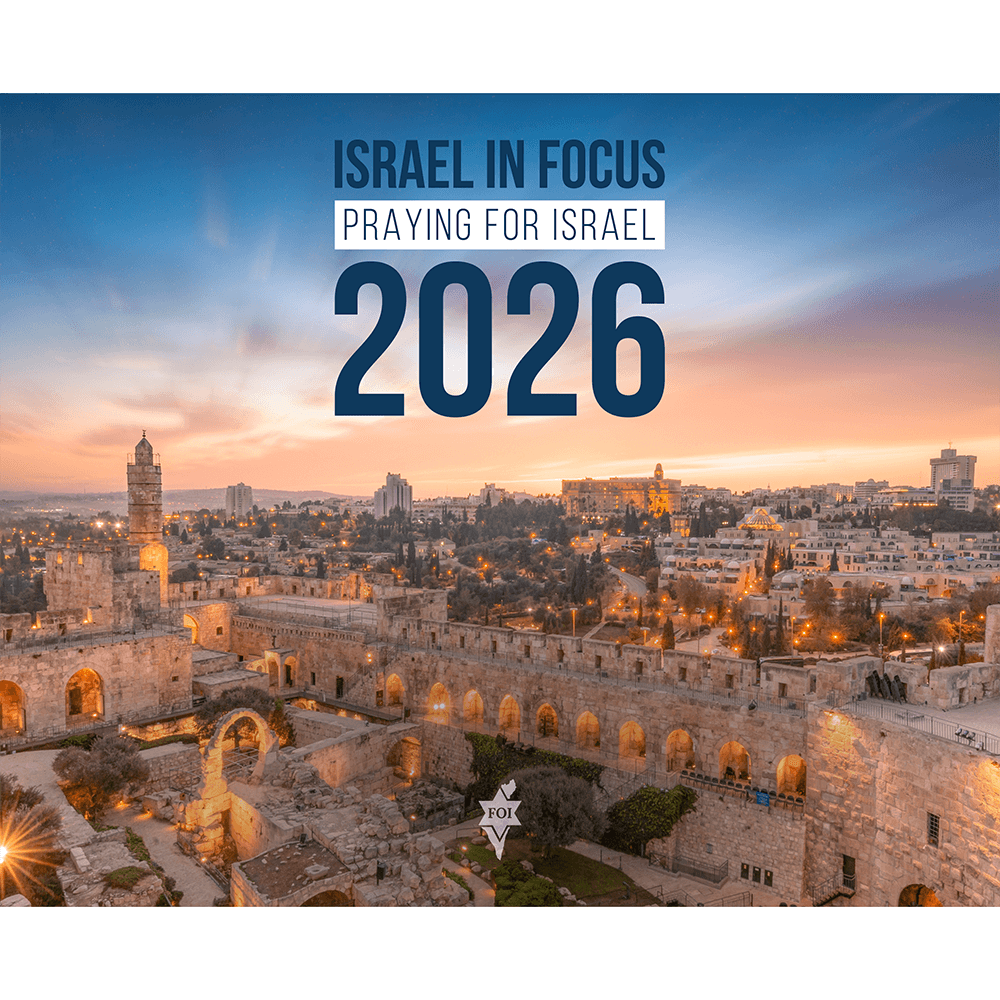
Pray purposefully through 2026 with our Praying for Israel calendar!
Each month highlights a powerful prayer focus for Israel and the Jewish people—rooted in Scripture and paired with stunning images from the Land of the Bible. Whether you're praying for peace in Jerusalem, safety for IDF soldiers, or hope for Holocaust survivors, this 12-month calendar will guide your heart and prayers with purpose. Be reminded daily of God’s promises and stand faithfully in prayer for His Chosen People throughout the year!
Apples of Gold: "About Whom is this Written?"
Christmas was approaching, and during this time of year, many ultra-Orthodox men liked to make fun of Zvi for placing his faith in Christ. During one particular encounter, the men mocked him, saying, “Your God is born!” But Zvi took the opportunity to share the truth with them. When they challenged him to prove that Jesus was the Son of God from the Old Testament, Zvi came prepared and opened the eyes of some of the young students in the group.
Music
The Friends of Israel Today and Apples of Gold theme music was composed and performed by Jeremy Strong.
Partner with us!
As you reflect on God’s goodness this holiday season, we invite you to partner with us in sharing His love with the Jewish people. Your financial gift is essential—it ensures we stay on the air, teaching biblical truth about Israel and the Jewish people. If this program has ministered to you, please consider making a gift today.


