

Israel My Glory In Depth: Interview w/ Mike Stallard:
 When so many headlines signal disaster for Israel and the world’s hatred toward it, peace and security seem so far off. But the Bible has an amazing future in store for Israel! Our newest Israel My Glory issue teaches the story of the book of Amos, and Dr. Stallard closes our study with an article detailing God’s wonderful promises to the nation of Israel.
In Israel’s current precarious state, it can be hard to imagine the nation enjoying peace, prosperity, possession of the Promised Land, and prominence among the nations. But God has promised just that. Joining our broadcast this week, Dr. Stallard provides biblical teaching from his Israel My Glory article on this time prophesied in Amos that Israel can anticipate with joy. Enjoy his conversation with Chris this week, and prepare your heart to learn more about God’s plans for Israel in His prophetic Word!
Chris Katulka: Thanks for joining us for the Friends of Israel Today. I'm Chris Katulka, your host and teacher. Foiradio.org is where you can connect with us. We have over a decade of content on the site featuring teaching and amazing interview guests. Again, that's foiradio.org. Please go visit us there.
Now, today our program is all about our magazine, Israel My Glory. In fact, this episode is called Israel My Glory: In Depth, where we interview one of the writers of our award-winning Christian magazine, Israel My Glory. And in a moment, we're going to share with you a way you can get a one year free subscription to Israel My Glory, so stick around for that. Today I'm going to sit down with Dr. Mike Stallard, the Vice President of International Ministries here at the Friends of Israel, to talk about his latest article based on Amos 9:11-15, a very exciting part of the prophet Amos, and his article is called “Raise Up, Rebuild, Restore.” God's wonderful promises to Israel couldn't be plainer, but some Christians reject the obvious. We're going to have a great interview with Dr. Mike Stallard, so stick around for that.
But before we get to him, here's what's happening in the news. The Israel Defense Forces announced that they recovered the remains of the final Israeli hostage from the October 7 attacks—Staff -Sgt.-Maj. Ran Gvili. His body was found at the al-Batesh cemetery in the area of northern Gaza. Ran will be laid to rest in his hometown of Meitar. Well, here's my take: information about the whereabouts of his remains were provided by a captured Islamic Jihad terrorist interrogated by Israeli intelligence, bringing Gvili home finally ends a devastating moment in Israel's history, allowing them to finally turn the page.
Chris Katulka: Hi, I am Chris Katulka. I'm the host of the Friends of Israel Today radio program and editorial writer for Israel My Glory Magazine. Now today we're going to have Dr. Mike Stallard on, he's the Vice President of International Ministries and he's going to be talking about his article, “Raise Up, Rebuild, Restore” in our most recent issue of Israel My Glory that is all about the book of Amos, the prophetic fall and the rise of Israel. Now listen, I want you to stick around because in a moment I'm going to share with you how you can get a one year free subscription to our award-winning Christian magazine, Israel My Glory. So I want you to stick around for that and we're going to turn now to Dr. Mike Stallard. Mike, great to see you.
Mike Stallard: Hey, thanks for having me. This is one of my favorite passages in the Old Testament.
Chris Katulka: I was going to say, of all of the passages to give you in nine chapters of Amos, they gave you the best one I would say.
Mike Stallard: Yes. Now the others were interesting, but this one is wonderful.
Chris Katulka: It’s fantastic.
Mike Stallard: Yes.
Chris Katulka: Hey, a couple of years ago I was invited to an event. It was kind of a pro-Palestinian event that promoted a theology called Palestinian Liberation theology, and there was a gentleman named Naim Ateek that was there and he was preaching about this Palestinian Liberation theology and he was diving into Amos, the prophet Amos, to talk all about how God's covenant with Israel is done. It's no longer a book about Israel's future or Israel's hope. God's done with them, he's moving on and in Jesus, everything changes. We're leaving the old way behind and we're moving forward. But I thought it was interesting, Mike, he completely left out Amos 9:11-15. Why is that significant in this prophet?
Mike Stallard: Yeah, well he did stop at verse 10, “All the sinners of My people shall die by the sword.” That's where he stopped. All the prophets in the Old Testament have judgment, judgment, judgment, but there's hope and there's a future for national Israel. And I've read Naim Ateek’s book on Palestinian Liberation theology and he says, basically, our pastors don't use the Old Testament anymore. He said we're looking for a new way to interpret the Old Testament that allows us to read it without believing in a future for national Israel. And I go, “Well, why don't you just read it and accept what God says?” And that's a difference. The thing that makes this passage so wonderful is if you take it at face value, it's kind of like Christians going to the end of Romans 8. In Romans 8 at the end, that beautiful security passage, “Nothing will separate us from the love of God, which is in Christ Jesus.” We look at that, we take it at face value and we adore it and we say “Hallelujah.” We come back to the Old Testament and Amos 9 is just like that, only it's for Israel. And some Christians struggle with it because it's for Israel and it's about their land. And so I think to be consistent, we have to have the same way we interpret in Amos that we do in Romans.
Chris Katulka: Can I ask you, first you have to kind of catch us all up here on what's going on with Amos. When is Amos writing? What are the scenarios taking place and what's the vision that God is giving Amos?
Mike Stallard: Well, Amos is being written in the middle eighth century BC, so he's about 750-755 years before Christ. And he's also during, he's prophesying during the period of the divided kingdom. After Solomon died, the kingdom split. The northern tribes, the 10 northern tribes, didn't want to follow the house of David anymore. They rebelled against the house of David. And so you have the northern kingdom, 10 tribes. The southern kingdom, Judah and Benjamin together called Judah and the northern tribe kept the name Israel. And so you have this divided kingdom among the people of Israel that God always intended to be a united nation. And it's in that context that we have this promise given 750 years before Jesus that in spite of the judgments that are coming, in fact, this is before the Assyrian captivity, maybe 30 years or so before the Assyrian captivity. And it's interesting that Amos is a prophet from Judah. He's a southern boy. He's from the southern tribe.
Chris Katulka: Just like you, right?
Mike Stallard: Just like me.
Chris Katulka: That's right up here in the north.
Mike Stallard: And he's sent up north just like I am. He’s sent up north and he's up there preaching in the north to the northern tribes and he starts out preaching about all the sins of all the nations around including Judah, and they're all very happy about that. Praise the Lord. But then he zeroes in on their sins and most of the book is the sins of the northern tribes, and so he pounds them and pounds them and pounds them, but at the end he said, ‘Hey, but don't worry about it. There's hope. Yeah, you need to repent, you need to get right with God, but your nation is not thrown away forever.’ And he comes back at the very end and he gives this very beautiful passage that affirms what God has in store for them, this united kingdom one day, never to be taken out.
Chris Katulka: I want to read just the first two verses here. Maybe we can pull some things out from it. It says this in Amos 9 starting in verse 11 that, “In that day,” (talking about a future day), “I will restore David's fallen shelter (or booth). I will repair its broken walls and restore its ruins and I'll rebuild it as it used to be so that they may possess the remnant of Edom and that all the nations that bear My name, declares the Lord who will do these things.” I want to talk about this idea because you had mentioned that these two kingdoms were divided, but it seems like a lot of the hope of the prophets, not just Amos but also Ezekiel, also Jeremiah, is that not only would God restore his people, but he would actually reunify the nation as it was once under King David, for instance.
Mike Stallard: Well, and that's exactly what the text says if you take it at face value. When he says, ‘I will raise up the tabernacle or booth or sukkot of David, which has fallen down, been divided, I'm going to repair it. I'm going to raise it up and it's going to be like it was in the old times.’ The point is, united… restored. So you have a restoration of the divided kingdom back into one kingdom. It's a clear statement I think. There's not a whole lot of room there to see spiritualized language. There's no figures of speech. Pretty much is a straightforward promise.
Chris Katulka: Now I do want to ask though, in verse 13, it talks about the fact that ‘when the reaper will be overtaken by the plowman and the planter by the one who treads grapes, new wine will drip from the mountains and flow from all the hills and I will bring back My people Israel back from exile.’ I'm interested, you had just mentioned about the importance of a literal interpretation of the Scriptures, but it seems like there's this abundance of agricultural imagery in Amos 9:13. So why shouldn't the readers view this passage as a figurative passage? How do we interpret moments like that when a prophet is writing?
Mike Stallard: Yeah, I think a lot of Christians they'll read and they'll see some figurative language in verse 13 and assume therefore the whole thing is figurative. And that's unfortunate. You got to take it line by line. Verse 11, there's nothing figurative there.
“I'm going to raise up.” It's a rather straightforward statement. There's no need to invoke anything else. And same with verse 12. And then verse 13 has the figurative language. “The mountains will drip with sweet wine” and all that. But then in verse 14 it says the same thing that verse 13 means. But in a straightforward way, literal way. “I will bring back the captives of My people Israel. They shall build the waste cities and inhabit them. They shall plant vineyards and drink wine from them and they shall also make gardens and eat fruit from them.” The issue of plentiful provision and prosperity for the people. And so that's stated clearly in verse 14, a straightforward way which helps define what verse 13 is about. And there's no need for the others to be interpreted any differently.
Chris Katulka: Can you help me understand something here? Oftentimes when I think we understand prophecy, whether it's in the Old Testament or the New Testament, our minds move forward for what God's going to do in the future. But here it almost seems like the prophet Amos is saying, in order for us to move forward, this restoration of the nation of Israel, David's fallen booth that will be rebuilt, the reunification. It seems like we almost have to remember what happened in the past. It's almost like we're going back to the future like the movie. We have to understand what was happening here in order for us to move forward. Why was what David built, how God used David to build the kingdom? Why is that so significant when Amos is clinging to that in order to think forward, especially when we think about the fact that Jesus is a son of David who would restore the booth of David. How would you see that?
Mike Stallard: Well, the nation of Israel is a special nation. When God decided to bring…enter into history in a human form, in the incarnation, he had to choose some branch of the human race to come into the world. And he didn't choose the Irish, he didn't choose the Chinese, he didn't choose the Brazilians. He didn't choose the Spanish or the Polish or the Russians. He chose the Jews, the Jewish people, and he entered into Jewish flesh. And that nation, he is the Messianic King, He is the promised Messianic King in the line of David. And He's going to come and rule and reign forever, fulfilling the ultimate part of the Davidic covenant promise given to David about his dynasty, not just throughout history but culminating in the special Messianic Kingdom to come. Now all the prophets have laid that out for us. Isaiah is probably particular about that and he's going to prophesy just a few years down the road here from Amos. And so that's very important that we understand the connection that Jesus has to David and that the point is of culminating in an ultimate kingdom. And I think that's what Amos is talking about here
Chris Katulka: In Amos 9:15 it says, “I will plant Israel,” (that's the people), “in their own land” (that's the land of Israel), “never again to be uprooted from the land that I have given to them.” And I'm interested because this seems to show a permanent possession of the land. How does this, number one, challenge this idea that the church has replaced Israel and kind of the land washes out… in Jesus, now that Jesus has come, the land no longer matters. I'm interested, how does this challenge that and why does this still matter today? It’s funny, I go online, Mike, and I see over and over and over again, Christians are more now than ever criticizing us who believe that there is a purpose to the land of Israel, that God is very much a part of this land that he promised Abraham the descendants and the blessing from Genesis chapter 12. And it seems as though they go, ‘Oh, that's just what the Old Testament preached. Now we're moving on in Christ.” But here Amos is pointing forward to a day when Israel will inhabit the land again, never to be uprooted again because this is the land that I have given them. How does this challenge that understanding?
Mike Stallard: Well, I think it knocks it in the head. I think it kills it because what those Christians who don't believe like we do, they need to read the whole Bible and they need to read the Old Testament as it's given, as God gave it. And so the idea that the New Testament comes along and changes the Old Testament, that's really what they're saying. The New Testament changes what God said. Well, that means that God's promise here was not correct. That's really, and they don't mean it that way, but it's an indirect denial of the inerrancy of the Bible. Did God mean what he said? Is that promise historically accurate? And the fact is it is. And for that to be historically accurate, there has to be a day in the future when Israel will be in the land never to be taken out again.
This can't be fulfilled in the return from Assyria or Babylon. Going back further from Egypt. Can't be fulfilled in those things. It can't be necessarily fulfilled from coming back after Rome in 1948. We don't know yet. We'll see what happens, but there's coming a time when they're in their land never to be taken out. Did God mean that just like he said or not? And again, like I said earlier, if we can't trust that statement, how can we trust anything, any promise that God makes in the New Testament such as the ending of Romans 8? And so I think we need to be very careful and very cautious about that. I think Christians are treading on dangerous ground when they allow the New Testament to wipe out promises that God made in the Old Testament.
Chris Katulka: Do you think that Amos is redirecting the hearts of the nations surrounding Israel, Judah itself and then also Israel? You had mentioned that in our previous segment that everybody got judged because of the way that they were sinning and abandoning God. And so Amos was not just pointing the finger at the Northern 10 tribes, he pointed it at Judah and the surrounding nations. But do you think that ultimately Amos at the very end is reorienting people's minds and hearts back to Jerusalem by saying that there's going to be a day when God will restore the fallen or broken booth of David? That seems… that's a very not only Davidic thing, which is talking about a king, but it's also talking about a city as well, it seems like.
Mike Stallard: Yeah, I think, and if you want to think about missions, both Israel in the Old Testament and the church in the New Testament are to be lights to the world. We Christians today are to be lights to the world. Israel was to be a light to the world. There's a little bit of a difference in the way that mission was carried out. In the Old Testament days it was more of the nations come to Israel. In us, it’s we go to the nations. So there's a little bit of a difference in the way that's portrayed. And here it's kind of like the Old Testament promised the future, when God's kingdom comes, the nations are going to come up to Israel. And of course Jesus the Messiah, he comes back, he sets up his kingdom in Israel and his headquarters is Jerusalem. It's not Washington DC, it's not London, it's not Berlin, it's not Paris, it's not Moscow, it's not Tehran. It is Jerusalem. And that's where he's going to rule and reign as a Jewish King. That's why I can say in verse 12 that “they may possess the remnant of Edom.” Edom is in southern Jordan. So it gives that example, but then it makes it global. “And all the Gentiles who called by My name.” So all those who are believers throughout the world, all of them will come up to Jerusalem, up to Israel where the Jewish Messiah, the Davidic King rules the world.
Chris Katulka: Yeah, I just was thinking, this almost could be offensive to people in the northern 10 tribes who are sitting there going, ‘Wait a minute, my capital's here in Samaria. Why in the world am I going to go down to Jerusalem?’ But that's God reorienting his, as we were saying, it's reorienting and rebuilding the booth of David, which is going back to what David had built ultimately through God, by putting the capital in Jerusalem. God, making a promise, eternal promise with him that is ultimately fulfilled in Jesus. And again, the idea that he's going to establish his kingdom in Jerusalem, that picture of…Amos is going, ‘I know you all are worshiping over here and you're going over there, but we have to understand that God's going to rebuild his capital for everything in Jerusalem.’
Mike Stallard: And ultimately we have to answer the question, is God's design in history always best? And the answer is yes. And the question is how did God put it together? And that's how he's put it together. And the northern tribes need to accept how God has designed it to go. And so Jesus is not just the King over the southern tribes. He's King over all of them, and he's their Messiah. He's the Messiah of the North. He's the Messiah for the whole world. And so “He's the King”, as Zechariah 12:9 says, “of the whole earth.”
Chris Katulka: That's right. I love what Psalm 72 says. It says, “all the kings will bow at the Messiah's feet and bring tribute and gifts.” And again, I think Amos, you got the best part of Amos. Dr. Stallard, thank you for being with us. Hey, I promised you that I would share with you a way that you can get a one year free subscription to our award-winning Christian magazine, Israel My Glory, and you stuck around. Thank you so much. So here's what I want you to do. I want you to go to israelmyglory.org/subscribe, and there, if you've never subscribed before, you can get a one year free subscription. That's six issues that will come to your house of Israel My Glory magazine. But listen, you can also get a digital edition of Israel My Glory that will give you 50 years of Israel My Glory content right at your fingertips on your cell phone, tablet, computer, you name it. It gives you so many great resources of great biblical teaching about Israel and the Jewish people, including this Amos and a study that comes right from Dr. Mike Stallard himself in his article, Raise Up, Rebuild, and Restore. Thank you so much for being with us, and thank you for your time. I hope that you subscribe to Israel My Glory.
Steve Conover: Now, Apples of Gold, a dramatic reading from the life and ministry of Holocaust survivor, Zvi Kalisher.
Mike Kellogg: People here in Israel are extremely nervous. This is partly due to the economic situation. When I try to speak with them, many say, “There is no longer a God because He sees and allows His chosen nation to fall down.
One man asked, “What do you think, Zvi?”
I replied, “What you say is not true. God has chosen us and brought us to this Promised Land. We shall live and not die. In October 1973, when the Arab armies attacked us, the Israeli population was very demoralized. Why did God spare us? And why are we living now? We are still alive and still a nation because God loves us. Is it not true that we love our children? Of course, we do. If we do not punish them for their misdeeds, they will continue to do as they wish. It is the same with our God. He loves us; therefore, He punishes us when we need it until we ask for His forgiveness. If people ask for forgiveness, change their ways, and turn to God, He will bless them. If you do so, you and all your friends will know the truth about our God. And when He makes a promise, He keeps it! He is not as we humans are.” After that, this man asked, “What do you think I should do? Should I believe in God?”
“Yes,” I replied. “But you should ask God what to do, instead of asking me.”
With surprise he asked, “How can I ask God?
I told him he could go directly to God in prayer because He is our Father and will answer him.
“How shall I pray?” he questioned. I then opened the Bible and read the Lord’s teaching about prayer in Matthew 6:9. Then this man realized about whom I was speaking. “Jesus?” he asked incredulously. “He was against our Torah. How can I believe in Him?”
I then read from Galatians 3:10: “Cursed is everyone who does not continue in all things which are written in the book of the law, to do them.” This was another surprise to him, and he declared, “Jesus is the great enemy of the Jews.” “That is what people say,” I told him. “And you, my friend, believe them.” He thought for a moment and then replied, “That is how I felt before, but not now.” Then we read together John 3:16: “For God so loved the world that He gave His only begotten Son, that whoever believes in Him should not perish, but have everlasting life.” “This is all so new to me,” he said. “It would be nice if you would give me some books, so that I may read about these things for myself and share them with my friends. I want to show them how they lied to me. I will visit you every week, and you can teach me from the Bible.” Through this man, two other families came to me, and I gave them my testimony about the Lord. I was sure that after such a lengthy conversation about our Savior, they would not return. But the Lord opened their hearts and now we meet every week. All of these dear people are now secret Christians. Perhaps one day soon they will openly acknowledge Jesus as
their Messiah and Lord.
Chris Katulka: Thanks for joining us for today's episode of The Friends of Israel Today. We want to thank Dr. Mike Stallard for being with us. Don't forget to get your free Israel My Glory trial subscription by visiting us at our website, foiradio.org. Again, that's foiradio.org. Our mailing address is FOI Radio, PO Box 914, Bellmawr, New Jersey, 08099. Again, that's FOI Radio, PO Box 914, Bellmawr, New Jersey, 08099. You can call us on our listener line. That number is 888-343-6940. Again, that's 888-343-6940. Today's program was engineered by Bob Beebe, edited by Jeremy Strong, who also composed and performs our theme music. Lisa Small is our executive producer. Sarah Fern is our associate producer. Steve Conover is our executive director here at The Friends of Israel. I’m Chris Katulka, your host and teacher. The Friends of Israel Today is a production of The Friends of Israel Gospel Ministry. Passion for God's Word. Compassion for God's Chosen People.
Watch the Interview
Israel My Glory Magazine
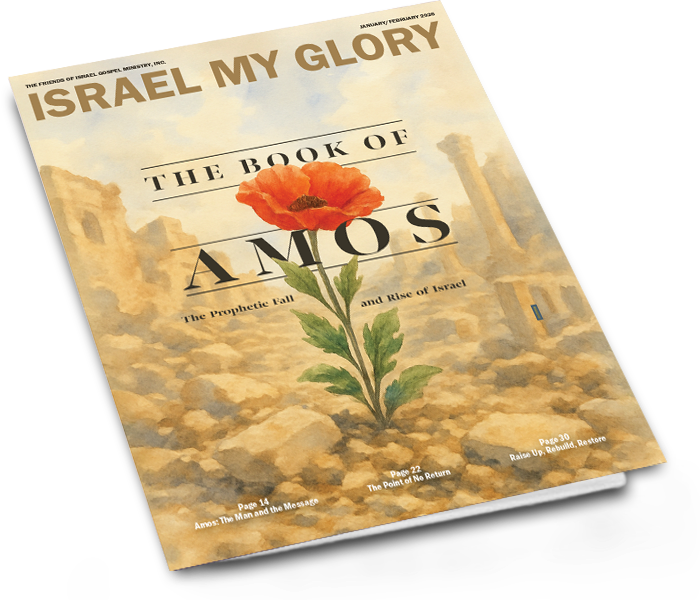
Since 1942, Israel My Glory has been a highly trusted, sought-after tool in the study of God’s Word. This award-winning magazine, published by The Friends of Israel Gospel Ministry, stands firmly on the literal-grammatical interpretation of the Bible. It is simply the best there is if you want to understand Scripture, Israel, and prophecy.
Sign up for your free one-year print or digital trial today!
*First-Time Subscribers Only
Apples of Gold: "How Can I Believe in God?"
In the 1970s, Israel faced economic hardship, causing many Israelis to feel abandoned by God and to even doubt his existence. Amidst this distress, Zvi provided a source of hope to the Israeli community, proclaiming God’s plan to sustain His people. Through an encounter with one skeptical man, Zvi shared the Good News of the Messiah and encouraged the man to pray. Zvi was able to counter the misconceptions about Jesus that are prevalent among Jewish people by sharing the truths God reveals in His Word.
Music
The Friends of Israel Today and Apples of Gold theme music was composed and performed by Jeremy Strong.
Partner with us!
Your financial gift is essential—it ensures we stay on the air, teaching biblical truth about Israel and the Jewish people. If this program has ministered to you, please consider making a gift today.


