

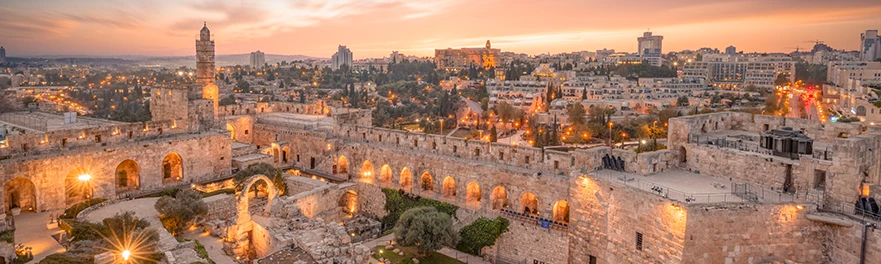
Psalm 122: Our Command to Pray for Israel:
Many influential voices are shaping a narrative that demonizes Israel, and it’s catching on at an alarming rate with young Christians in particular. But God loves Israel, and we should too. More than that, we should be praying for Israel. This isn’t an optional exercise for the Christian life—it’s an essential act of obedience to God’s command. Part 1 of our 3-part study on praying for Israel takes us to Psalm 122 and its well-known directive to pray for the peace of Jerusalem, the capital city of the Jewish nation where God placed His name.
The Bible’s order to pray for Israel calls believers to align their hearts with His, and its instruction to pray for Jerusalem’s peace (shalom) is an entreaty to seek wholeness and righteousness in every layer of the city’s being. While many tie their views on Israel to its politics, we must let Scripture and the covenant God made with Abraham dictate our immovable support for the nation. Discover the blessing God has promised to those who love and pray for Jerusalem!
Steve Conover: Thank you for joining us for the Friends of Israel Today. I'm Steve Conover, executive director of The Friends of Israel Gospel Ministry, and with me is our host and teacher, Chris Katulka. Foiradio.org is where you can connect with us. We have over a decade of content on the site featuring Chris Katulka’s insightful teaching and various interview guests. Again, that's foiradio.org. Chris, this new series we're starting today, it may be one of the most important things we can learn as we support Israel.
Chris Katulka: Yeah, we're going to take the next few weeks, Steve, to answer the question, “Why should I pray for Israel?” And I'm going to tell you I've been concerned about what I've been reading and seeing online, especially social media. When it comes to support for Israel and the Jewish people, typically you see antisemitism or anti-Israel sentiments coming from Islamic extremism or from even the progressive left. But more and more, Steve, I'm seeing it even come from evangelical Christians, and so we need to speak into this issue. So for the next three weeks, we're going to be asking the question, “Why should I pray for Israel?”
Steve Conover: But first in the news, Iran’s Supreme Leader, Ayatollah Ali Khamenei, said recently that if the U.S. strikes Iran, the whole region will feel it. According to the semi-official Tasnim News Agency, he warned, “The Americans should know that if they start a war, this time it will be a regional war.”
Chris Katulka: Well, Steve, here's my take. The Iranian regime is broke, hungry, running out of water, and rattled by nationwide protest movements that refuse to die out. Khamenei isn't the type to step aside quietly, but the real question is this, how much fuel does he actually have left to project strength? At some point, bluster meets reality.
Chris Katulka: Today we're kicking off a brand new series called “Why Should I Pray For Israel?” Maybe you're listening on the Friends of Israel Today Radio podcast, or maybe you're driving in your car right now listening on the radio. Wherever you are, I'm really glad that you're with us. I've felt a growing burden to address this topic because quite honestly, the conversation in the wider Christian world has shifted. There are influential voices, big platforms, big followings telling Christians that Israel no longer matters, that God is finished with the Jewish people, that the Old and New Testaments belong exclusively to the church and that Israel's rejection of Jesus somehow erased them from God's mercy.
None of that is true. None of that is biblical, and yet it's shaping the faith of an entire generation. A few months ago I was speaking at a Friends of Israel conference, one I've done for more than 10 years, and for the first time ever I found myself sitting with parents who were heartbroken. Their Christian sons and daughters raised in homes that taught them to love and support Israel, and the Jewish people were now repeating deeply anti-Israel and even anti-Jewish ideas they'd absorbed from social media. These young adults were calling Israel illegitimate, dismissing the Jewish people as the “synagogue of Satan,” and questioning basic biblical truths their families had held for decades. That was a wake up call for me, everybody. So for the next three weeks, we're going to explore why it matters that Christians pray for Israel. Not because of politics, not because of trends, but because ancient Scripture reveals that God still has a plan, a promise, and a future for Israel and the Jewish people. A future that is woven directly into his unfolding redemptive work and the prophecies that shape our hope as believers in the Lord Jesus.
So you'll see that praying for Israel isn't an optional add-on to Christian life. It's actually an act of obedience, a response to God's heart and a way to align ourselves with his purposes in the world today. So we're going to go right to the biblical source that gives us that command, that heart to pray for Israel, and that's Psalm 122. In Psalm 122:6-9, this isn't just a vague spiritual nicety or some sentimental encouragement to think warm thoughts about the holy city and the capital of Israel, Jerusalem. It's the direct biblical imperative. See, when David commands in Psalm 122:6-9, to “pray for the peace of Jerusalem,” he's not offering a suggestion for the exceptionally devout or the politically interested. He's summoning God's people into active obedience. See the Hebrew word for sha’alu, which is translated as “pray”, actually has the force of a command and could be interpreted as “seek” or “inquire after” or “intercede for.”
It carries the weight of urgency signaling that the welfare of Jerusalem is not something God's people may pray for if they feel like it, but something that we're commanded to uphold before the Lord. See throughout Scripture, wherever God commands his people to pray for something, it is because that prayer is tied directly to his purposes in the world. See, God doesn't command empty gestures. He calls his people to align their hearts with his own. So praying for the peace of Jerusalem is at its core, an act of obedience and alignment with the revealed heart of God. So when David uses the word “peace”, he's not just talking about a shallow peace, a modern sense of no fighting. The Hebrew word for shalom is so much deeper, so much richer, carrying the meaning of wholeness, completion, harmony, safety, justice, stability, and flourishing under God's rule. See, shalom is the world as God intended it to be.
Creation functioning in order, righteousness rooted in the community, right relationships between people and presence centered existence. That's so important. God's presence at the center with his people and his creation. See, when Psalm 122 urges us to pray for the shalom, the peace of Jerusalem, it's a prayer for every layer of life to come under God's good and righteous order. It is a longing for a city to flourish not simply politically or socially, but spiritually, morally, and communally. It's a prayer for the place where God chose his name to dwell, to experience the fullness of his blessing and because shalom is tied directly to God's presence, praying for Jerusalem's shalom is ultimately a prayer for the advance of God's future kingdom and the fulfillment of his promises. But this raises a natural question. Why Jerusalem? What makes this city so central that God attaches a command to pray for it?
Scripture is clear that Jerusalem is not just an ancient cultural center or the site of historical biblical significance. It is the city God himself chose. In 2 Chronicles 6:6, it declares unequivocally, “I have chosen Jerusalem that my name may be there.” And 1 Kings 11:36, it adds that the city was chosen so that David's line, that's where Jesus would come from, through David's line, that “David's line would have a lamp before me in Jerusalem.” Meaning that God's covenant with David is inseparable from God's choice of that city, Jerusalem. See the city of peace, Jerusalem, is where God placed his earthly throne. You can read about that in Jeremiah 3:17. Where the temple stood, where sacrifices were offered, where kings ruled, where prophets spoke, where Jesus taught, died, rose ascended and will one day return. It's the epicenter of biblical revelation and redemptive history. From Genesis 22 on Mount Moriah, where Abraham bound Isaac to Revelation's vision of the New Jerusalem, God's story keeps circling back to this place.
To dismiss Jerusalem or to treat it as merely symbolic is to detach ourselves from the geography of redemption. The city's significance, it's not man-made, it's God-declared. Loving God while remaining indifferent to Jerusalem is like claiming loyalty to a king while ignoring his throne. And don't forget, Jerusalem, even today, is the capital of Israel. Psalm 122 strengthens this point by tying the peace of Jerusalem directly to the welfare of God's people. “May they prosper who love you.” See, this is more than a poetic sentiment. It reveals a spiritual law woven into covenant history. Blessing toward Jerusalem carries blessing with it. And this mirrors the Abrahamic promise, the Abrahamic covenant in Genesis 12:3, “I will bless those who bless you and curse those who curse you.” See, God's economy is one of outward flowing blessing.
When Gentiles bless Israel, blessing doesn't diminish but increases both for Israel and for those who bless. Psalm 122 makes it clear that those who pray for the peace of Jerusalem, who seek her good, who align themselves with God's purpose for her, receive blessing in return. And see, this isn't transactional, it's relational. It reflects God's commitment to the people and places he chooses. Praying for Jerusalem becomes a way of participating in God's covenantal generosity, a way of entering into the gracious overflow of his promises. Jerusalem's peace is also inseparable from God's unfolding redemptive plan, both past and future. Historically, the city was the stage on which God revealed his holiness, his sacrificial system, his kingship, and the expectations for the Messiah. The prophets describe Jerusalem as the hub of God's activity among the whole world, the nations. Isaiah envisioned a future when the nations would stream to Jerusalem to learn God's ways.
You can read about that in Isaiah 2:1-4. Zechariah foresaw a day when the Lord himself would fight for Jerusalem and reign from it. Jesus wept over the city, taught in the city, died and rose in the city and will return to the Mount of Olives which faces the city of Jerusalem. Even the early church was born in Jerusalem and radiated outward pointing the world back to Jerusalem. To pray for Jerusalem's peace is to pray for the forward movement of God's redemptive plan. It's to pray that God's promises will be fulfilled, that his purpose will advance, and that his appointed future for Israel, the nations, and the world will ultimately come to fruition. Jerusalem's destiny is not merely historical, it's prophetic. Praying for Jerusalem also connects Christians to 3000 years of biblical intercessors, those who pray for Israel and the Jewish people.
When believers pray for Jerusalem today, they join David, Solomon, Isaiah, Jeremiah, Daniel, Ezra, Nehemiah, the apostles, the countless generations of Jewish believers who pleaded with God for the city's peace and restoration. And in doing so, Christians stand in continuity with the spiritual heritage that they're grafted into, which is what we'll talk about next week from Romans chapter 11. They affirm that God has not abandoned his covenant people or rejected his promises. Instead, they affirm that God's gifts and calling upon Israel remain irrevocable. Paul said that in Romans 11:29. When Christians pray for Israel and the Jewish people and Jerusalem, they acknowledge this continuity and honor the spiritual root that nourishes their own faith in Jesus. See, our prayers become an expression of biblical loyalty, gratitude, and humility toward the God who chose to bring salvation from Zion—that's Jerusalem. This is why Psalm 122 concludes with a personal commitment, “For the sake of my brothers and friends, I will now say, ‘may peace be within you.’ For the sake of the house of the LORD our God, I will seek your good.” When we come back, we're going to wrap up here and see how from Psalm 122, Christians should think about the current events, the conflicts, and the tension surrounding Jerusalem and why praying for Jerusalem, Israel, and the Jewish people matters to our own spiritual life. Stick around.
Steve Conover: Chris, I'm really looking forward to this year's Friends of Israel Look Up Conference coming up on March 5th and 6th online.
Chris Katulka: Same here, Steve. And I'm especially excited about this year's theme, Dispensationalism: Myths, Truths, and Why It Matters. It's such an important topic for understanding the Bible clearly.
Steve Conover: It's so important, Chris. And this year all four sessions will be taught by Dr. Mike Stallard. He's our Vice President of International Ministries. Mike is one of the clearest and most respected voices teaching on dispensational theology today.
Chris Katulka: Now across the four sessions, Dr. Stallard explains what Dispensationalism actually teaches, why we should interpret the Bible consistently, it's so important, and how it shapes our understanding of prophecy, Israel, and God's plan of redemption.
Steve Conover: We've designed this conference to equip everyday believers with discernment.
Chris Katulka: So here's what I want you to do. Join us for the Look Up Conference this March 5th and 6th at 7:00 PM online as we explore Dispensationalism: Myths, Truths, and Why It Matters. You can get all the details on how to register at foiradio.org. Again, visit us at foiradio.org.
Chris Katulka: Welcome back everyone. We're wrapping up our first segment of a three-part series called Why Should I Pray for Israel? And we're looking at Psalm 122. And we're just about to hear how David brings this command to pray to a close. See David ends the Psalm with determination. His love for Jerusalem is not theoretical or emotional. It's active. He resolves to seek the city's good because the people of God dwell there and because the house of God stands there, the temple. In other words, David's commitment to Jerusalem flows from his commitment to God himself. This is the example Scripture gives to believers: to love Jerusalem because we love the God who chose her. When modern Christians pray for Jerusalem, they're not entering a political debate or embracing nationalistic sentiments. They're obeying Scripture. That's why we're called Christian Zionists. They are participating in God's redemptive plan.
They're joining in the ancient prayers of God's people. They are connecting themselves to the Abrahamic promise that blessings flow outward when Israel is blessed. They are praying for the place where God's kingdom will one day be fully realized and they are allowing their hearts to be shaped by the same affections that fill the heart of God. See, this perspective reshapes how Christians should think about current events, conflict and tension surrounding Jerusalem. The city has always been contested, always been at the heart of spiritual warfare, always been the focal point of nations and empires, and yet Scripture never instructs believers to disengage or grow indifferent. Instead, the Bible calls God's people to what? Pray. Even more urgently when the city is threatened. Praying for Jerusalem doesn't mean ignoring suffering on any side of a conflict. It means praying for God's justice, God's righteousness and God's peace to prevail. It means longing for the day when the weapons are laid down and when the Prince of peace reigns. And when shalom fills the earth as waters cover the sea.
To pray for the peace of Jerusalem is to ultimately pray for the kingdom to come. And Christians who pray for Jerusalem rehearse the reality that their own spiritual peace is tied to God's covenant faithfulness. Did you hear that? Your own spiritual peace is tied to God's covenant faithfulness to Israel and the Jewish people. If God is faithful to Jerusalem, if God is faithful to Israel and the Jewish people, then he will be faithful to the church. If God keeps his promises to Israel, he'll keep his promises to us. In Jerusalem, it becomes the living testimony of God's steadfast love and a reminder that he doesn't abandon the works of his hands. And when we pray for the peace of Jerusalem, we also confess that our hope is rooted in the God who writes history, keeps covenants and brings his purposes to completion.
And in the end, Psalm 122:6-9, calls believers to join God in loving what he loves, choosing what he chooses, blessing whom he blesses and praying for what he commands us to pray for. The Psalm reminds us that Jerusalem’s story, Israel's story, the Jewish people's story is not finished and that God's purposes for the city are far from complete. And it beckons Christians, it calls on us to take up their place in the long line of intercessors who have been praying, echoing throughout the millennia, praying for the peace of Jerusalem as an act of theological faithfulness, spiritual maturity and covenantal alignment with God. It is a way of participating in God's unfolding plan for the world. A plan that began with Abraham, moved through David, culminated in Jesus, and moves forward toward the Messiah Jesus's return. It is obedience, blessing, and worship all wrapped up in one. To pray for the peace of Jerusalem. For the sake of the God who chose Jerusalem, for the sake of the people who dwell in it, and for the sake of the redemptive plan anchored to it, the call remains: pray for the peace of Jerusalem. And in doing so, may God's people everywhere discover the blessing promised to all who love the city he calls his own.
Steve Conover: Now Apples of Gold, a dramatic reading from the life and ministry of Holocaust survivor, Zvi Kalisher.
Mike Kellogg: Deuteronomy 20:1 says, “Do not be afraid, for the LORD your God is with you.” Here in Israel, we live in the light of this promise day by day, as we face Scud missile attacks from Iraq. We are sure of God’s protection; therefore, we can sing confidently the words of our national anthem, “Hatikva”: “Od lo av-da tik-va-te-nu,” which means “Our hope is not yet lost.”
Even with missiles being dropped on us nightly, people continue their daily routines with high morale because they know God has said, “I have set watchmen on your walls, O Jerusalem; they shall never hold their peace day or night” (Isa. 62:6). Although most of our people do not believe in the Messiah, they do trust in the promises of God to His Chosen People.
There are, however, many new immigrants in Israel, especially from the Soviet Union, who do not know the promises of God since they have lived all their lives under Communism. As soon as they arrive, the ultra-Orthodox try to convert them into their fold of Judaism. They tell the
émigrés not to have any contact with Christians. But truth ultimately conquers. And people are most interested in learning the truth in times of trouble, such as Israel is experiencing now. I consider it an obligation to comfort such people with the Word of God, and I am thankful the Lord has enabled me to speak their language. When I first talk with a new immigrant, it is not with warnings but in the spirit of friendship. Then, when I have gained his trust, we can be open with each other, and I can share my faith.
Initially, the émigrés are surprised to find a Jewish person who believes in Christ, especially in Israel. Even as missiles are raining down, they seem more interested in knowing how and why a Jewish person can believe in Jesus. One émigré told me, “It is impossible for a Jew to praise the name of this One whom Jews have hated through the centuries.”
I replied, “I have heard many say this. You have been brainwashed against believers from the moment you stepped off the plane. But if you read the Jewish Scriptures for yourself, you will understand how to have true faith in God. I do not have with me any of the old commentary books—no stories, no traditions. But if you want it, I will give you a Bible in the Russian language. Then you can make your own decision about God.”
Even though the immigrants have been instructed to stay away from believers, they are independent and want to make their own decisions in their new land, and they are open to discussion. Of course, some are skeptical. Some have asked me if believers in the Lord are against the Jewish religion.
I responded, “I am not against any religion if it is in accordance with the Bible. As it is written in Deuteronomy 12:32, ‘Whatever I command you, be careful to observe it; you shall not add to it nor take away from it.’ But, I am sorry to say, most of the people of Israel are far from being the ‘holy people to the LORD your God’ that He has instructed them to be in Deuteronomy 7:6. I only want to help you find the Lord, your Savior. Then you will truly be His Chosen People.”
These immigrants were very moved by our conversation. They said they had learned more in one hour than they did during several days of instruction from their assigned “guides.” I pray the Lord will give me more opportunities to speak with Soviet immigrants. I am also praying that, as they read the Scriptures, the Lord alone will be their Guide and lead them into His truth, which alone will make them free (Jn. 8:32). Finally, during these difficult days, I “Pray for the peace of Jerusalem: may they prosper who love you” (Ps. 122:6).
Steve Conover: Thank you for joining us for today's episode of The Friends of Israel Today. Don't forget to register for our upcoming Look Up Conference. It focuses on Dispensationalism: Myths, Truths, and Why It Matters coming up March 5th and 6th. You can find out more on our website. That's foiradio.org. Again, that's foiradio.org. Chris, we're not done with this series on prayer. Where are we headed next week?
Chris Katulka: Yeah, so we've been asking why should we be praying for Israel? Today we looked at the command to pray for Israel from Psalm 122:6-9. Next week we're going to look at what actually the heart that we should have when we think about praying for Israel and the Jewish people. That's grounded in Romans chapter 11, where Paul says that Christians actually have a heart of humility, Steve, a humility toward Israel and the Jewish people even in their disobedience. Because that is the root on which we find all of our spiritual nourishment, the root, the olive tree imagery in Romans chapter 11.
Steve Conover: Very good. We look forward to it. As mentioned once more, our web address is foiradio.org. That's foiradio.org. You can reach us by mail at FOI Radio PO Box 914, Bellmawr, New Jersey, 08099. Again, that's FOI Radio PO Box 914, Bellmawr, New Jersey, 08099. Our listener line is 888-343-6940. Again, that's 888-343-6940. Today's program was engineered by Bob Beebe, edited by Jeremy Strong, who also composed and performs our theme music. Our executive producer is Lisa Small. Our associate producer is Sarah Fern. The late Mike Kellogg read Apples of Gold. Our host and teacher is Chris Katulka, and I'm Steve Conover, executive director of The Friends of Israel. The Friends of Israel Today is a production of The Friends of Israel Gospel Ministry. Passion for God's Word. Compassion for God's Chosen People.

Apples of Gold: So Long Our Hopes Are Not Yet Lost
Despite Israel facing missile attacks from Iraq, the influx of immigrants into Israel continued. Recognizing the opportunity to share Scripture with those who had spent their lives under Communist rule, Zvi started building relationships and sharing his faith. Believing firmly that truth ultimately prevails, he felt a strong commitment to reach out to these new arrivals. Listen as Zvi offered comfort through the Word of God, praying that the Lord alone would direct them and lead them to the truth.
Music
The Friends of Israel Today theme music was composed and performed by Jeremy Strong.
Partner with us!
Your financial gift is essential—it ensures we stay on the air, teaching biblical truth about Israel and the Jewish people. If this program has ministered to you, please consider making a gift today.


