

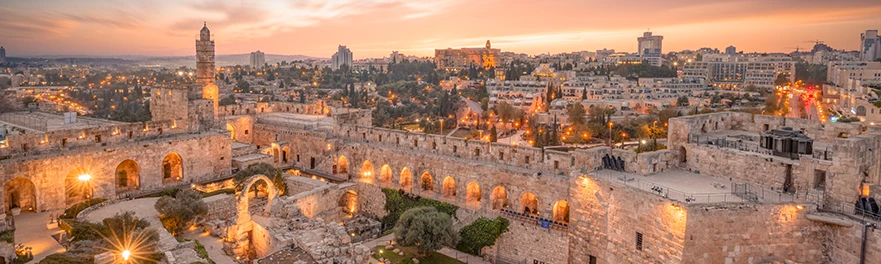
Romans 11: Having a Heart of Humility:
The belief that the church has replaced Israel in God’s plans and affections has grown increasingly popular among Christians today. Yet, God’s Word teaches that the church is not a replacement, but rather a wild branch grafted into a covenantal olive tree rooted in Israel. Part 2 of our 3-part series on why we should pray for Israel examines the apostle Paul’s defense of God’s Chosen People in Romans 11.
Scripture is clear: Israel’s rejection of Jesus is not final, but Gentiles’ salvation should provoke the Jewish people to jealousy and draw them back to their Messiah. Gentile believers must be humble, not boasting against the Jewish people, through whom came the Scriptures, the prophets, and the Messiah Himself. So, we are called to pray expectantly that God will continue to keep His promises—for the salvation of Israel and the redemption of the world. Join us and gain a practical defense for Israel straight from Scripture!
Steve Conover: Thank you for joining us for the Friends of Israel Today. I'm Steve Conover, executive director of the Friends of Israel Gospel Ministry. With me is our host and teacher, Chris Katulka. Chris, we had a series that we began last week on praying for Israel, where we headed this week?
Chris Katulka: Yeah, we're going to continue that series on Why Should I Pray for Israel, especially as a Christian. And last week we looked at David's command in Psalm 122, his command to pray for Jerusalem, and I believe also including Israel and the Jewish people. But today we're going to look at how the Apostle Paul approaches it, especially for the church, because what I'm seeing today, especially among certain evangelicals, is a haughtiness toward Israel and the Jewish people when actually the Apostle Paul calls us to have a heart of humility toward them. So we're going to be looking at Romans chapter 11 and the olive tree imagery that we see the Apostle Paul writing about to connect us to why we should be praying for Israel.
Steve Conover: But first in the news, a feel good story here. A 2,000 year old street in Jerusalem, the Pilgrims Path has reopened after a 20-year excavation, running from the southern edge of the ancient city at the pool of Siloam up toward the Temple Mount. Built in the first century, likely under Herod the Great or even Pontius Pilate, this was the road Jewish pilgrims walked as they ascended to worship at the Temple.
Chris Katulka: Steve, I've walked this path before and this pilgrim's path links the Western Wall at the Temple Mount with the ancient city of David. And it lets visitors literally walk the same path Jewish worshipers once traversed 2000 years ago and once again proving for the entire world that Jewish history binds. As they uncover all these amazing things, it binds the Jewish people to the land of Israel. Today we're continuing our series on Why Should I Pray for Israel? And maybe you're listening again on the Friends of Israel Today podcast. Thank you so much or you're driving right now and you're listening on the radio. Wherever you are, we're so thankful that you've tuned into us and I hope that you visit us at foiradio.org. I've been feeling a growing burden to speak into this topic because to be completely honest, something has shifted in the wider Christian world.
Influential voices, big platforms, huge followings are telling Christians that Israel isn't important anymore. That God has moved on from the Jewish people, that the promises of Scripture no longer apply to them and that the church has completely replaced Israel in every meaningful way. Not only is that false, it's the exact kind of thinking the Apostle Paul warned against in Romans chapter 11. Now, a few months ago, I was at a Friends of Israel conference, an event that I've been a part of for more than a decade. And for the very first time, I found myself not so much teaching and asking questions. I actually found myself acting more like a counselor to heartbroken parents. They're young adults and daughters raised in homes that taught them to love Israel and the Jewish people were now repeating deeply anti-Israel and even anti-Jewish ideas from social media. Some were claiming that Israel was illegitimate.
Others were throwing out phrases like the “synagogue of Satan” and many were confidently declaring that God has no future for Israel at all. And these weren't hostile unbelievers. These were Christians who wake up diligently on Sunday to get their young families to church. And that conversation hit me like a wake-up call because the very attitudes that we're seeing today are the attitudes Paul, the apostle Paul, addresses head on in Romans chapter 11, a warning to Gentile believers not to become arrogant, not to look down on the Jewish people and not to forget the spiritual root of our faith that's Israel itself. Don't boast against the natural branches, Paul says. You don't support the root. The root supports you. That truth matters now more than ever. When Christians forget their spiritual roots, we detach ourselves from God's covenant faithfulness to Israel. It's easy to drift into pride, into dismissing Israel, into believing the lie that the church has replaced God's Chosen People.
Paul calls that kind of thinking “spiritual conceit”, and he commands us to respond with humility. And in this series, we're returning to Scripture to explore why Christians should pray for Israel. Not because of politics, not because of personalities, but because the Bible reveals that God's purposes for Israel are ongoing, unbroken, and tied directly to his redemptive plan for the whole world. And today we begin with Paul's urgent warning, a warning the church needs to hear again. Don't boast. Don't grow arrogant. Remember the root that carries you. This posture of humility is one of the strongest reasons Christians should pray for Israel today. So let's open up to Romans chapter 11, where the apostle Paul devoted an entire section of his letter to the Romans to warn Gentile believers against pride, arrogance, and spiritual triumphalism toward the Jewish people. This warning in Romans 11 is not a minor footnote in the New Testament, and it isn't a gentle suggestion.
It's a pastoral rebuke from the Apostle Paul himself that's firm, sobering, and deeply embedded within the unfolding plan of God for his covenant people. And what makes this passage especially relevant to the modern church is that Paul is not addressing unbelievers or antagonistic pagans. He's actually speaking directly to Gentile Christians who had begun to misunderstand their relationship to Israel. And this misunderstanding he knew could lead to a disfigured Christianity, one that forgets its roots, boasts in its status and loses sight of God's long-term covenant faithfulness. And again, this is what I'm seeing over and over again as I watch certain preachers and teachers online with a haughty attitude toward Israel and the Jewish people. Now, in Paul's day, the gospel message was spreading rapidly across the Gentile world. God was opening doors in cities like Philippi, Corinth and Ephesus. It was an exciting moment. Gentiles who were once far off were now being brought near through the blood of Christ, as the apostle Paul says in Ephesians chapter two, verse 13.
Yet with this excitement came danger. As many Gentiles began embracing the Messiah, most of Israel did not. The early church could easily have drawn a wrong conclusion. Perhaps God's done with Israel. Maybe he's replaced them with us now. Well, Paul saw this theological drift coming from the Roman congregation, and before that seed could even begin to sprout into a full-blown arrogance, he uprooted it with an unmistakable clarity. Do not boast against the branches. You do not support the root, but the root supports you. That's Romans 11:18. What Paul does in this chapter is remarkable. He reminds Gentile believers that their very identity as Christians is inseparably linked to the story of Israel. They are not an unrelated people that God has simply grafted into his plan at random. They have been placed into an ancient, living, covenantal tree with roots that stretch back to Abraham, Isaac, Jacob, the promises, the patriarchs, the prophets, and ultimately the Messiah himself.
In the olive tree metaphor, Israel is the cultivated tree, nurtured, chosen, as Paul says, shaped by God's redemptive work through millennia. Gentiles, Paul says we're the wild branches brought in not because of merit. This is important, everybody. Brought in not because of merit, but because of mercy. Their place in the tree is something astonishing, unexpected and entirely rooted, no pun intended, in grace. This grafting makes humility not merely appropriate, but absolutely essential. The image of the olive tree would have been deeply familiar to Paul's audience. It was a symbol of covenant blessing, divine provision in God's presence. The olive tree was central in the agricultural life of ancient Israel, but even more, it functioned as a theological symbol of God's ongoing faithfulness. By using this imagery, Paul highlights continuity, not discontinuity. He doesn't describe two different trees, one for Israel and one for the church.
There's one tree, one root, one story of redemption. Gentiles don't replace Israel. They join Israel's story through the mercy of God. This entirely rules out any posture of superiority or triumphalism or disdain toward the Jewish people. See, Paul anticipates the very question that many Christians still ask today. “Has Israel stumbled so as to fall beyond recovery?” And his response is emphatic. Do you remember Romans 11:11? “By no means, may it never be.” Israel's unbelief is tragic, but it's not final. Their stumbling opens the door of salvation to the nations, but God is not finished with them. They remain in Paul's words, "Beloved for the sake of the Fathers.” (Romans 11:28). That's Abraham, Isaac, and Jacob. This is the heart of Paul's warning. The Gentile church must never assume that God has abandoned his covenant people or replace them with a new spiritual nation. There's nothing biblical about that.
The root, the Abrahamic promise still stands. A land, a descendants, and a blessing. The gifts and calling of God are irrevocable. They can't be broken. Israel's story is not over. In fact, its climactic chapter lies ahead according to Romans 11. And this theological reality, this biblical reality transforms the way Christians ought to view Israel today. If the Jewish people remain beloved, chosen, and covenantally significant, then arrogance has no place whatsoever in the Christian heart. Instead, humility, gratitude, and prayer must characterize our posture. Paul explicitly says that Gentile salvation is meant to provoke Israel to jealousy, a jealousy that leads them back to their Messiah as he writes in Romans chapter 11, verse 11. Gentile believers are not passive observers of Israel's story. They are invited into a posture of intercession that's prayer and expectation. Their salvation is a part of a larger divine strategy aimed at Israel's future demonstration of obedience to Paul and the apostles' teaching.
The modern church has often struggled with Paul's warning. Throughout history, many Christians slipped into precisely this arrogance that Paul forbids us to have. The belief that the church has replaced Israel, the core, it's this title called supercessionism or replacement theology is fueled centuries of contempt, persecution of the Jewish people and biblical and theological distortion. The tragic irony is that the very people God called to provoke Israel to longing for their Messiah instead drove them further away through hostility and oppression. See, Romans 11 stands as a corrective, a theological course realignment, calling a church back to humility and love. Christians today must read these words, not as ancient history, but as a living exhortation for today. “Do not be wise in your own conceit”, the Apostle Paul says in Romans 11:25. An arrogant Christian misunderstands the gospel. A humble Christian understands that everything, salvation, adoption, inheritance, all of these theological and biblical truths that we stand on, you know where they come from?
They flow from the Jewish root. This humility should naturally guide us right into prayer for Israel and the Jewish people. And when believers recognize that they are grafted into Israel's story, they begin to see the Jewish people, not as those who rejected Jesus, but as the original recipients of God's promises, the people through whom the scriptures came, the prophets came, and through the most important, Jesus, the Messiah himself came. And this recognition creates actions, not haughtiness, but spiritual indebtedness. As Paul says earlier in Romans, “if the Gentiles have shared in their spiritual blessings, they owe it to them to minister back material blessings.” That's Romans chapter 15, verse 27. If we owe material blessings, how much more should we offer spiritual prayer and intercession for Israel and the Jewish people? See, prayer becomes an act of gratitude, an acknowledgement of all that Israel has given to the world.
Paul ties Israel's future redemption to a global spiritual renewal. When Israel stumbles, blessing comes to the world. But when Israel returns, Paul says it will be life from the dead resurrection. Romans chapter 11, verse 15. That phrase is prophetically, eschatologically charged. It suggests a worldwide awakening, a physical resurrection, an unparalleled moment of God's redemptive action in human history. The church that prays for Israel is not only praying for one nation, it's praying for the whole world, for the climax of God's redemptive plan and for the fulfillment of the promises that will bless all nations. That was the whole point of God's promise to Israel and the Jewish people that go back to Abraham to bring blessing to all the families of the earth. So prayer for Israel becomes prayer for the kingdom of God to advance in power in the future when his kingdom comes.
See, Paul also presents Israel's partial hardening, not as a random occurrence, but as a part of God's sovereign design. The hardening is partial and temporary, a pause, but not an end. God is orchestrating history in such a way that the full number of Gentiles come in and then all Israel will be saved. This mysterious but beautiful sequence should fill the church and believers within awe rather than arrogance. See, we stand inside a story that began long before us and will continue long after us. We stand on the shoulders of people who carried the covenants and preserved the scriptures and brought forth the Messiah Jesus. And so recognizing this history cultivates a deep sense of reverence for God's unbroken purposes. So we're going to take a quick break and when we come back we're going to see how prayer for Israel is a way of positioning ourselves properly within God's grand prophetic narrative. So stick around.
Steve Conover: Chris, I'm really looking forward to this year's Friends of Israel Look Up Conference coming up on March 5th and 6th online.
Chris Katulka: Same here, Steve. And I'm especially excited about this year's theme, Dispensationalism: Myths, Truths, and Why It Matters. It's such an important topic for understanding the Bible clearly.
Steve Conover: It's so important, Chris. And this year all four sessions will be taught by Dr. Mike Stallard. He's our Vice President of International Ministries. Mike is one of the clearest and most respected voices teaching on dispensational theology today.
Chris Katulka: Now across the four sessions, Dr. Stallard explains what Dispensationalism actually teaches, why we should interpret the Bible consistently, it's so important, and how it shapes our understanding of prophecy, Israel, and God's plan of redemption.
Steve Conover: We've designed this conference to equip everyday believers with discernment.
Chris Katulka: So here's what I want you to do. Join us for the Look Up Conference this March 5th and 6th at 7:00 PM online as we explore Dispensationalism: Myths, Truths, and Why It Matters. You can get all the details on how to register at foiradio.org. Again, visit us at foiradio.org.
Chris Katulka: Welcome back, everyone. We're wrapping up our second installment of a three-part series called Why Should I Pray for Israel? And we're looking at Romans chapter 11, and we're just about to dive into the prophetic part of Romans 11. See, prayer for Israel is a way of positioning ourselves properly within God's grand prophetic narrative. Every time a Christian prays for the peace of Jerusalem, as we talked about last week, for the salvation of the Jewish people and for God's protection over them, they reorient their heart toward biblical humility. They acknowledge their dependence on the Jewish root and align themselves with God's covenant love. They echo the heart of Jesus who wept over Jerusalem, longing for her to recognize the time of her visitation. They echo the heart of the prophets who cried for Israel's restoration. They echo the heart of Paul who said that he could wish himself accursed for the sake of his brethren and his kinsmen, according to the flesh.
Ultimately, praying for Israel is not about politics, sentiment, or ideology. It's about obedience to Scripture, imitation of Christ himself and alignment with biblical teaching. It's a posture of humility, an acknowledgement that God is faithful to his promises and that his purposes for Israel have not been revoked. It's the recognition that the Jewish people remain central to the unfolding drama of redemption, God's plan of salvation. And it's an act of hope, trusting that God will one day fulfill his promises that all Israel will be saved, bringing about life from the dead for the entire world. Just read Romans 11. In a time of rising global antisemitism, confusion within the church and a world increasingly growing hostile toward biblical truth. Paul's warning in Romans 11 is not academic. It's prophetic. It calls the church to have a spirit of humility and gratitude and fervent prayer for Israel and the Jewish people.
It reminds believers that their faith is rooted in the Jewish Messiah, Jesus, the Jewish prophets, the Jewish scriptures, the Jewish promises, and it invites us to pray with expectation, knowing that God's faithfulness to Israel is a testimony to his faithfulness to all his people. This is why Christians must pray for Israel today, not as an afterthought, not as a political statement, but as a theological conviction that's grounded in scripture. Our prayers reflect our understanding of God's purposes and our humility before his plan. Our gratitude for the spiritual heritage that he has brought us salvation. To pray for Israel is to stand where Paul stood, where Jesus wept and where the prophets cried out. It's to align ourselves with the heart of God, past, present, and future, a heart of humility.
Steve Conover: Now, Apples of Gold, a dramatic reading from the life and ministry of Holocaust survivor, Zvi Kalisher.
Mike Kellogg: One recent morning, I met a small group of young religious children at the bus station with a teacher. As is my custom, I said to them, Shalom bokotov, which means “Peace, good morning.” The teacher gave me a nasty look, but the children answered very nicely. "Shalom. "I asked the teacher," Are you not feeling well? Can I help you? ""No." I asked, "Why are you so unhappy?" He answered, "Because I do not want an atheist like you to have such close contact with my pupils." I asked, "How do you know I am an atheist?" He responded, "A person who believes in God covers his head, but your head is uncovered." I then asked, "Was Moses a Jew?" "Of course,” he said. "You are right, but what did the Lord say to Moses when he was standing before the burning bush?” The teacher did not answer, so one of the children said, ““I know. The Lord said, “Do not draw near this place. Take your sandals off your feet for the place where you stand his holy ground.”” I then said, “You see, the Lord did not tell Moses to cover his head. Who are you that I cannot stand before you with my head uncovered? Do not think your long beard and black hat can save you.” He became more interested in what I was saying and the children were hanging onto my every word. The teacher asked, “How can you speak about salvation with such surety?” I replied, “I have had the great privilege of being saved and not because I was so nice or so good. I am a sinner just like everyone else, but I will have everlasting life. Psalm 23:6 says, “I will dwell in the house of the Lord forever.”” By now, two buses had come and gone, but the teacher didn't seem upset about it.
He wanted to prove himself right and he didn't care how long it took, and then suddenly he said, “Ah ha, now I know who you are. You are a missionary.” I asked him, “What about Abraham and Jonah? Were they not missionaries? Even all of your ultra Orthodox rabbis are missionaries. The only difference between them and me is that I preach the gospel of God according to the Bible, but you and the rabbis spread only vanity. Even when I greeted you with Shalom, you would not answer me. In the law, God commanded us, love your neighbors as yourself. Instead, you're teaching your pupils to hate their neighbors.” This made him very angry and he shouted, “A Christian has no right to tell me how to educate my pupils.” I responded. "It is not important whether you call yourself a Jew or a Christian. The important thing is to keep the very least of the Lord's commandments, and in doing this, you will find him.
He will then receive you just as he received me when I came to him on his terms. It is written in Isaiah 2:3. “Out of Zion shall go forth the law and the Word of the Lord from Jerusalem." We were very near to this prophecy's fulfillment. Please, please pray for the peace of Jerusalem.
Steve Conover: Thank you for joining us for today's episode of the Friends of Israel Today. Another reminder to register for our upcoming Look Up conference, Dispensationalism: Myths, Truths, and Why it Matters that's coming up March 5th and 6th. You can find out more on our website, foiradio.org. Chris, where are we headed next week?
Chris Katulka: Well, earlier we saw in Psalm 122, the command to pray for Israel and the Jewish people and Jerusalem from David. Today we heard from Paul to have a humble heart toward the root that supports us, that's the Jewish people and the promises that God made to Israel and Jewish people. But you know what's amazing, Steve, is that when the Holy Spirit indwells a Christian, I believe it orients their hearts to Jerusalem. And that's what we're going to talk about next week is why should a Christian pray for Israel and the Jewish people? It's because God's oriented our hearts to do that by the indwelling of the Holy Spirit. And so that's what we're going to look at next week.
Steve Conover: We look forward to it. This has really been an essential series. Join us next week, as mentioned, our web address is foiradio.org. Our mailing address is FOI Radio PO Box 914, Bellmawr, New Jersey, 08099. You can call our listener line. That number is 888-343-6940. Today's program was engineered by Bob Beebe, edited by Jeremy Strong, who also composed and performs our theme music. Our executive producer is Lisa Small. Our associate producer is Sarah Fern. The late Mike Kellogg read Apples of Gold. Our host and teacher is Chris Katulka, and I'm Steve Conover, executive director of The Friends of Israel. The Friends of Israel Today is a production of the Friends of Israel Gospel Ministry. Passion for God's Word. Compassion for God's Chosen People.

Apples of Gold: I Will Dwell in the House of the Lord
At a bus stop, Zvi greeted a teacher and his pupils, but the teacher responded rudely. When Zvi inquired why, the teacher explained he assumed Zvi was an atheist because he wasn't wearing a head covering. Zvi countered that not observing this man-made tradition did not equate to atheism, which opened a door for him to share the good news of the Messiah.
Music
The Friends of Israel Today theme music was composed and performed by Jeremy Strong.
Partner with us!
Your financial gift is essential—it ensures we stay on the air, teaching biblical truth about Israel and the Jewish people. If this program has ministered to you, please consider making a gift today.


