


The Lord's Prayer, Part 3:
The Lord’s prayer is brief and seemingly simple at first glance. But as we dig deeper into Jesus’ model prayer for His disciples, we understand God’s intentions more clearly by uncovering the rich context that His listeners understood. Concluding our 3-part series on the Lord’s prayer, we consider the Year of Jubilee, a year of rest occurring every 50th year, which God instituted for the Israelites in the Mosaic Law.
The Year of Jubilee allowed for a reset: Slaves were freed, debts were canceled, and land was restored to its original owners. So when Jesus prayed, “Give us this day our daily bread. And forgive us our debts, as we forgive our debtors,” He alluded to this Year of Jubilee as a shadow of greater freedom to come. He stands ready to provide sustenance, forgive debts, and free captives—but the nation of Israel first must repent and turn to its Messiah. We hope you now understand the Lord’s prayer in its special Jewish context!
If you missed the first two parts of this series, you can find them in our archives.
Steve Conover: Thank you for joining us for The Friends of Israel Today. I'm Steve Conover, executive director here at The Friends of Israel Gospel Ministry. And I want to encourage you to visit foiradio.org. That's where you can connect with us. We have over a decade of content and it features Chris Katulka's insightful teaching and our various interview guests. Again, that's foiradio.org. Today, our teacher, Chris Katulka, is wrapping up his three-part series on the Lord's Prayer. We hope it's been a blessing to you. And if you've missed part one or two, you can go back and listen. Again, that's at foiradio.org. But first in the news, Iran has suspended its talks with the United States in response to Israel's military operations in Lebanon against Hezbollah. At the same time, Iranian leaders are threatening to close the Strait of Hormuz and the Strait that borders Yemen, two of the world's most strategic shipping routes.
Iran is insisting that negotiations will not resume until Israel halts its operations in Lebanon and Gaza. You know, this situation should remind us that Iran's nuclear program is only part of the challenge. Stopping their nuclear ambitions is important, but their behavior against Israel and the rest of the Middle East is the larger issue. Even as their citizens are suffering from the aftermath of the successful US operation, Epic Fury, its leaders remain focused on funding and supporting Hezbollah and Hamas, their proxies and partners in terror against Israel. That tells us something. The regime's influence is tied to a broader agenda of exporting instability and supporting terrorism throughout the region.
Chris Katulka: Well, we've been on a three-week journey through the Lord's Prayer and we're not looking at it from a personal bedtime prayer, but actually what it was like when Jesus first spoke it, who He spoke it to. Because really when Jesus spoke it, He was speaking to the Jewish people sitting there at the Sermon on the Mount. It was a national call, Israel's national call to repentance and to turn back to the God of Abraham, Isaac, and Jacob through faith. And the only One who could restore them, that's Jesus. That's why I've titled this message for the past three weeks, Israel's Altar Call. It's their altar call moment. That's what the Lord's Prayer is. In week one, we looked at the opening line, if you will, to the prayer, “Our Father in heaven, hallowed be thy name.” And we trace that language actually back to the prophet Ezekiel in Ezekiel chapter 36, where God promises to sanctify, that's what hallowed means, to sanctify his name among Israel and the nations by doing what?
By restoring his people to the land physically and putting his Spirit within them and vindicating his covenant faithfulness, God's covenant faithfulness before the entire world. In week two, we looked at, “Your kingdom come, your will be done on earth as it is in heaven.” And we said that the kingdom Jesus was praying for was both physical and spiritual in character. A full restoration of Israel as a nation and a people. The 12 tribes gathered, the Son of David reigning, that's Jesus. The Spirit poured out. Everything the prophets in Amos, Micah, Ezekiel, and Jeremiah described all coming to fruition. And we said that the Lord's Prayer follows that same sequence as a prayer of salvation.You acknowledge God's holiness. You confess your need and you cry out for his kingdom to replace your own. Israel's altar call, phrase by phrase, as we go through this amazing prayer. Well, today we arrive at the closing moment of this prayer and I want to suggest to you that Jesus was not just drawing on the prophets when he taught in this prayer, but he was also reaching back even further all the way back to the law of Moses to one of the most remarkable and quite honestly misunderstood institutions in all of the Old Testament.
And it's called the Year of Jubilee. So let's start in Leviticus chapter 25 where God is speaking to Moses on Mount Sinai and he's laying out really the rhythms, if you will, the rhythms by which the nation of Israel is to order its life while they were in the land. Every seventh year, according to the law, the land gets a Sabbath. There's no sowing, there's no pruning, there's no harvesting. The land rests. Just like the people of Israel rest every seventh day on Sabbath. Well, the land gets a rest every seven years. That means the Israelites would prepare for the Sabbath year and whatever God provided naturally from the land they could harvest, but they couldn't sow. They couldn't do that. They had to let the land rest. And then after seven cycles of seven, so seven times seven, if you know your math, is 49.
So after 49 years, that 49th year is a Sabbath year, but then the following year, the 50th year is declared the year of Jubilee. The trumpet sounds, that's the shofar, the rams horn. It blows across the entire land of Israel. And you know what happens? Everything resets. That's the point. Everything resets. Debts are canceled. Could you imagine your financial debts just wiped cleaned every 50 years? The slaves are freed. The land that was sold over the course of 49 years returns to its original family and every Israelite who had fallen into poverty, who had lost his inheritance, who had sold himself into servitude just to survive, he goes home. He walks back to his ancestral land. He starts over. Whatever was lost, whatever was broken, whatever had been taken, it's restored. Now think about what God was doing in this institution. He was building into the very calendar of Israel a reoccurring picture of total restoration.
Every 50 years, the nation of Israel presses a reset button and that reset was not arbitrary. It went back to the original distribution of the land among the 12 tribes of Israel. Everything returned to the way God designed it to be at the very beginning. See, the Jubilee was not just economic policy. It was a biblical statement. God was saying, "This land is mine. These people are mine, the people of Israel. No matter how far things drift, no matter how much is lost, there's a day coming when everything goes back to the way I intended it to be. Because a lot can change in 49 years. But here's where it gets prophetic. Because the prophets of Israel began to look at the year of Jubilee as something much bigger. They began to understand that the rhythms God built into the calendar were shadows, pointers to a greater Jubilee that was coming.
A Jubilee, not just for one generation, but for the whole nation, not just for 50 years of accumulated debt, but for centuries of exile, judgment and broken covenants as well. A Jubilee that would cancel the ultimate debt, free the ultimate captives and restore Israel to her ultimate inheritance. And no one saw this more clearly than the prophet Isaiah. And that's why in the beginning of Isaiah 61, one of the most electrifying passages in the Hebrew Bible, God speaks through Isaiah and says this. "The Spirit of the sovereign Lord is on me because the Lord has anointed me to proclaim the good news to the poor. He has sent me to bind up the brokenhearted, to proclaim freedom for the captives and to release from darkness for the prisoners to proclaim the year of the Lord's favor.” See, that's Jubilee language. That's the sound of the shofar.That's the proclamation that debts are being canceled. Captives are being set free. The land is being restored. And Isaiah is saying," There's a Jubilee coming that will dwarf every Jubilee that has ever gone before it. And the One who proclaims this will be the Anointed One, anointed by the Spirit of the sovereign Lord himself. Now, when you jump to Luke chapter four, what's going on? Well, now you're in Luke chapter four and Jesus is in Nazareth and he stands up and he opens the Torah to a passage that was supposed to be read that day. It's called the Haftarah, when they would read the prophets in the synagogue service. Jesus didn't pick this passage. It was providential. It landed on the very day that he was supposed to read this and he stands up and he reads it and they hand him the scroll and he turns to Isaiah 61 and as he unrolls it, he finds this passage and he reads it aloud to the congregation and then he rolls the scroll back up and he hands it to the attendant.
He sits down and every eye is fixed on him. And you know what he says? Today this Scripture is fulfilled in your hearing. He read Isaiah 61, the one I just read to you and he's saying today, not someday or not eventually. Today. Jesus is standing in that synagogue and announcing that He is the Messianic agent of the great Jubilee. He is the One Isaiah pointed to. He's the Anointed One by the Spirit. He is here to proclaim the year of the Lord's favor. The shofar has sounded. The great reset has begun. And then not long after, He teaches his disciples to pray the Lord's Prayer. And then suddenly two phrases that we have always read in the past take on an entirely new depth. “Give us this day our daily bread and forgive our debts.” And when we come back, we're going to look at how these two aspects of the Lord's Prayer fit within the year of Jubilee. So stick around.
Steve Conover: How we understand the Bible really matters. And a big part of that is how we view Israel in God's plan.
Chris Katulka: Yes, Steve, exactly. And Israel plays such an important role in the Scriptures and that's why at this year's Friends of Israel's PROCLAIM Conference, we're going to be looking at A Biblical Case for Zionism. We're going to be asking a crucial question. Why should Christians care about Israel today? Because see, how you view Israel actually impacts how you understand all of Scripture.
Steve Conover: And I'm excited about this conference because it isn't just about current events or politics.
Chris Katulka: No, actually it's all about God's promises. See, if God keeps his promises to Israel, we can trust him to keep his promises to us. And that's why this issue matters so deeply, not just for us here at Friends of Israel, but for every believer.
Steve Conover: It truly comes down to knowing God, rightly knowing his Word and responding to what he loves.
Chris Katulka: And that's why we want you to join us as we study A Biblical Case for Zionism, July 17th and 18th in Winona Lake, Indiana, August 14th and 15th in Lancaster, Pennsylvania, or October 16th and 17th in Richmond, Virginia.
Steve Conover: If you've missed those dates, don't fear. You can find out more about our PROCLAIM conferences and check those dates at foiradio.org. Again, that's foiradio.org.
Chris Katulka: Welcome back everyone. We're going to take a look at “Give us this day our daily bread and forgive us our debts” from the Lord's Prayer in Matthew chapter six, but we're connecting it back to Leviticus chapter 25, which is the year of Jubilee when God resets and restores everything for the nation of Israel back to its original intent. Now on the surface, this sounds like a very simple request for provision to say, “give us this day our daily bread.” It's something that I read growing up before we would eat dinner. We would always say, “give us this day our daily bread.” And it really is that. It's a prayer for provision, but you have to consider the context of the Jubilee. See, in the 50th year, Israel could not plant, they could not harvest. For two consecutive years, the Sabbath year and then the year of Jubilee, the land lay unworked, which means the people of Israel, if they were going to eat, were completely and utterly dependent on what God provided.
Remember, they could go harvest what God naturally had allowed the land to produce, but they couldn't intentionally farm the land. They had to let it rest. And he had promised in Leviticus chapter 25 that the six years’ harvest would be enough for three years. But see, you had to trust that. You had to live by faith that what God gave you was enough. So when Jesus teaches his disciples to “give us this day our daily bread,” see, he was invoking that Leviticus 23 posture. He is calling Israel back to a Jubilee dependence on God, not the self-sufficiency of a nation that has forgotten its covenant, not the anxiety of a people scrambling under Roman occupation trying to secure their own future, but the radical daily, open-handed trust of a people who look to their Father in heaven to provide what they need one day at a time.
This is the posture of restoration. And this is what it looks like to live as a people whose kingdom is not of this world, whose provision comes from the throne of heaven rather than from the systems of men. “Give us this day our daily bread” is not just a prayer for food. It's a declaration of dependence. It's Israel returning to the posture of the wilderness where every morning the mana appeared and every morning you had to trust that it would come again. And then there's “forgive us our debts as we forgive our debtors.” Debts right at the heart of the Jubilee. In Leviticus 25, the cancellation of debts was not optional. It was commanded. When the shofar sounded, the debt was gone. The creditor did not get to decide. God declared the Jubilee and the debt was canceled and the one who had lost his land, his home, his freedom, guess what?
It was restored. He went back. He started over. And when Jesus builds debt forgiveness into the Lord's prayer, he's not offering a general principle about being nice to people who owe you money. See, he's actually situating this prayer inside the Jubilee. He's saying to Israel, "The great Jubilee has arrived. The year of the Lord's favor has been proclaimed and part of entering into that Jubilee, part of receiving its benefits is becoming a Jubilee people, a people who release others as they themselves have been released, a people who forgive debts because their own debt, the massive unpayable centuries debt of Israel's unfaithfulness can be canceled by what? The grace of God. And think about what Israel owed generations of broken covenant, generations of idolatry, injustice, rejection of the prophets. The debt was staggering. And here's Jesus standing in the middle of that history announcing that the Jubilee has come.
The debt has been canceled. But, and this is the altar call here, you have to receive it. You have to repent. You have to turn. You have to come home. Because see, that's what the Jubilee required. The slaves didn't automatically walk free on Jubilee morning while sitting in his master's house doing nothing. No, he got up. He went home. The return was part of the restoration. The movement back toward the original inheritance was inseparable from the proclamation of freedom. And that is exactly what Jesus is inviting Israel to do. The entire Lord's prayer, when you read it through the lens of Jubilee is a portrait of a people turning back. First they look up. Our Father in heaven, sanctify your name. Hallowed be your name. You are holy. I am not. Second, they look forward. Your kingdom come, your will be done on earth as it is in heaven, which means restore what you promised.
Let the original design break through. And third, they look to God for their daily need. Give us this day our daily bread. We are dependent on you. We trust you to provide even when we can't provide for ourselves. And then finally, forgive us our debts. Cancel what we owe. Sound the shofar over our lives. Let the Jubilee come to us. Forgive us of our ultimate debt, which is what? Our sins. This is the altar call. This is the moment of return and restoration. And here's what I want you to see as we close out these three weeks together. The year of Jubilee was not just about Israel getting something. It was about Israel being restored to something, restored to the land, restored to the family inheritance, restored to the original design of the 12 tribes, the covenant people living in the place God gave them under the King God appointed, Jesus, filled with the Spirit that God had promised.
See, when Jesus proclaimed Jubilee in Luke 4, he's not just offering individuals a fresh start. He's announcing the beginning of Israel's national restoration. The kingdom is at hand. The debts can be canceled. The captives can go free. The land can be restored. Everything that was lost can come back, but Israel has to receive it. The nation has to repent. The people have to pray this prayer, not as words, but as a cry, a genuine, broken, faith-filled cry from a nation that finally acknowledges that God is holy. That his kingdom is better than any kingdom they could ever build for themselves. That they need his provision, they need his forgiveness and that they are ready, finally ready to come home. That's Israel's altar call. And that's what these three weeks have been building toward. And I want to speak to someone listening today. You see, I believe this message is for more than just Israel in the first century.
Every one of us has a Jubilee moment. Every one of us has a debt we can't pay. A captivity we cannot break. A long road home that we cannot walk on our own strength. And every one of us has a Father in heaven who has written the debt off, sounded the shofar and is standing at the end of the road waiting for us to come back. Well, how does that happen? I want to share something. Repentance is the door and the door is open. I pray that you would think about turning to the Lord. Maybe you've gone astray. Maybe you're looking for hope. I pray that you turn to the Lord and know our God is a God of restoration and you can see all of that wrapped up in the Lord's Prayer.
Steve Conover: Now, Apples of Gold, a dramatic reading from the life and ministry of Holocaust survivor, Zvi Kalisher.
Mike Kellogg: Sometimes I go to the ultra-Orthodox synagogues where I have long discussions about faith. You cannot go there and immediately begin telling people about Jesus. You must have patience. When I question what they believe, or when they start to understand in whom I believe, they usually become angry and threaten to throw me out.
Recently I met several men who attend one of the ultra-Orthodox synagogues I have visited. When our discussion turned to the Holocaust, one said, “If you had gone through what we went through in those days, you would not speak as you do.”
“I passed through all the seven halls of hell,” I replied. “And I was jealous of those who had died. I was a skeleton; the Gestapo almost beat me to death; and all this began when I was 10 years old.”
Now they all were paying attention. “We would like you to come to our great synagogue and speak about what happened to you,” one said. I was shocked. Here was an opportunity to tell them about the Lord. When I arrived at the synagogue, they welcomed me warmly and listened intently to everything I said about the Holocaust. Then came the questions:
“What synagogue do you attend? Who is your rabbi? Which rabbi taught you to pray?”
I was waiting for them to ask, because if I had mentioned the Lord, they would have become angry. But because they brought up the subject, I gave them my entire testimony, explaining how I came to know Jesus Christ. Of course, I could not say Jesus Christ, but rather, Yeshua Hamashiach in Hebrew.
As soon as I mentioned Yeshua they all shouted at me. “This is the biggest insolence against heaven!” one yelled.
“But you asked me who my rabbi is and how I came to know God,” I said.
“I read the Bible and started to know the Lord and receive Him as my Savior. Why? Because I read Isaiah 53, where it is written, ‘He was wounded for our transgressions, He was bruised for our iniquities; the chastisement for our peace was upon Him, and by His stripes we are healed’” (v. 5).
They were extremely surprised and asked many questions. I told them I do not need their many rabbis to tell me how to dress and think. I have the Lord and His Word. I led them to Deuteronomy, where it is written, “Hear, O Israel: The LORD our God, the LORD is one! You shall love the LORD your God with all your heart, with all your soul, and with all your strength.
You shall not go after other gods, the gods of the peoples who are all around you (for the LORD your God is a jealous God among you)” (6:4–5, 14–15).
They know these verses well because they pray them every morning. Yet they do not understand what they say because they are blind to the truth.
They revere their rabbis so much they have practically turned them into gods, believing what the rabbis tell them instead of God’s Word.
“Whom are you following?” I asked them. “I believe in the living God, not as you. I follow God, not men.”
Then they asked how I came to such an understanding of Scripture. I told them, “I do not read books written by rabbis, fictional stories made up by men. I read only what was written by the Holy Spirit of God. What He wrote is what is important. And I believe it. Is this not good enough for you?”
This time they had no reply. They became friendly again, and we finished our long conversation. They were nice to me, and one told me, “This is not the last time we will speak. We will see you again.” I hope so.
Steve Conover: Thanks for joining us for today's episode of The Friends of Israel Today. Again, we would love for you to join us at one of our PROCLAIM prophecy conferences where you'll be equipped to give a biblical case for Zionism. You can find out more at foiradio.org. Be sure to join us next week as Chris begins a new teaching series on the Shema, the most important prayer in Judaism found in Deuteronomy 6, as we learn how God expects their hearts and ours to love him. As mentioned, our web address is foiradio.org. Once again, that's foiradio.org. Our mailing address is FOI Radio, PO Box 914, Bellmawr, New Jersey, 08099. Again, that's FOI Radio, PO Box 914, Bellmawr, New Jersey, 08099. You can call our listener line. That number is 888-343-6940. Again, that's 888-343-6940. As we close, I'd like to thank our radio team, host and teacher Chris Katulka, executive producer, Lisa Small, associate producer, Sarah Fern, engineer Bob Beebe, program editor, Jeremy Strong. Apples of Gold was voiced by the late Mike Kellogg and I'm Steve Conover, executive director of The Friends of Israel. The Friends of Israel Today is a production of The Friends of Israel Gospel Ministry. Passion for God's Word. Compassion for God's Chosen People.
PROCLAIM Conference
PROCLAIM Conference
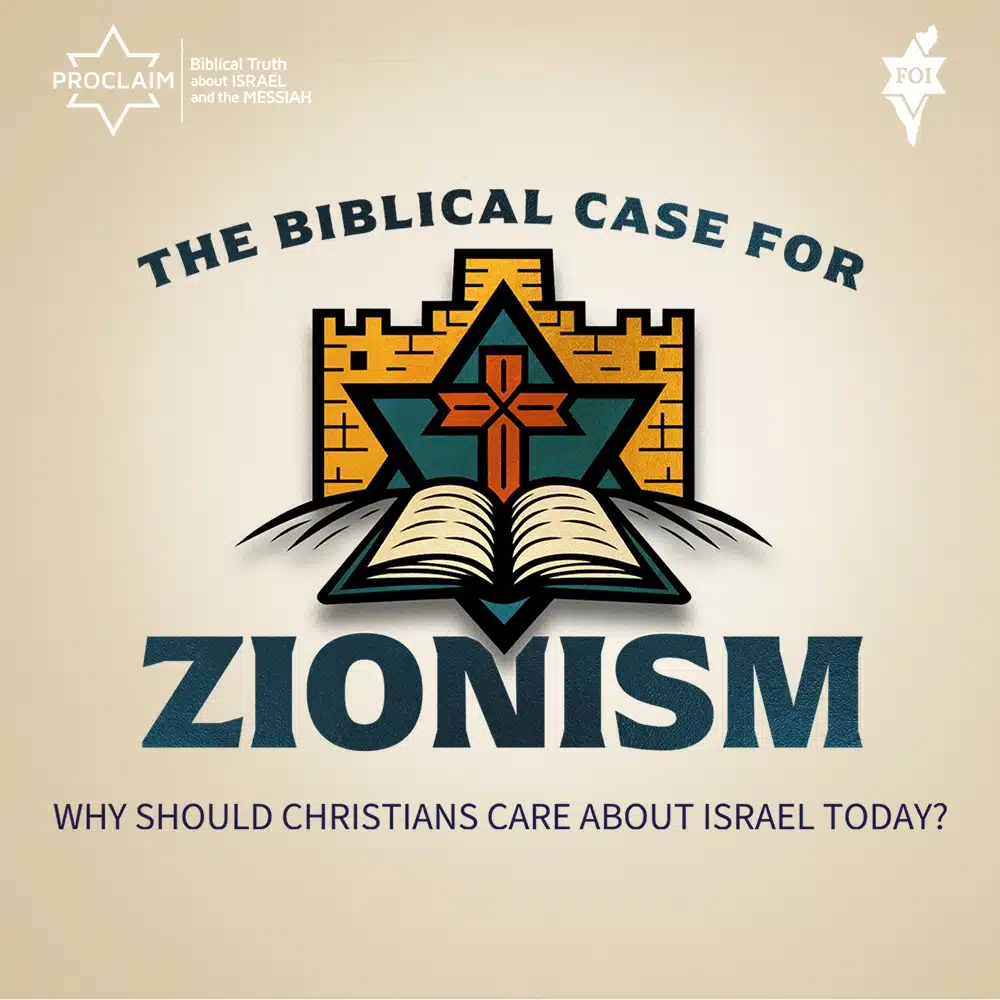
Why Should Christians Care about Israel Today?
In an age of rising antisemitism, this question has never been more pertinent.
Join The Friends of Israel Gospel Ministry as we examine The Biblical Case for Zionism. Each message will explore a different section of Scripture to show how the Bible overwhelmingly supports Zionism—the idea that we should love the Jewish people and support the modern state of Israel.
We invite you to come eager to learn and trust you will leave with a renewed confidence that God’s people should love whatever God loves—and that includes Israel.
Apples of Gold: Jesus My Rabbi
Always eager to share the gospel, Zvi went to the ultra-Orthodox synagogue where he met other Holocaust survivors. The men asked Zvi about his synagogue and his rabbi. Zvi used this opportunity to testify that Yeshua Hamashiach (Jesus Christ) is his Savior, citing Isaiah 53 as the biblical foundation for his belief. Although initially met with anger for mentioning Yeshua, Zvi challenged them to follow God's Word directly rather than relying on the teachings of men and rabbis. The conversation ended on a friendly note, with the men expressing a desire to speak with Zvi again in the future.
Music
The Friends of Israel Today theme music was composed and performed by Jeremy Strong.
Partner with us!
Your financial gift is essential—it ensures we stay on the air, teaching biblical truth about Israel and the Jewish people. If this program has ministered to you, please consider making a gift today.


