

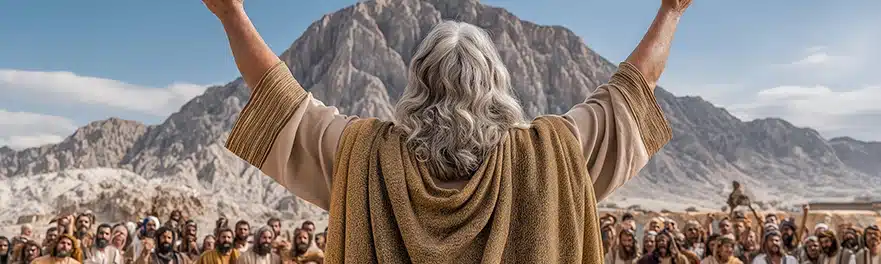
The Shema, Part 2:
Before the call to love God “with all your heart,” the well-known Shema begins with an instruction to “hear.” While this part of the Shema is easy to overlook, it sets the tone of God’s Word to the Israelites, as it invites them to know and follow Him truly, developing a heart of loving obedience. Part 2 of our series on Deuteronomy 6 examines God’s call to the Israelites to change their hearts and guide them into true devotion to Himself.
The Shema didn’t place the instruction to love as a correction to the Levitical Law. Rather, it taught that to keep the Law without a heart filled with love is useless. God instructed Israel to hear His voice, for listening to Him produces the thorough, complete love commanded in the Shema: to love the Lord “with all your heart, with all your soul, and with all your strength.” Be encouraged this week to give the Lord your whole heart—your whole being—in loving submission under His sovereign hand.
If you missed Part 1 of this series, you can find it in our archives.
Steve Conover: Thank you for joining us for The Friends of Israel Today. I'm Steve Conover, executive director here at The Friends of Israel, with me is our host and teacher, Chris Katulka.
Chris Katulka: Steve, we're in the middle of a series that we're doing here called Loving God With Your Whole Heart: The Shema from Deuteronomy. And the Shema is an interesting Hebrew word. It means to “listen” or “to hear,” but it's really the heartbeat of the law of God because it was never about the rituals as much as it was about the relationship. And that's what we're trying to show here during this series is that the law was important, but the law had to originate from somewhere and it couldn't originate just from tablets, it had to come from the heart and that's where Moses is orienting us today as we enter into our second part of our series here.
Steve Conover: We look forward to it. But first in the news, Israel's military responded after Hezbollah rockets struck Israeli territory in the North despite intense behind the scenes pressure from the Trump administration to absorb the fire to protect ongoing diplomatic negotiations. Israel's actions of self-defense have frustrated the Trump administration, which is trying to make a deal with Iran.
Chris Katulka: Well, Steve, here's my take. Iran is using Hezbollah in Lebanon as leverage for peace trying to preserve itself and Israel is Hezbollah's number one target. Now, a lesser government would've tried to stay quiet to keep Washington happy, but see, Israel didn't do that. And why? Because well, they reserve the right to defend itself from the endless attacks from Hezbollah and ultimately the source of Hezbollah and Hamas, Iran.
Chris Katulka: Well, we're in the middle of a series that we're calling Loving God With Your Whole Heart: The Shema from Deuteronomy 6. And we're not just looking at the law of God from the Torah given by God to Moses on Mount Sinai. We're looking at the heart of the law— the Shema, which means to “listen” or “hear” from God who gives the law and where that law emanates from. Is it just an act performed by the Israelites to please God or does it come first from the heart?
Before Moses gives Israel a single law in Deuteronomy, before he warns them about entering the promised land, before he tells them what to do when they get into the land, before any of the practical instruction that fills the chapters ahead in Deuteronomy, he tells Israel to listen. Shema, that's what he says. Hear. Hear, O Israel. That's the first word, not obey, not perform, not sacrifice, it's “hear.” Listen to me, and everything that follows in what we call the Shema, the great confession of Israel, the prayer that's worn in phylacteries of Jewish worshipers. The words recited morning and evening by faithful Jewish people for across thousands of years, everything hangs on that opening imperative. Listen, hear me. And before you can love, you have to hear. Before the heart can be moved, something has to reach it. And Moses is not beginning with a command to act.
He's beginning with a call to receive. Shema, Israel, “Hear, O Israel. The Lord our God, the Lord is one. And you shall love the Lord your God with all of your heart and with all of your soul and with all of your might.” Six words in Hebrew for the confession itself. One sentence for the command that defines what covenant life is actually for. And in that sentence, the entire trajectory of the Bible's understanding of what God wants from his people comes into focus. Not in the details of the legislation of the book of Leviticus, not in the priestly structure of the tabernacle, but here in this single world-reordering declaration to do what? To love God. Now, there's a temptation when we move from Leviticus to Deuteronomy and specifically to the Shema, to read it as a correction. As if Moses is walking back the legal and ceremonial architecture of the earlier books saying in effect, "You know what? Forget about Leviticus. Forget about what God was doing there. What God really wants is just love."
Well, see, that reading is a mistake and actually does harm to both texts. Leviticus is not a wrong turn that Deuteronomy corrects. The God who gave the detailed sacrificial law at Sinai is the same God who commands love in the Shema. The priestly system and the great command are not in competition, they're in conversation. But they are in conversation about a real problem. And the problem is this: the human heart has a remarkable capacity to build elaborate religious structures while remaining fundamentally unchanged inside them. To learn the liturgy without loving the God the liturgy is for, to master the external form while the interior life stays barren. This is not a problem unique to ancient Israel. This is a constant temptation of every religious community and every age.
The tendency to let the practice of faith become a substitute for the heart of faith rather than its expression. And what Moses is doing in Deuteronomy and what the Shema crystallizes in particular is not replacing the practice with the heart. He is insisting that the practice must grow from the heart or it's not really the practice of faith at all. It's a performance. It's religious theater. The distance between those two things, the practice that grows from love and the performance that mimics it is the distance between Leviticus rightly received and Leviticus reduced to a system. Because it is worth saying clearly, there is heart in Leviticus. Don't get me wrong here. Leviticus is full of heart. It would be a serious error to read the book of sacrifice and purity as a loveless legal code. The Day of Atonement is not a bureaucratic exercise. It's a profound and costly act of grace built into the calendar of the nation of Israel in which once a year the high priest enters the most sacred space in the world and makes atonement for the sins of the whole people.
All of it. The whole year's worth. The blood carried behind the veil, the scapegoat bearing the confessed sins of Israel into the wilderness. These are not cold transactions. They're a picture of a God who takes sin seriously enough to deal with it and who makes a way for his people to be clean before him. And this is not a God who is indifferent to the heart. That is a God who has structured the whole sacrificial system around the question of what stands between his people and himself and has moved to remove it. That's grace. That's love. But the sacrificial system requires something of the worshiper that the system itself could not provide. It requires that the one bringing the offering actually knows what the offering is for. That the Israelites standing at the door of the tent of meeting with a lamb in his hands is not simply completing a religious obligation, but is coming before a Holy God with a genuine acknowledgement that something between them needs to be addressed.
A genuine trust that God has provided a way. Take away that interior heart reality and the sacrifice is just a ceremony. The lamb still dies. The priests still perform his function. The blood is still applied, but the whole thing has become what the prophets will later condemn in the Old Testament as a religious form without the one thing it was designed to carry. See, the Shema is Moses naming that interior reality directly and commanding it. "You shall love the Lord your God with all your heart.” Let me tell you the Hebrew word for heart. It's lev. That's the word for heart, lev. And in Hebrew thought, the heart is not primarily the seat of emotion the way we tend to use it in English. We say heart and we mean feelings. The warm, spontaneous, often involuntary surge of affection or grief or longing. But see, in Hebrew, lev is broader and deeper than that.
It's the center of the whole inner person. The place where thought and will and desire and intention all converge in one place. So when Moses commands love with the whole lev, with the whole heart, he's not commanding a feeling. He's commanding an orientation of the entire interior life toward God. You are thinking, you are choosing, you're wanting, you're deciding, all of it toward him, all of it his. And this is why the Shema begins with the word “hear” because the reorientation of the heart that Moses is calling for does not come from one's willpower alone. See, it arises from the God of Israel who is one. Ehad, one. Not one among many, not the highest among the pantheon of gods, not the local deity of a particular tribe among other tribes with their own deities. One, uniquely and comparably entirely himself. Yahweh, our God. Yahweh is one.
And to hear that, to truly hear it, let it land. Let it reorganize your understanding of reality. It's to find yourself in a position where the only coherent response is love. Exclusive, wholehearted love toward the Creator of all things. Because if he is what the Shema says he is, then there is no other object of love that deserves to compete. Moses is not engineering an emotional response in Deuteronomy. Let me get that straight. There's no emotional engineering going on here. Moses is simply presenting a reality and calling Israel to hear it deeply enough that the response follows naturally. You shall love because once you've truly heard who he is, love is the only thing that makes sense. And when we come back, we're going to continue our conversation on the Shema. So stick around.
Steve Conover: How we understand the Bible really matters. And a big part of that is how we view Israel in God's plan.
Chris Katulka: Yes, Steve, exactly. And Israel plays such an important role in the Scriptures and that's why at this year's Friends of Israel's PROCLAIM Conference, we're going to be looking at A Biblical Case for Zionism. We're going to be asking a crucial question. Why should Christians care about Israel today? Because see, how you view Israel actually impacts how you understand all of Scripture.
Steve Conover: And I'm excited about this conference because it isn't just about current events or politics.
Chris Katulka: No, actually it's all about God's promises. See, if God keeps his promises to Israel, we can trust him to keep his promises to us. And that's why this issue matters so deeply, not just for us here at Friends of Israel, but for every believer.
Steve Conover: It truly comes down to knowing God, rightly knowing his Word and responding to what he loves.
Chris Katulka: And that's why we want you to join us as we study A Biblical Case for Zionism, July 17th and 18th in Winona Lake, Indiana, August 14th and 15th in Lancaster, Pennsylvania, or October 16th and 17th in Richmond, Virginia.
Steve Conover: If you've missed those dates, don't fear. You can find out more about our PROCLAIM conferences and check those dates at foiradio.org. Again, that's foiradio.org.
Chris Katulka: Welcome back, everyone. We're in the middle of our series called Loving God With Your Whole Heart: The Shema from Deuteronomy chapter six. I encourage you to read it. It's where we've been looking at God's call to Israel to listen or hear that the center of the law is love for God. And see, then he goes on further. He says, "Love God with all your heart, all your soul, and with all your might." And that's what we're going to be looking at through the rest of this series. It's a threefold repetition, and it's not redundant. It actually shares the wholeness of what God wants from us. There is no partition in the self that stands outside of this love. There is no corner of the interior life that remains private, uncommitted, reserved for others. The soul, your life, your very self belongs to him. Your strength, your resources, your capacity, your energy deployed in the world belongs to him, all of it.
The Shema doesn't command a devotion that coexists alongside other devotions and simply ranks higher. It commands a devotion that reorganizes all other loves, all other allegiances, and all uses of the self around a singular center. This is the biblical foundation on which every commandment and Deuteronomy rests. Moses is not presenting the laws that follow as a list of religious obligations to be fulfilled in addition to living your life. He's presenting them as the natural outgrowth of a life whose center has been rightly placed because if you love God with everything you are, then the commandments are not a burden imposed from outside. They are actually the description of what loving him actually looks like in practice. They are love, specified, love given hands and feet and a daily shape to move forward to love God, to serve him and to serve others. This is the reframe that changes everything and it is the reframe that makes the distance between religion and relationship visible.
See, religion says, "Here are the requirements, meet them.” The relationship between you and God is measured by your compliance and your faith. Leviticus misread can sound like this. The sacrificial calendar, the purity codes, the detailed instructions about what is clean and unclean. If you receive all of it as a system to be maintained rather than a story to be inhabited, then you can work your way through the whole thing without your heart ever being engaged at all. You can be ritually compliant and spiritually absent. You can fulfill every requirement of the law as Paul will later describe in his own pre-Damascus road lifestyle and still be, as he also says, “the chief of sinners,” because the whole edifice was built on something other than love. See, relationship says, “hear,” that word, Shema, who he is, let that hearing go all the way down. Let it reach the lev, the heart, the center of self, and then love him from there.
And the practices of faith are not the foundation. They are the fruit of your relationship with the Lord. They grow from something and what they grow from that Jewish people have known for many centuries is the Shema: “Hear, O Israel, the Lord our God, the Lord is one.” And Moses understood that Israel's repeated failures in the wilderness were not failures of knowledge. They knew the law. They had been there when it was given. Their ears had heard the thunder of Sinai. Their eyes had seen the pillar of cloud and fire. They had the external markers of covenant identity. What they lacked, what the golden calf and the compliance and the stiffnecked resistance all pointed to, was a heart that had truly heard. A heart that had taken in not just the commands, but the God behind the commands and had responded with love. See, the Shema is Moses' attempt on the far side of 40 years of evidence to get Israel to start from the right place. Not the sacrifice first, not the law first, not the ritual calendar first.
First, hear who he is. Then love him with everything you have. Then only then the practice of faith becomes what it was always designed to be. The lived expression of a love that has taken root in the only place it can actually grow, in the heart, the whole heart. The heart that has been circumcised of its stubbornness and open to the only one worthy of it. I find it interesting as we close that at Jesus' transfiguration in Matthew 17, God says to Peter, James and John, "Listen to Him," speaking of Jesus. God is pointing back to Deuteronomy in two ways, I believe. First, Moses actually prophesied in Deuteronomy 18:15 that a prophet like him would arise like himself in the future and Israel should listen to him. It actually says that in Deuteronomy 18:15, “Listen to him.” But also, “listen” or "hear” is the same word for Shema in Deuteronomy 6:4.
"Hear, (listen) Israel, the Lord our God, the Lord is one.” And now God is telling us to listen and to hear from who? His Son. And where does Jesus constantly point us when it comes to following Him? First to the issues of the heart. So listen to Him, hear Him. He's calling you, not to ritual, but first and most important to a love for God that emanates from the heart.
Steve Conover: Now Apples of Gold, a dramatic reading from the life and ministry of Holocaust survivor, Zvi Kalisher.
Mike Kellogg: I have lost many jobs because of my faith. I had worked at one place for a long time, and the workers treated me badly because I believe in the Lord Jesus and shared my testimony with them.
I was very surprised, therefore, when one of them recently gave my wife an invitation for me. The invitation read, “You will see something you have never seen before, and you will never forget what you saw.”
That evening my wife and I went to the appointed place. There were many people there. Most were from Mea She’arim, the ultra-Orthodox section of Jerusalem. I asked someone what was going on. He said, “We are having a celebration. One who was lost has returned to the faith. You will see the great hero today!”
Just then, the so-called “great hero” entered the hall. He was a young man with a long beard and curls. Everyone clapped. When I asked why everyone was applauding, he said, “We are going to make you like him. He used to be as you are, but now he has returned to Judaism.” I replied, “You can see this every year at the annual Purim carnival, but I am surprised to see this after the carnival.”
Then he said, “Be quiet! The guest of honor wants to say something.”
The guest of honor spoke only a few words. “I have changed. You can see my beard and curls. I am like you again.” Everyone clapped enthusiastically. Then everyone began to congratulate him.
When it was my turn to greet him, he said, “Do you recognize me? We worked together for a while. Now I am truly a Jew.”
I told him, “Your beard and curls do not cover your sin. Your heart is as hard as stone.”
“Do not say that!” he whispered. “You cannot speak freely here like you would at work.”
I said, “If you really want to turn to God, a beard and curls will not help. The Lord said you must ‘Come, take up the cross, and follow Me’ [Mk. 10:21].”
He became very agitated and said, “Do not talk like that; these people can kill you!”
One who saw us talking asked me, “Do you have something to say?”
“Yes,” I replied, “Does changing a man’s clothes and growing a beard and curls mean his sins are forgiven?”
“No,” the man admitted, “but it shows we are different from others.”
I replied, “What you look like on the outside cannot change what you are on the inside. You cannot be right before a holy God simply by changing your outward appearance. The Lord must change your heart.”
“How can you change a heart?” he asked.
I told them, “I challenge you to read the Holy Scriptures. In Ezekiel 18:31–32, the Lord did not say to change our clothes. He said, ‘Cast away from you all [your] transgressions, and get yourselves a new heart and a new spirit.’”
After this, all were quiet. Then one said, “You are right, but what can we do now?”
Another said, “Oh that someone would remove the dust from my eyes!” I replied, “God has said, ‘Come now, and let us reason together. Though your sins are like scarlet, they shall be as white as snow; though they are red like crimson, they shall be as wool’ [Isa. 1:18]. God has revealed
Himself in the Bible, and in His Word we can find how to have forgiveness of sin and life everlasting.”
Treacherous men tried to trap me, but the Spirit of God began to work in their lives. Perhaps the seed that was planted will one day grow into life everlasting.
Steve Conover: Thanks for joining us for today's episode of The Friends of Israel Today. Again, we would love for you to join us at one of our PROCLAIM Prophecy Conferences, where you'll be equipped to give a biblical case for Zionism. You can find out more at foiradio.org. Again, that's foiradio.org. Chris, where are we headed next week?
Chris Katulka: Well, Steve, today we looked at the heart. Remember it says that you should love the Lord your God with all your heart, your soul and your might or your strength. Well, this week we looked at the heart. Next week we're going to look at the soul. What does that mean as we're thinking about God calling us to listen to him, that ultimately the law comes from inside of who we are, that our love and our relationship with God should drive us to want to love God more and to fulfill his commandments. Well, it's not just our heart, it's also our soul as well. So we're going to look at that next week.
Steve Conover: As mentioned, our web address is foiradio.org. Again, that's foiradio.org. Our mailing address is FOI Radio, PO Box 914, Bellmawr, New Jersey, 08099. Again, that's FOI Radio, PO Box 914, Bellmawr, New Jersey, 08099. You can call our listener line. That number is 888-343-6940. Again, that's 888-343-6940. As we close, I want to thank our radio team: Host and teacher Chris Katulka, executive producer, Lisa Small, associate producer, Sarah Fern, engineer Bob Beebe, program editor, Jeremy Strong. Apples of Gold was voiced by the late Mike Kellogg and I'm Steve Conover, executive director here at The Friends of Israel. The Friends of Israel Today is a production of The Friends of Israel Gospel Ministry. Passion for God's Word. Compassion for God's Chosen People.
PROCLAIM Conference
PROCLAIM Conference
Why Should Christians Care about Israel Today?
In an age of rising antisemitism, this question has never been more pertinent.
Join The Friends of Israel Gospel Ministry as we examine The Biblical Case for Zionism. Each message will explore a different section of Scripture to show how the Bible overwhelmingly supports Zionism—the idea that we should love the Jewish people and support the modern state of Israel.
We invite you to come eager to learn and trust you will leave with a renewed confidence that God’s people should love whatever God loves—and that includes Israel.
Apples of Gold: "God Looks On the Heart"
Zvi faced numerous hardships for his faith, often losing jobs because of his belief in the Lord Jesus. At one particular workplace, he endured harsh treatment and ridicule from his colleagues. To his surprise, those very same men eventually invited him to a celebration. It was held for a man who had converted to Judaism and renounced Christ—an event they hoped would pressure Zvi into doing the same. Hear the story of what happened when these men attempted to lead Zvi into a trap.
Music
The Friends of Israel Today theme music was composed and performed by Jeremy Strong.
Partner with us!
Your financial gift is essential—it ensures we stay on the air, teaching biblical truth about Israel and the Jewish people. If this program has ministered to you, please consider making a gift today.


