

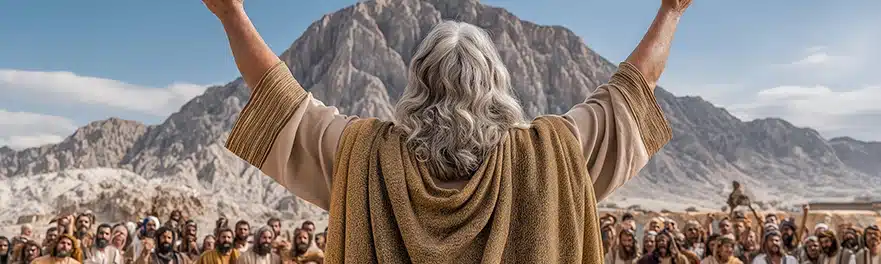
The Shema, Part 3:
Are we made of body and soul, or are we one holistic being? After studying the heart last week, our study of the Shema in Deuteronomy 6 brings us to Moses’ instruction to the Israelites to love the Lord with all their soul. The Hebrew word nefesh used in Deuteronomy 6 sheds light on what our soul truly entails. Rather than ghosts (souls) trapped inside machines (bodies), we were designed by God as one whole entity. Nefesh indicates our core being as God created us.
So when Moses commanded the Israelites to love God with all their soul—their nefesh—more than mere outward obedience was required. Rather than compartmentalizing their lives and offering a surface-level obedience of the Levitical Laws, the Israelites needed to worship Him with the entirety of their being. Believers in the Lord Jesus are called likewise to love God with all that we are—so let’s commit to this kind of love each day!
If you missed the first two parts of this series, you can find them in our archives.
Steve Conover: Thank you for joining us for The Friends of Israel Today. I'm Steve Conover, executive director here at The Friends of Israel Gospel Ministry. I want to encourage you all to visit foiradio.org where you can connect with us. We have over a decade of content on the site and it features Chris Katulka's insightful teaching and various interview guests. Again, that's foiradio.org. Today, our teacher Chris Katulka continues part three of his four-part series on the Shema from Deuteronomy 6. We're looking forward to that, but first in the news, Palestinian Authority President Mahmoud Abbas has announced presidential elections will be held in 2027, though no specific date has been set. The announcement came via an official decree reported by the Palestinian news agency, WAFA. Abbas, aged 90, limits decision making to his tight inner circle and rarely leaves his headquarters in the city of Ramallah except to travel abroad.
The Times of Israel reports, Abbas and the Palestinian Authority are under mounting pressure from the United States, the European Union, and Arab states to implement reforms and hold elections amid widespread accusations of corruption, political stagnation, and the body's declining legitimacy among Palestinians. You know the last time Palestinians held elections was 20 years ago in 2006. Hamas won that election and the result was a violent civil war that ultimately split Gaza from the West Bank. Even today, Hamas continues to poll surprisingly well among Palestinians and depending on who they face, they could very well win again. That's one reason many observers believe Habas has remained in power for so long. While the elections might sound like a step toward reform, they also carry the very real possibility of bringing Hamas back to power, a risk that could have significant consequences for both the Palestinian territories, Israel, and the world.
Chris Katulka: There's a word that runs through the Hebrew Bible so often and in so many contexts that the English translation has never quite known what to do with it. The Hebrew word is nefesh and depending on where you encounter it, your English Bible could render it as soul or life or person or self or even a part of the body, the throat or even your appetite, nefesh. That range is not a translation problem to be embarrassed about. In fact, it's a clue. Nefesh is doing something in Hebrew thought that the English word soul, that's what nefesh means, soul, with all its borrowed Greek philosophical understanding was never built to carry. The Hebrew, it has its own connotations of this word nefesh, which we often translate as soul. So before we can understand what Moses means when he commands Israel to love the Lord with all their nefesh, with all their soul, we have to let go of some assumptions.
And that's what we're talking about. We're talking about the Shema. We're talking about “Hear, O Israel, the Lord our God, the Lord is one.” And we're saying that's when Moses says, "You should love the Lord your God with all your heart, soul and might or strength." When most of us hear the word soul, we hear something Greek before we hear something Hebrew. We hear Plato, the philosopher's idea of the immortal, the immaterial essence trapped inside of a physical body, the real you, the ghostly and eternal, temporarily housed in flesh that will eventually fall away and release it. That picture has shaped centuries of Western religious imagination and it has quietly worked its way into how Christians read their Bible even in places where the biblical text isn't saying anything like that at all. That's what we want to talk about today. Nefesh or “soul” doesn't mean the ghost that's hiding inside of a machine. The first time that the word appears in the Scriptures, it's not describing something that's added to the human body.
It's describing the human body alive. Genesis 2 tells us that God formed the man from the dust of the ground and breathed into his nostrils the breath of life and the man became a nefesh chayah, a living soul in the older translations or more precisely a living being. The breath of God enters the dust and the result, the whole result, dust and breath together is called nefesh. Not a soul inserted into a body, but a body animated by the breath of God that is the soul, the whole undivided and alive. This matters enormously for how we hear the Shema. Hear O Israel, the Lord our God, the Lord is one. When Moses says, "To love the Lord your God with all your nefesh, your soul, he is not asking for devotion from some detached spiritual component while the rest of you, the body, the appetites, the daily physical existence remains exempt.
He's actually asking for the love of your whole living self. There is no part of you that nefesh leaves out. This is a very Jewish concept. The range of meanings nefesh carries across the Hebrew Bible bears this out. In Genesis, the word is used for animals too. Every living creature, every nefesh chayah that moves on earth. Now, this is not because Scripture is collapsing the distinction between humans and animals, but because nefesh at its root means a living breathing thing. It's alive itself embodied. In other passages, nefesh refers to a person's throat or neck. Why? Of all things for nefesh to describe, why the throat or the neck? Well, that's the place where breath physically passes in and out of the body. The most literal location of life's coming and going. Psalms speak of the nefesh thirsting, the nefesh hungering, the nefesh panting like a deer for streams of water, the soul.
This is not a metaphorical language for some abstract spiritual yearning floating free of the body. It's the language of a whole embodied person. The person who gets thirsty, who gets hungry, who pants for breath, experiencing longing in the fullest, most physical sense available to human language, nefesh. And this is precisely why nefesh is also repeatedly simply translated as life. “Save my nefesh,” as the Psalmist cries out. Save my life. “He flees for his nefesh.” He flees for his life. When Scripture wants to talk about the totality of a person's existence, the whole bundle of breath and blood and need and longing and will that makes a person a person, nefesh is the word it reaches for. Not a fragment of you, not the spiritual residue left over once the physical is subtracted. Nefesh is all of you. This is the background against which Moses commands love the Lord your God with all your soul, your nefesh.
Set this beside lev, like we talked about last week. In the previous episode, Lev is the Hebrew word for heart. Heart in Hebrew thought is the center of will, intention and thought. The place where decisions are made and orientations are set. But see, nefesh is something different and complimentary to lev. If lev, the heart is the steering wheel, nefesh is the whole vehicle in motion. The entire embodied breathing and hungering, longing life of the person moving through the world. To love the Lord your God with all your heart is to have your inner orientation set toward him. To love him with all of your nefesh is for that love to claim your whole existence, your physical life, your appetites, your longings, the totality of what it means for you to be alive at all. And this is where the Shema becomes uncomfortable in exactly the way it should be.
Because if nefesh means your whole life, your actual breathing, eating, working, longing existence, then loving God with all of your nefesh is not a request for an interior feeling that can be kept separate from how you live. It's actually a claim on everything that you are. Your nefesh thirsts, the Psalmist says. And that thirst, that whole embodied longing belongs to who? God. Your nefesh can be in trouble, in danger, in anguish. And Moses is saying that even in the chambers where life is most desperately physically at stake, love for God claims that ground as well. There's no private compartment of bodily need or longing for self-preservation that stands outside the command. Nefesh leaves nothing out because nefesh by definition in Hebrew is the whole of you. It's everything and alive. This is also not incidentally why nefesh becomes the word Scripture uses when life itself is on the line.
The phrase “pursuing someone's nefesh" means hunting them to kill them. To save a nefesh is to save a life from death. When the Shema asks for love with all of your nefesh, it stands in continuity with a later harder demand that Jesus will make using exactly this conceptual frame that whoever would save his life, the direct concept of nefesh here must first be willing to lose it for his sake. The love that the Shema demands is not a love that costs nothing. It's a love that claims the very thing a person would otherwise spend every instinct protecting, which is what? Life itself. And here we return to the question that has run through this whole entire series, the distance between religion practiced outwardly and relationship inhabited from the center of self. Now, listen, when we come back, we're going to continue this conversation on nefesh, which is often translated as soul.
And we're going to see, again, this concept that the distance between the book of Leviticus and Deuteronomy. And we're going to see that again, it wasn't an accident where Deuteronomy is talking about the heart, the soul and the might of our love for God. While Leviticus again is showing us this sacrificial system, we're going to see the distance, but how God collapses that distance and why both are important. So stick around.
Steve Conover: How we understand the Bible really matters. And a big part of that is how we view Israel in God's plan.
Chris Katulka: Yes, Steve, exactly. And Israel plays such an important role in the Scriptures and that's why at this year's Friends of Israel's PROCLAIM Conference, we're going to be looking at A Biblical Case for Zionism. We're going to be asking a crucial question. Why should Christians care about Israel today? Because see, how you view Israel actually impacts how you understand all of Scripture.
Steve Conover: And I'm excited about this conference because it isn't just about current events or politics.
Chris Katulka: No, actually it's all about God's promises. See, if God keeps his promises to Israel, we can trust him to keep his promises to us. And that's why this issue matters so deeply, not just for us here at Friends of Israel, but for every believer.
Steve Conover: It truly comes down to knowing God, rightly knowing his Word and responding to what he loves.
Chris Katulka: And that's why we want you to join us as we study A Biblical Case for Zionism, July 17th and 18th in Winona Lake, Indiana, August 14th and 15th in Lancaster, Pennsylvania, or October 16th and 17th in Richmond, Virginia.
Steve Conover: If you've missed those dates, don't fear. You can find out more about our PROCLAIM conferences and check those dates at foiradio.org. Again, that's foiradio.org.
Chris Katulka: Welcome back everybody. We are talking about the Shema from Deuteronomy 6. Last week we looked at the concept of loving the Lord your God with all of your heart in Hebrew, lev. This week we're looking at loving the Lord your God with all of your soul. We're talking about this word, nefesh, which is for “soul.” But really what it encapsulates is our whole self, our whole living being. And again, Leviticus is not absent from this picture as we're looking at Deuteronomy and we're looking at the heart and the soul. The sacrificial system deals constantly in the language of nefesh. The life of the animal is given in the place of the life of the worshiper. The blood that is the nefesh, it says, poured out as atonement in Leviticus chapter 17, verse 11. In fact, Leviticus 17 says it absolutely plainly, the nefesh of every creature is its blood.
The entire logic of substitutionary sacrifice rests on this equation, life given for life. nefesh for nefesh. So when an Israelite brought the lamb to the altar, the ritual was never meant to be merely procedural. It was meant to dramatize what life and death and the cost of sin actually meant. nefesh was given so that nefesh could be spared. But here is the danger Moses is naming when he calls Israel to love the Lord their God with all of their nefesh. A person can participate in that entire sacrificial drama of Leviticus, bring the animal, watch the blood, walk away ritually clean and still withhold their whole life from the God the ritual was pointing toward. The lamb's nefesh can be surrendered on the altar while the worshiper's own nefesh remains exactly where it always was, oriented towards self-preservation, self-interest. The protection of one's own breath and appetite and longing untouched by what the sacrifice was supposed to mean.
And this is the gap between the practice and the heart that produced it. Leviticus can be performed by a nefesh, a life that has never once been surrendered to the God Leviticus exists to honor. See, the Shema, “Hear, O Israel, the Lord our God, the Lord is one,” closes that gap by refusing to let love remain theoretical. It will not be love with all your heart full stop as though the interorientation alone satisfies the command while your actual physical breathing existence goes on serving other masters. No, heart and nefesh, heart and life and might together, Moses stacks them precisely because love that does not reach into your whole life, your appetites, your fears, your instinct for self-preservation is not yet the love the covenant requires. See, the heart sets the direction and the nefesh is the whole self walking in it. And this is also why the great commandment, when Jesus repeats it centuries later, loses none of its force and adds soul to the list that already includes heart as though to make doubly sure no one mistakes love for God as a matter of sentiment alone. Love that has not reached your own nefesh, your appetites, your fears, your daily embodied existence, the life you would otherwise spend protecting at all costs has not yet reached far enough. See, the command was never asking for a feeling that kept safety upstairs while the life downstairs went on as before. It was asking for everything that breathes in you. See, Moses stood before a generation that had nearly lost their lives more than once in the wilderness for the sake of self-preservation, for fear, for hunger, for thirst, for the desperate animal instinct to survive at any cost, even the cost of trusting God. And when he tells them that instinct, that whole embodied self that fears and hungers and longs and clings to its own breath, that belongs to him, to God too. Not just your thoughts, not just your private devotion, your whole being, your whole life—nefesh.
See, next time in our final episode, we're going to see exactly what happens when Israel fails to give God exactly that—heart and nefesh both—across the centuries of monarchy and how the prophets Jeremiah and Ezekiel began to speak of a day when God himself would not merely command this wholehearted love but create it, writing his law not on stone tablets, but on the very nefesh and lev, the life and the heart, of his people. And that's what we're going to talk about next week as we wrap up our series that's all about me’od, to go even beyond what we've been talking about, to love the Lord your God with all your heart, with all of your life, your nefesh, your soul, and with all of your might or very being itself.
Steve Conover: Now, Apples of Gold, a dramatic reading from the life and ministry of Holocaust survivor, Zvi Kalisher.
Mike Kellogg: For many months I had not seen the ultra-Orthodox from the Chabad-Lubavitch movement. They try to convince people that their late leader, Rabbi Menachem Mendel Schneerson from New York, was the messiah.
I was wondering whether they had left for good, until recently when I heard a knock on my door. Several ultra-Orthodox men stood outside with one of their well-known rabbis. A few years earlier, this rabbi had argued with me on a crowded bus and shouted at me concerning my faith. He did not know upon whose door he had knocked and was greatly surprised when I answered.
“We have come to visit you,” he said, trying to appear in control. With him were two young assistants whom he was instructing in how to witness to people about Rabbi Schneerson.
“What news do you bring?” I asked.
“Important news,” said one of the young men. They began to speak about Rabbi Schneerson, about whom many in Israel no longer want to hear.
“Do you believe he is the true messiah?” one asked.
“You have believed a lie,” I replied. “You do not know the truth about God, so you have fallen into deep sin and believe a great falsehood.”
Nervously, the men looked at their rabbi. “Did you hear what he said about our holy messiah?” one asked him.
Then one asked me, “Why do you speak against such a holy one?”
“You are worshiping blindness,” I said. “And you will become spiritually blind, as your teacher has become.”
“How do you know you follow the truth?” one asked.
“Because I follow the Bible,” I replied. “I believe only in Almighty God, as is written in the Bible. Is the Bible not holy enough for you that you spend so much time reading books by rabbis instead of reading the Bible? And do you pray from the depths of your heart or from prayer books?”
“We pray from prayer books. How do you know how to pray without a prayer book?” one asked.
“I pray before the Lord, from my heart; and I am sure my prayer is received in heaven.” I showed them the important passage of Deuteronomy 6:4–6, where it is written: “Hear, O Israel: The LORD our God, the LORD is one! You shall love the LORD your God with all your heart, with all your soul, and with all your strength. And these words which I command you today shall be in your heart.”
They recite these verses many times each day, but they do not understand what they say because they read so quickly.
We had a nice conversation, and I gave them each a piece of cake and a cup of coffee. This hospitality surprised them. One young man remarked,
“We know you are against us. Yet you receive us warmly, as friends. Why?”
“I believe in Almighty God,” I said. “With Him there is no hatred, only love.”
Now the rabbi stirred, emerging from his calmness. “Do you know with whom you speak? He has believed in This Man!”
Then the students wanted to know how I came to believe in Jesus. So I told them! It was a great opportunity for me to explain the true way of salvation. I opened my Bible and read to them what is written about the Lord Jesus in the Old Testament, particularly Isaiah 53. They listened, reading along with me while glancing at the rabbi, waiting to see what he would do. But he did nothing. Then he said, “It would be better if we left.”
“Why?” one asked. “We are reading the Bible. Is it forbidden to read the Bible?”
But they left, telling me, “We want to see you again.” Please pray they return and that we can have another conversation about the Lord.
Steve Conover: Thank you for joining us for today's episode of The Friends of Israel Today. Again, we would love for you to join us at one of our PROCLAIM prophecy conferences where you'll be equipped to give a biblical case for Zionism. You can find out more at foiradio.org. And join us next week as Chris finishes our series on the Shema. As mentioned, our web address is foiradio.org. Again, that's foiradio.org. Our mailing address is FOI Radio, PO Box 914, Bellmawr, New Jersey, 08099. Again, that's FOI Radio, PO Box 914, Bellmawr, New Jersey, 08099. You can call our listener line. That number is 888-343-6940. Again, that's 888-343-6940. As we close, I want to thank our radio team: host and teacher, Chris Katulka, executive producer, Lisa Small, associate producer, Sarah Fern, engineer Bob Beebe, program editor, Jeremy Strong, and Apples of Gold was voiced by the late Mike Kellogg. I'm Steve Conover, executive director of The Friends of Israel. The Friends of Israel Today is a production of The Friends of Israel Gospel Ministry. Passion for God's Word. Compassion for God's Chosen People.
PROCLAIM Conference
PROCLAIM Conference
Why Should Christians Care about Israel Today?
In an age of rising antisemitism, this question has never been more pertinent.
Join The Friends of Israel Gospel Ministry as we examine The Biblical Case for Zionism. Each message will explore a different section of Scripture to show how the Bible overwhelmingly supports Zionism—the idea that we should love the Jewish people and support the modern state of Israel.
We invite you to come eager to learn and trust you will leave with a renewed confidence that God’s people should love whatever God loves—and that includes Israel.
Apples of Gold: "How Do You Know that You Follow The Truth?"
Imagine Zvi’s surprise when he opened his door to find several ultra-Orthodox men with one of their well-known rabbis who had once publicly rebuked him for his faith on a crowded bus years earlier. Unaware of who lived there, the men were traveling to share about the man they believed was the messiah: Menachem Mendel Schneerson, a rabbi from New York. Zvi welcomed them in and shared the truth of the Scriptures with these men who were earnestly seeking the Messiah. Listen to find out how they responded when Zvi explained the only way of salvation—through the Lord Jesus.
Music
The Friends of Israel Today theme music was composed and performed by Jeremy Strong.
Partner with us!
Your financial gift is essential—it ensures we stay on the air, teaching biblical truth about Israel and the Jewish people. If this program has ministered to you, please consider making a gift today.


