


IMG In Depth: Interview with David Gunn:
 Because God loves His people, He has dwelt among them in various ways throughout history—in the Tabernacle, the Temple, and the person of Jesus Christ. But when Jesus died on the cross to save sinners from death, God gave humanity access to Himself in a new way: within believers in Jesus themselves through the Holy Spirit.
This week, David Gunn joins the show to detail this shift from God’s localization to His personal indwelling in his article “The Nearness of God” from our latest issue of Israel My Glory magazine. David discusses how Scripture uses the word temple to describe believers, why Jesus’ encounter with the Samaritan woman at the well signaled a paradigm shift in worship, and what it means to have immediate access and nearness to God. Tune into this week’s excellent broadcast to gain a wealth of insight into God’s loving presence not only with, but within His children!
Read "The Nearness of God" by Dr. David Gunn.
Steve Conover: Thank you for joining us for the Friends of Israel Today. I'm Steve Conover, executive director of The Friends of Israel Gospel Ministry. With me is our host and teacher, Chris Katulka. Foiradio.org is where you can connect with us. We have over a decade of content on the site and it features Chris's teaching and amazing interview guests. Again, that's foiradio.org. Today is our Israel My Glory: In Depth interview, and Chris will be sitting down with Dr. David Gunn to talk about his latest article, The Nearness of God. It was featured in the July/August issue, The Four Temples: God's Houses of Worship. You don't want to miss this encouraging interview. But first in the news, former Iranian president Mahmoud Aminejad has reportedly been placed under house arrest after Iranian authorities uncovered his alleged contacts with Israel and the Mossad. According to the report, Israel had secretly explored recruiting Aminijad and potentially helping him return to power following the collapse of Iran's regime.
A collapse of power in Iran is exactly what we're seeing in the aftermath of Operation Epic Fury. With the Iranian regime significantly destabilized, a power vacuum has begun to emerge. And the big question now is who will ultimately fill that void? Only time will tell.
Chris Katulka: Hi, I'm Chris Katulka. I'm the editorial writer for Israel My Glory and the host of The Friends of Israel Today Radio program. And I'm so glad that you're with us as we do our Israel My Glory: In Depth episode here as we're looking at our most recent issue of Israel My Glory, which is all about the four temples that you can find in the Scriptures, not only from the past, but also the future to come. And it's all about God's houses of worship. And so in a moment, I'm going to share with you how you can get your one-year free subscription to our award-winning Christian magazine, Israel My Glory. You got to stick around for that. Okay? We're not going to give it away for free right away, but so stick around because today we have a very special guest, Dr. David Gunn. He's the assistant director of our media department here, and he's going to be talking about his article that he wrote in this issue, The Nearness of God, which is all about the idea of our bodies as believers being the temple of the Lord, the indwelling of the Holy Spirit.
And so David, it's great to have you with us. Thank you so much for being here.
David Gunn: Thank you, Chris. It is a privilege to be here.
Chris Katulka: Well, okay, so you describe the temple in so many great ways. You really catch people up in your article on what we've been going through in this article in this issue of Israel My Glory by showing us that the presence of God, the glory of God, it came down into the tabernacle. It came down into Solomon's temple. It came down in the person and work of the Lord Jesus, but it also comes down the moment when a believer places their trust in the Lord Jesus. It's an indwelling moment. And so you walk through this history and I want to kind of backtrack here and go to the temple because you talk about the temple veil being torn and at that moment, the barrier between humanity and God was removed. Do you think that the original Jewish audience would've kind of immediately understood the symbolism of that tearing of the veil or do you think that took time for it to sink in?
David Gunn: Yeah, it's an interesting question. We can't know for sure because the Bible doesn't tell us exactly how quickly people got acclimated to this kind of an idea and to the symbolism going on there, but I'll give you my hunch.
Chris Katulka: I like that.
David Gunn: My hunch is I think people probably picked up on it pretty quickly. And I say that for a couple of reasons. So to the first century Jewish audience that received these scriptures and that witnessed these things in the first place, the symbolism that was all bound up in temple worship was something they were very, very familiar with. We read about these things in books. For them, it was part of their everyday lived experience as well as a part of their institutional history of their nation going back centuries. So I suspect they would have pretty much seen the significance right away and that it would've sunk in relatively quickly. If I wanted to really argue for that position, a couple of observations do come to my mind from the Book of Acts. The first major ingathering of people into the church as the church is born on the day of Pentecost occurs during the celebration of the Feast of Weeks, the Feast of Shavuot, which coincidentally we are recording this on that very day.
Chris Katulka: That's right.
David Gunn: Shavuot begins tonight.
Chris Katulka: Some providence there.
David Gunn: Very providential. The Feast of Weeks was, of course, one of the pilgrim festivals, which is why you have such a large crowd of Jewish people gathered there in the vicinity of the temple. They've come from all over the diaspora to come and observe the festival at the house of the Lord, or at least in its vicinity. And that's the moment when the church is born and that's the moment when Peter gets up and preaches and you have thousands of people becoming believers in Jesus. The text doesn't overtly make the connection, but I just can't help but wonder, was the tearing of the veil, was this supernatural redecorating that had gone on in the temple in the air? Was it news? Well, you would expect it probably would be as these Jewish pilgrims are coming in for the first time. These things are having just occurred.
That would be pretty big news. And does that pave the way for them then to receive the message of the gospel? We don't know for sure, but it's very plausible. A few chapters later in the book of Acts, I believe Acts chapter six, as the word of the gospel is spreading, as the church is growing, he makes this very casual comment where he says many of the priests were coming to know Jesus. They were becoming believers. And I wonder why that would be. Maybe there are multiple reasons, but one that immediately suggests itself to me is that they would have been more familiar with the symbolism of the temple and of the worship system, the sacrifices and so on, more than anyone else in Israel. And so is there a possible connection there? I think there could be.
Chris Katulka: Yeah, those priests could have been the ones that might've gone in and witnessed the tearing of the temple veil itself.
David Gunn: Very likely.
Chris Katulka: And probably maybe even had a hunch after in direct connection with Jesus' death that things are about to change here, which was something that was not some... Jesus didn't invent this idea of the tearing of the veil and really the indwelling of the Holy Spirit. That goes back to the Old Testament, the idea of the indwelling of the Holy Spirit and that things would change. But what's interesting is that when we look at this change, that tearing of the veil, and as you so eloquently said, the idea that now there's the indwelling of the Spirit in the life of a believer, it almost begins to show this shift that's happening from a localized picture of God's presence in the temple or the tabernacle to really a broader picture of how God is working in the lives of believers around the world. So how would you respond to a Christian who still feels drawn to some sacred spaces or pilgrimage or these sites that are meaningful?
We go to Israel and you walk into the Church of the Holy Sepulcher and they're kissing the place where Jesus died, was buried and resurrected historically. They're kissing these grounds and they're almost worshiping the stones and not the actual Jesus who resurrected. How would you speak to them in this concept of localized to now a global picture of God's presence?
David Gunn: Sure. Well, some believers do find themselves particularly drawn to special places, whether that's in a church or out in nature, or you mentioned the pilgrimage sites, that's a great example of that. I don't necessarily think that that's always wrong or that a person who feels that they're sort of wired that way, that they should feel guilty about it or something like that. We were created as embodied physical beings. And I think as a part of that, it's very natural for people to feel a certain connection to physical places. You probably experienced that in your own life and even in your own relationships. If you and your wife, for example, go back to the place where you proposed, there's probably something special about that experience. It's not that being in that place magically makes you love your wife more necessarily. It's just that the place is associated with fond memories.
And so it takes on kind of a special significance to you. And so it is in the religious realm as well. Some people, for example, will find that they can worship God more easily. They can feel closer to God, maybe walking out hiking in the woods or something like this. Or many times when we go to Israel, people do have those kinds of experiences, a sort of a nearness to Jesus just because you're in this place that has a direct physical connection to what you know from the gospel records. I don't necessarily think any of that is wrong. On the other hand, it could become a problem. And I think the difference is this. Do I think about my worship and my prayer life in such a way that it is dependent on some localized thing? Do I have to be in the cathedral in order to worship God effectively?
If so, then I've probably missed a major part of the New Testament teaching on what the church is supposed to be about and what Christian worship is supposed to be about.
Chris Katulka: So the thing that I'm thinking as I'm reading through your article, The Nearness of God, is that now it's moved from a... As you were mentioning earlier, pilgrims would make a pilgrimage to be near God in the temple to worship him there in the holy place, but now he's in us. Can you speak to that a little bit? Because that's the most extreme form of nearness that there could possibly be.
David Gunn: Yeah, exactly. Well, I start out the article by pointing out that the wages of sin, according to the Bible, is death and that the essence of death is separation. We see that physically, that when we undergo physical death, that means that our spirit is separated from our body. In a similar way, there's this concept of spiritual death and spiritual death is basically the idea of the entire self being separated from our Creator. And I think we see that going all the way back to Genesis chapter three. Before the fall, Adam and Eve are living in this idyllic paradise in the Garden of Eden and it is a life that is lived in rich fellowship with God. Intimate, relational, everyday life, man and God perfectly in harmony, dwelling together. And then the moment that they fall, the moment they thrust the human race into sin by their disobedience, what happens?
Now they're going to be expelled from God's presence. And so that becomes then this problem that is with us for all the centuries of biblical history. We are estranged from God, not only in moral terms, but also even in this relational way. We cannot be in his presence. And so through the person and work of Jesus Christ settling our sin problem for us, that then opens the way for God now to rejoin us, to be with us in, as you said, the most intimate, possible, conceivable way. And it's all because of what Jesus does on the cross. And again, I think very poignantly depicted by the tearing of that veil.
Chris Katulka: Well, listen, we're going to take a quick break. I'm here with Dr. David Gunn, the assistant director of our media department here at The Friends of Israel Gospel Ministry. And when we come back, we're going to look at some more really in-depth questions. And what I'm excited to find out is, is there even a need for a temple in the future? So you're going to want to stick around for that and also for information on how you can get a one-year free subscription to our award-winning Christian magazine, Israel My Glory. So stick around.
Steve Conover: How we understand the Bible really matters. And a big part of that is how we view Israel in God's plan.
Chris Katulka: Yes, Steve, exactly. And Israel plays such an important role in the Scriptures and that's why at this year's Friends of Israel's PROCLAIM Conference, we're going to be looking at A Biblical Case for Zionism. We're going to be asking a crucial question. Why should Christians care about Israel today? Because see, how you view Israel actually impacts how you understand all of Scripture.
Steve Conover: And I'm excited about this conference because it isn't just about current events or politics.
Chris Katulka: No, actually it's all about God's promises. See, if God keeps his promises to Israel, we can trust him to keep his promises to us. And that's why this issue matters so deeply, not just for us here at Friends of Israel, but for every believer.
Steve Conover: It truly comes down to knowing God, rightly knowing his Word and responding to what he loves.
Chris Katulka: And that's why we want you to join us as we study A Biblical Case for Zionism, July 17th and 18th in Winona Lake, Indiana, August 14th and 15th in Lancaster, Pennsylvania, or October 16th and 17th in Richmond, Virginia.
Steve Conover: If you've missed those dates, don't fear. You can find out more about our PROCLAIM conferences and check those dates at foiradio.org. Again, that's foiradio.org.
Chris Katulka: Well, welcome back everybody. I am here with Dr. David Gunn. We're going through his article in our most recent issue of Israel My Glory, which is called The Four Temples: God's Houses of Worship. And we're looking at his article, which is The Nearness of God, talking about the indwelling of the Holy Spirit. And you really touch into something interesting here. You used a Samaritan woman in John chapter four as almost a crux moment in your article. It's the centerpiece of the article it feels like. Why did you decide to use that as an anchor for what you were trying to explain about what God is doing in history at that moment? Because Jesus makes a pretty profound statement there in John chapter four.
David Gunn: He sure does. So I chose that passage to be kind of the anchor to this article, largely for just utilitarian reasons. That is to say this is the section of Scripture that probably most directly and clearly speaks to this coming shift in the way that God wants us to conceptualize our worship. Also happens to be the first place that that truth is taught in an explicit way. We would say that there are probably hints of it in the Old Testament, but it's Jesus one-on-one with the Samaritan woman there in John chapter four where this first comes through in a really clear and explicit way. And so that just kind of made it a natural place for me to want to camp out in the article. What's really cool about that passage, I think, and this would be a natural follow-up question, would be why does Jesus choose to make this announcement in that kind of a setting?
You would almost expect him to explain this coming shift. We're going to move away from localized temple worship to this universal kind of a thing, worshiping in spirit and in truth. You'd almost expect him to make that announcement maybe at the temple before crowds of Jewish believers or something. And yet he doesn't, which is so like Jesus. He conducts himself constantly throughout his ministry in a way that is sort of counterintuitive that you don't always expect. He announces it in this one-on-one conversation with a Samaritan woman, which is very taboo, culturally speaking. Typically in that day, a Jewish man would not be having a chit-chat with a Samaritan woman anyway for all kinds of reasons, and yet he does. And I think among other things, that suggests an interest on Jesus's part for the individual in addition to these big grand theological themes.
Jesus is in a sense the Good Shepherd who, when necessary, leaves the 99 behind to go after the one lost sheep. And so you see both of those dimensions in his ministry. He preaches to the entire house of Israel. He preaches to massive crowds. He distributes fish and loaves to these massive gatherings. So there's this collective sense in which Jesus is ministering to people, but he at the same time takes time to minister to people one-on-one. And we see that very much in the theme that I'm exploring in this article because Paul will bring out both a collective sense of temple worship in the New Testament church, the gathered church worshiping God together, and an individual sense that you as an individual Christian are like a localized temple of the Holy Spirit. Both of those dimensions are important. And I think we see both of those right there in the first passage where this truth is taught.
Chris Katulka: When Jesus goes to that Samaritan woman, her place of worship at that time was Mount Gerizim because the Samaritans only held to the first five books of Moses and so Mount Gerizim was the place of worship for them. And then Jesus comes along and says something very profound. This place nor Jerusalem essentially will be the place of worship. So my question as we wrap up here is, is Jesus saying there's no more need for a temple in general? What's the purpose of Jerusalem with Jesus's announcement there? Because it does seem as though, especially as we go through this article, that there will be a temple in the future and we also see a city of Jerusalem coming down out of heaven. So how do you reconcile Jesus's words there with what I've always thought, that there would be a future temple that would be built one day?
David Gunn: Yeah, we do believe that there will be a temple standing on the Temple Mount in Jerusalem someday. We're thinking they're particularly of the fourth temple, which is described by the prophet Ezekiel, and that is a temple that will be established during Christ's millennial reign. So as the Messianic King and Priest, it is appropriate for him to have his seat of government in the city of Jerusalem and also to have this rebuilt temple as sort of the center of Jewish worship during the millennial reign. So when Jesus announces this shift to the Samaritan woman all the way back in John four, “I know a time is coming and is even now here when the worshipers will no longer on either of these mountains worship God.” I think he's talking there about the church age specifically. So from the day of Pentecost until the rapture of the church, we're going to have this unique kind of aspect to our worship that it's not going to be localized anymore.
That doesn't necessarily mean that there won't be any more temples in the future. We do see the temple returning. However, it is interesting to me that when Ezekiel describes his temple, it's not just a return to the temple worship that existed under the old dispensation. He describes a future temple, but it's a little bit different in certain areas. And one of the major differences is that there's no more veil. I find that absolutely fascinating. Very interesting. Instead of a veil indicating a separation of God and man, in Ezekiel's temple, there's a set of double doors there that seem to be designed to be opened up.
Chris Katulka: That's amazing.
David Gunn: And my hunch is they're probably just going to be left open. I can't prove that from Scripture, but…
Chris Katulka: I like that hunch though.
David Gunn: But that's my guess just based on the theology of what Jesus accomplished at the cross. So will there be a localized temple in the future? Yes. A lot of Christians have questions about that. How is that going to work? How do we square that with other elements of theology? And for the answer to those questions, I'll just point you to the other article in this issue of Israel My Glory, which deals with the future temple. But the point I would make here is that even though there's going to be a future temple, there's going to be a return to some form of a localized worship system. I don't think that invalidates what Jesus did at the cross. I suspect in a way Ezekiel's temple will be a center of worship, but worship is still going to continue also to have this global kind of a dimension or an element to it because of what Jesus accomplished in the past.
Chris Katulka: Well, you really put the bow tie right on the ending there by showing us we started with the veil that was being torn and in the very end there is another temple that's coming where hopefully, as you're saying, your hunch is that the doors are wide open because of God's presence on earth, his nearness to us. And so I've been encouraged by your article and by what you're saying. And just another reminder for us as believers that we have the Holy Spirit dwelling in us. We are walking temples. And sometimes I think we can be a little laissez-faire about that concept when in reality we should be walking every day knowing God is with us, near to us, and we can walk in newness of life today as the Apostle Paul says.
David Gunn: Yes, that's right. It's a very important truth of the New Testament, one that we probably tend to underemphasize.
Chris Katulka: And that's why we're here talking to you, my friend. Dr. David Gunn, thank you so much for being with us. And I promised you that I would let you know how you can get a one-year free subscription to our award-winning Christian magazine, Israel My Glory. It's really simple. Are you ready? Just go to israelmyglory.org/subscribe. And when you're there, you actually have two options. We're giving you options. One, you can get the print edition that will come to your home, or you could subscribe to our digital edition that will show up on your phone, your tablet, your computer. That way you can actually resource and get all of your Israel My Glory resources of the past 50 years right at your fingertips. That's right. 50 years of Israel My Glory for free for one year. Again, that's israelmyglory.org/subscribe. Thank you so much for being with us and we'll see you next time.
Chris Katulka: Hey, listen, if you would like to get your copy of Israel My Glory magazine, it's a one-year free subscription. That's right, one year free subscription. That's six issues that'll come right to your house. You can have it mailed, our print edition, or I would encourage you to get our digital edition of Israel My Glory, which would give you more than 40 years of Israel My Glory content right at your fingertips on your cell phone, on your tablet, on your computer, all of it by just going to israelmyglory.org/subscribe. Again, that's israelmyglory.org/subscribe, and we'd love to give you a one-year free subscription of Israel My Glory Magazine. Thank you so much for being with us and we'll see you soon.
Steve Conover: Thank you so much for joining us today for The Friends of Israel Today. We want to thank David Gunn for being our guest today. Don't forget your free Israel My Glory trial subscription. Visit our website at foiradio.org. Again, that's foiradio.org. Join us next week as we learn about God's unique idea of the year of jubilee and what it teaches us about the good news of the gospel. As mentioned, our web address is foiradio.org. Again, that's foiradio.org. Our mailing address is FOI Radio, PO Box 914, Bellmawr, New Jersey 08099. Again, that's FOI Radio, PO Box 914, Bellmawr, New Jersey 08099. You can call our listener line at 888-343-6940. Again, that's 888-343-6940. Today's program was engineered by Bob Beebe, edited by Jeremy Strong, who also composed and performs our theme music. Our executive producer is Lisa Small. Our associate producer is Sarah Fern. Our host and teacher is Chris Katulka, and I'm Steve Conover, executive director of The Friends of Israel. The Friends of Israel Today is a production of The Friends of Israel Gospel Ministry: Passion for God's Word. Compassion for God's Chosen People.
Watch the Interview
Watch the Interview
Israel My Glory Magazine
Israel My Glory Magazine

Since 1942, Israel My Glory has helped readers understand God’s plan for Israel, trust His promises, and respond faithfully in changing times.
This trusted resource from The Friends of Israel Gospel Ministry equips believers with clear biblical teaching, timely insight, and practical encouragement.
Get your free one-year trial subscription today!
*First-time subscribers only
PROCLAIM Conference
PROCLAIM Conference
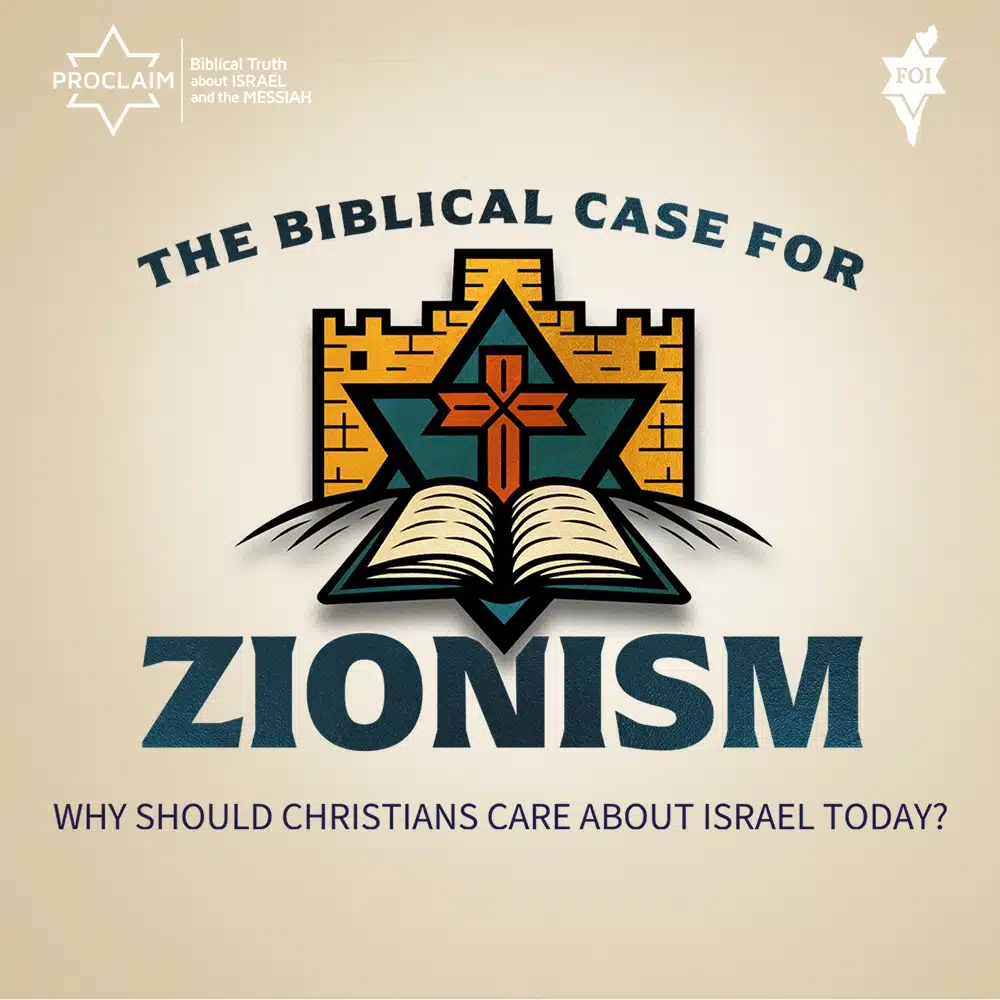
Join The Friends of Israel Gospel Ministry as we examine The Biblical Case for Zionism. Each message will explore a different section of Scripture to show how the Bible overwhelmingly supports Zionism—the idea that we should love the Jewish people and support the modern state of Israel.
We invite you to come eager to learn and trust you will leave with a renewed confidence that God’s people should love whatever God loves—and that includes Israel.
Music
The Friends of Israel Today theme music was composed and performed by Jeremy Strong.
Partner with us!
Your financial gift is essential—it ensures we stay on the air, teaching biblical truth about Israel and the Jewish people. If this program has ministered to you, please consider making a gift today.


