

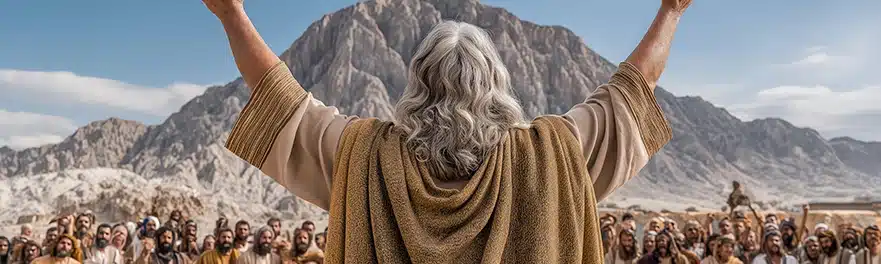
The Shema, Part 1:
In Moses’ final words to the Israelites in Deuteronomy, he told them, “Circumcise therefore the foreskin of your heart, and be no longer stubborn.” The listening Israelites, already physically circumcised as a mark of the nation’s covenant with God, must have been taken aback. But what God intended for His people went far beyond the act of keeping a single commandment from the Law. We open a new series this week studying the Shema in Deuteronomy and what genuine love for the Lord God looks like.
Though the Israelites were circumcised, this external sign was never the end goal in and of itself. Such a sign cannot produce obedience. Rather, it was always meant to point to the interior condition of the heart. God’s ultimate goal for His people was not outward obedience to His Word, as demonstrated by circumcision, but an inward removal of sin and commitment to Him. As Moses called the Israelites away from stiff-necked hardening of their hearts and toward true devotion to their God, may we also commit to faithfully obeying Him!
Chris Katulka: Hi everyone. Thank you so much for joining us for The Friends of Israel Today. I'm Chris Katulka, your host and teacher. Now let me ask you a question. Have you visited our website yet, foiradio.org? If you haven't, you need to get over there because this is a way that you can connect with The Friends of Israel Today, a way that you, right there from your phone or your tablet or your computer, can support Israel and the Jewish people. And how is that possible? Well, we actually have over a decade of biblical content on our website and teaching with amazing interview guests as well that are all centered on how Christians can support Israel and the Jewish people biblically. So again, if you'd like to find out more, go to foiradio.org and check it out. Today, I'm going to start a new series on the Shema.
The Shema is a very important word and prayer to the Jewish people. The Shema means “to hear.” That's what Shema means “hear.” “Hear, O Israel, the LORD our God, the LORDis one!” But what we're going to look at is how Deuteronomy really presents the heart of the law and that it wasn't just supposed to be ritualistic. It wasn't supposed to be something that was lived out through law, but actually in Deuteronomy, you can see Moses' final plea, his preaching to the people of Israel to have a relationship with the Lord and not just a religion. And so we're going to start that today, a three-part series all on the Shema. “Hear, O Israel, the LORD our God, the LORD is one!”
But before we get to that, let's look at what's happening in the news. Israeli Prime Minister Benjamin Netanyahu said that he will not let his country's enemies, that's Iran and Hezbollah, dictate its security strategy. In a recent statement, Netanyahu declared Israel has a full right to defend itself and will use that right as long as necessary. He also indicated that he remains in close contact with President Trump, who he calls a friend and he holds in high respect. Well, here's my take. Israel's kind of stuck between a rock and a hard place. Iran and its proxies continue to terrorize Israel while the Trump administration is attempting to make a peace deal, which also puts pressure on the Jewish state. The Trump administration needs to give room for Israel to defend itself against the constant attacks from Hezbollah and Iran, which are an existential threat that the United States doesn't have to live with on a daily basis.
Well, today we're going to begin a three-part series called Loving God with Your Whole Heart: The Shema from Deuteronomy 6. My goal is to show the distance between Leviticus and Deuteronomy is the distance between religion and relationship. Between God's covenant kept outwardly and a covenant loved inwardly. And the Shema is the guide that binds Leviticus and Deuteronomy together. But before we get to that, let's first lay the foundation. So we're going to turn to the book of Deuteronomy. And there's a moment in Deuteronomy that most readers, they kind of walk right past and it's easy to do. By the time you get to chapter 10, you've already been through the retelling of the 10 commandments. The Shema in chapter six, you've been through the warnings about entering the land and Moses reminds Israel repeatedly, almost impatiently, that Israel was not chosen because of their righteousness.
And then tucked into a passage about what God requires, Moses says something that should stop every reader cold. He says, "Circumcise therefore the foreskin of your heart and be no longer stubborn." Now, if you've grown up reading the Bible, that phrase might feel familiar enough that it no longer lands with the weight that it might have carried. But sit with it for a moment. Moses is speaking to a circumcised people. Every male in that camp bore the physical mark of the covenant in his flesh. This wasn't a crowd of pagans. This was the covenant community of Israel descended from Abraham, Isaac and Jacob, redeemed from Egypt, sustained through 40 years in the wilderness by the hand of God himself. They had a sign. Every one of them had a sign and Moses tells them to circumcise their hearts. That's not a small thing to say.
It is if you follow the logic carefully though, an implicit admission that the physical sign, while real, while required, while given by God himself, was not doing the work everyone assumed it was doing. The mark in the flesh did not guarantee the posture of the heart. And you know who knew that? Moses. He lived it for four decades in the desert with his people. He watched them build a golden calf while the mountain was still smoking where God was revealing the 10 commandments to him. He interceded for them when God threatened to start over entirely. He'd seen what circumcised flesh and an uncircumcised heart looked like in practice. It looked like rebellion. It looked like ingratitude. It looked like what chapter nine calls plainly and without softening, “a stiff necked people.” And this is where Deuteronomy begins to show us something that Leviticus for all its precision and holiness could not quite reach on its own.
Leviticus is a magnificent book. In fact, it's one of my favorites. It's the architecture of holiness, the detailed, painstaking blueprint for how a holy God could dwell among an unholy people. The sacrificial system, the purity laws, the day of atonement, the Levitical priesthood, it's all real. It was all given by God and all of it pointed to something true about the nature of sin, the cost of atonement, and the seriousness in which God takes his own holiness. You don't read Leviticus and come away thinking that God is casual about his covenant relationship with his people Israel. You come away understanding that the distance between a holy God and a sinful people is vast and that bridging that distance, really costs something. But see, Leviticus operates largely in the external register. It tells you what to do, what to bring, what to avoid, how to approach.
Its categories are clean and unclean, acceptable and unacceptable, inside the camp, outside the camp. All of those categories are incredibly important. They're not arbitrary religious exercises. They are as the New Testament writers will later make clear shadows of something greater to come. The external was always supposed to signify an internal reality. The problem is that the external form can be maintained without the internal reality ever taking root. And this is the distance between Leviticus and Deuteronomy and it's the distance between religion and relationship. Between a covenant kept outwardly and a covenant loved inwardly. I'm going to tell you something. Deuteronomy is Moses preaching, not legislating, preaching. He is standing on the plains of Moab, east of Jordan. He knows he's not going to cross over to the land that God promised Israel. He's speaking to a generation that was either children or not yet born when the law was first given at Sinai.
He's not reading them statutes. He's pleading with them. He's interpreting for them. He's laying before them with urgency of a dying man what all of this has actually all been about and what it's been about, what it's always been about is love. That's right, love. “You shall love the Lord your God with all of your heart, with all of your soul and with all of your might.” That's the part of the Shema, which means “to hear.” “Hear, O Israel, the LORD our God, the LORD is one.” That's all wrapped up in chapter six, which we're going to talk about in our next two episodes. And let me tell you something, this isn't a language of legal compliance. You do not command love the way you command a tax payment or a sacrificial offering. Love is not a transaction. You can't compel it through external pressure, though external pressure may shape the conditions in which it grows or dies.
When Moses commands Israel to love God, he is pointing to something that no ritual could produce and no law could mandate. He's pointing to the interior life, the place beneath outward observance where a person either truly belongs to God or merely performs belonging. And that is precisely why the circumcision of the heart matters so much in chapter 10 of Deuteronomy. The context is important. Remember, Moses had just finished recounting one of the most embarrassing episodes in Israel's history: the golden calf. He reminded them that while he was on the mountain receiving the law from God, they were below constructing an idol and calling it the god who brought them out of Egypt. He had told them without flinching that God was angry enough to destroy them. That he, Moses himself interceded for them, that he threw down and shattered the tablets of the law in grief, that he fasted for 40 days twice in a row, prostrate before God, pleading for a people who had already demonstrated what lived in their hearts when no one was watching.
See, it's in this context, the context of radical failure of covenant faithlessness, of outward religiosity, collapsing the moment it meant real pressure, that Moses calls for the circumcision of the heart. And he's not making a new biblical argument in that moment. He's drawing on the conclusion that the wilderness wandering had already revealed: the external sign was never sufficient. It was always a signpost. And if you mistake the signpost for the destination, you can stand before a mountain blazing with the glory of God and still build an idol as soon as the man who spoke for God walks out of sight. “Stiffnecked,” Moses says. It's actually a remarkable phrase, stiffnecked. The Bible returns to it again and again in connection with Israel's resistance to God. The image is actually agricultural. It's of an ox that will not be guided. The animal that stiffens the muscles of its neck to resist the yoke.
Applied to a people, it names a kind of internal resistance that no external force could overcome. You can put the yolk on. The animal can still stiffen its neck. You can apply the mark of the covenant circumcision in the flesh, but the person can still harden their heart. See, the circumcision that mattered, the only one that could produce what the covenant that God had made with his people was designed to produce was one that could not be done with a blade. Now, none of this means that the physical circumcision was a mistake or a placeholder that God intended to discard early. The sign of the covenant given to Abraham was real and remained binding within the framework of the law that God had given to Moses. The New Testament will have its own extensive arguments about the relationship between circumcision and faith and Paul will work through it at length in Romans and Galatians, but that's another conversation.
What Deuteronomy is doing is not abolishing the external sign. It's exposing the limits of what any external sign can accomplish on its own. The sign points, it does not produce. And this is a biblical principle with implications far beyond circumcision and it applies to us today as well. And I always like to say, Israel's story is my story. Before we start pointing fingers at Israel, if you just weren't so stiff necked, if you would've just had an internal circumcision of the heart and loved God, the whole story could have been different. No, you know what? I like to say Israel's story is my story because I have the capacity as a follower of Jesus with the indwelling of the Holy Spirit to also have a stiff neck and a hard heart. And that's why when we come back, we're going to see how this plays out in the church today as well, so stick around.
Steve Conover: How we understand the Bible really matters. And a big part of that is how we view Israel in God's plan.
Chris Katulka: Yes, Steve, exactly. And Israel plays such an important role in the Scriptures and that's why at this year's Friends of Israel's PROCLAIM Conference, we're going to be looking at A Biblical Case for Zionism. We're going to be asking a crucial question. Why should Christians care about Israel today? Because see, how you view Israel actually impacts how you understand all of Scripture.
Steve Conover: And I'm excited about this conference because it isn't just about current events or politics.
Chris Katulka: No, actually it's all about God's promises. See, if God keeps his promises to Israel, we can trust him to keep his promises to us. And that's why this issue matters so deeply, not just for us here at Friends of Israel, but for every believer.
Steve Conover: It truly comes down to knowing God, rightly knowing his Word and responding to what he loves.
Chris Katulka: And that's why we want you to join us as we study A Biblical Case for Zionism, July 17th and 18th in Winona Lake, Indiana, August 14th and 15th in Lancaster, Pennsylvania, or October 16th and 17th in Richmond, Virginia.
Steve Conover: If you've missed those dates, don't fear. You can find out more about our PROCLAIM conferences and check those dates at foiradio.org. Again, that's foiradio.org.
Chris Katulka: Welcome back, everyone. We started a new series on the Shema in Deuteronomy, looking at the heart of the law. We just saw how Moses in his final moments with Israel encouraged God's chosen to see that simply practicing the law wasn't enough. God didn't just want ritual. He wanted a relationship with his people. But what about us? We have our own external markers of identity. We have baptism. We have communion, the Lord's supper. We have church membership. These two can sometimes carry inherent limitations as well. The form can be present while the heart reality is absent. You can get wet from baptism and still be in the language of Deuteronomy, “stiff necked”. You can take the bread and cup and still love the world more than you love the God the bread and cup proclaim. The external form was designed by God to signify a change inside an internal reality, to celebrate it, to reinforce it to market publicly.
It was never designed to create it unilaterally. Moses understood this and Deuteronomy is his attempt, his last attempt to say as plainly as possible to a people who he had demonstrated over and over again, the gap between their external covenant status with God and the actual condition of their hearts. He's not cynical. I want you to hear this. Moses isn't cynical about the law of God. He's not putting down the book of Leviticus. He's not suggesting that the whole enterprise that God established had failed. Moses is something more like a father who has watched his children grow up knowing all the right words without ever quite understanding what the words are for. And he's trying in the time that he has left to help them understand. What is the covenant God made with them for? What are the laws for? What is all the sacrifice and ceremony and priestly labor for?
Not to produce religious compliance, not to create a civilization of people who performed the right rituals in the right sequence. The covenant from its first words to Abraham in Genesis 12 was a love story. God choosing Israel, not because they were great, but because he loved them and because he intended to work through them to reclaim what was lost in the garden. And it's a love story that cannot be lived from the outside in. You cannot love by being rote in your ritual. You cannot receive love you've reduced to a transaction. Circumcision of the heart is Moses saying, in the plainest language he knows: the sign was always about this. The knife in the flesh was always pointing here to the interior, to the place where God and his people either truly meet or only appear to. To the heart that either loves him or is still, even after Egypt and Sinai and 40 years of manna and water from the rock, stiffnecked.
And he was telling them and he's telling us today that religion without transformation is a sign without a reality. A word that never became flesh, a stone tablet that was never rewritten on the heart. And that's why next week we're going to look at the Shema. We're going to dive down and see how it reorients, the Shema reorients the goal of the law toward love. The Shema from Deuteronomy 6:4-5 anchors all of Deuteronomy. "Love God with all of your heart, soul, and strength." Leviticus doesn't have a Shema equivalent. Deuteronomy's circumcision of the heart language explains why the law was given, not to create a performance system, but to cultivate a people whose interior life, the inside of our hearts, mirror our covenant status, our relationship with the God of Abraham, Isaac and Jacob through who? Jesus the Messiah. The law is meant to shape the heart not merely govern behavior.
So that's what we're going to look at next week as we turn to the Shema.
Steve Conover: Now, Apples of Gold, a dramatic reading from the life and ministry of Holocaust survivor, Zvi Kalisher.
Mike Kellogg: It is no secret that people fear death. But death cannot be avoided. Ecclesiastes 12:7 says, “The dust will return to the earth as it was, and the spirit will return to God who gave it.” God has given each of us an eternal spirit, and all who believe in the Lord Jesus will live with Him eternally.
Recently an elderly woman in my neighborhood died. Many of her neighbors, including me, gathered and spoke with one another. As we were talking, one of this woman’s relatives said, “I am sorry she has died and has no children to take care of her in death. My wife and I have already taken care of our own funeral arrangements. Most important, we have given a large sum of money to the synagogue to guarantee someone will say kaddish [prayer for the dead] when we die and light a yahrzeit lamp [memorial candle] each year on the anniversary of our deaths. But since this poor lady had no money and no children, no one will remember her.”
I was saddened by this man’s remarks and said, “It is possible this poor lady will someday be richer than you.”
“How can that be?” he responded.
I told him, “If she had a proper relationship with God through His Son, she will be rich in eternity.” I then related the account of the rich man and the beggar from Luke 16:19–23, highlighting verse 22: “The beggar died, and was carried by the angels to Abraham’s bosom. The rich man also died and was buried.”
Someone asked how I had come to this conclusion. I replied, “It is written in the Bible. King David did not fear what would happen to his body. Instead, he prayed, ‘do not take Your Holy Spirit from me’ [Ps. 51:11]. Psalm 23 was not written for the rich only, but for everyone who trusts in the Lord and ‘will dwell in the house of the LORD forever’ [v. 6].” The man asked, “Do you never think about what will happen to you when you die?”
I answered, “My future is secure because I have received the Lord as my Savior, and in Him there is no death or darkness, only life and light.” They did not understand what I meant. I asked if they had ever read the Bible, and the man replied, “It was impossible to read the Bible in Russia, and we cannot read Hebrew.”
I said, “But you have been in Israel for several years; surely by now you know Hebrew.”
He replied, “Oh yes, we can speak it, but we do not understand it well enough to read something as deep as the Bible.”
I took out my Bible and read in Hebrew John 14:19: “Because I live, you will live also”; Job 19:25: “I know my Redeemer lives, and he shall stand at last on the earth,” and Isaiah 26:19: “Your dead shall live, together with my dead body shall they arise.” I then translated these verses into Russian. They could not accept the concept of resurrection after death. Referring to the lady who had just died, the man said, “We have all seen her dead body. How can you say she will live again?”
I said, “It is written in Ezekiel 18:4, ‘The soul who sins shall die,’ but the Lord has given us a free choice concerning our soul’s destiny. If we ask Him to forgive our sins, He will grant our request and assure us of eternal life with Him. If we reject His love for us, we will die in our sins and spend eternity in the Lake of Fire, forever separated from God.”
When we parted, they were no longer hurling accusations, but were friendly and thanked me for spending time with them. I pray God will water the seed sown and eventually grant the harvest of these souls to eternal life.
Chris Katulka: Thanks again for joining us for today's episode of The Friends of Israel Today. We would like for you to join us for one of our PROCLAIM prophecy conferences where you'll be equipped to give a Biblical Case for Zionism. You can find out more at foiradio.org and be sure to join us next week as we continue our study on the Shema from Deuteronomy chapter six as we see the love of God, the love for his law lived out from the inside out. Our web address is foiradio.org. Again, that's foiradio.org. Our mailing address is FOI Radio, PO Box 914 Bellmawr, New Jersey 08099. Again, that's FOI Radio, PO Box 914, Bellmawr, New Jersey, 08099. Write to us, we'd love to hear from you. You can call our listener line too.That's 888-343-6940. Again, that's 888-343-6940. Today's program was engineered by Bob Beebe. Edited by Jeremy Strong, who also composed and performs our theme music. Steve Conover is our executive director here at The Friends of Israel. Executive producer is Lisa Small. Associate producer is Sarah Fern. The late Mike Kellogg read Apples of Gold. And I'm Chris Katulka, your host and teacher. The Friends of Israel Today is a production of The Friends of Israel Gospel Ministry. Passion for God's Word. Compassion for God's Chosen People.
PROCLAIM Conference
PROCLAIM Conference
Why Should Christians Care about Israel Today?
In an age of rising antisemitism, this question has never been more pertinent.
Join The Friends of Israel Gospel Ministry as we examine The Biblical Case for Zionism. Each message will explore a different section of Scripture to show how the Bible overwhelmingly supports Zionism—the idea that we should love the Jewish people and support the modern state of Israel.
We invite you to come eager to learn and trust you will leave with a renewed confidence that God’s people should love whatever God loves—and that includes Israel.
Apples of Gold: "No One Will Remember Her"
Death is a universal fear, yet it remains an inevitable reality. This truth sparked a somber discussion among Zvi and his neighbors following the death of an elderly woman in their community. As they grieved, many focused on the lack of money or children she left behind to keep her memory alive. However, Zvi recognized a greater hope for her soul. Discover how he used the moment to share the promise of the Messiah and the eternal assurance found in believing in Jesus.
Music
The Friends of Israel Today theme music was composed and performed by Jeremy Strong.
Partner with us!
Your financial gift is essential—it ensures we stay on the air, teaching biblical truth about Israel and the Jewish people. If this program has ministered to you, please consider making a gift today.


